In glasses adorned with dried fruits, Peshawar shop serves ‘most unique’ shakes in town

1 / 2
Muhammad Ibrahim pours juice in a glass decorated with dry fruits at his shop in Peshawar, Pakistan on March 21, 2025. (AN Photo)
2 / 2
Muhammad Ibrahim prepares dessert, with bowls full of dry fruits on display at his shop in Peshawar, Pakistan on March 21, 2025. (AN Photo)
Short Url
Updated 26 March 2025
Follow

In glasses adorned with dried fruits, Peshawar shop serves ‘most unique’ shakes in town

  • Amir Sab’s Special Dry Fruits Juice shop serves fresh shakes in glasses entirely covered with gooey, sweet paste and whole dried fruits
  • Shakes retail for between $2-6, steep for Peshawar but which many people are still willing to pay due to drinks' unique look and taste

PESHAWAR: Muhammad Ibrahim stood at his shop, Ameer Sahib Juice Shop, earlier this month and stuck whole pistachios, cashew nuts, almonds, walnuts and raisins to a large milkshake glass covered in a gooey paste. 

He was preparing the glass for what many in the northwestern Pakistani city of Peshawar describe as the “most unique,” and “most beautifully presented” shakes in town. Ibrahim and his brother, Ismail, co-owners of the shop they set up in 2005, grind dates, honey and chocolate to prepare a soft and sticky paste that they carefully apply on the outside of each glass, on which the dried fruits are then glued. The end product is a glass that looks like it is entirely made of dried fruit.

Into the glass are poured thick shakes made from a variety of seasonal fruits, with more edible decorations added on top to finish the offering. The drinks have become as much of a social media hit as they are loved by customers who throng the shop in Ramadan and throughout the rest of the year. 

"At takes at least 15-20 minutes to prepare the glass," Ibrahim told Arab News at Peshawar’s famed Namak Mandi where his store is located. "We make it in the morning and serve it at iftar time.”
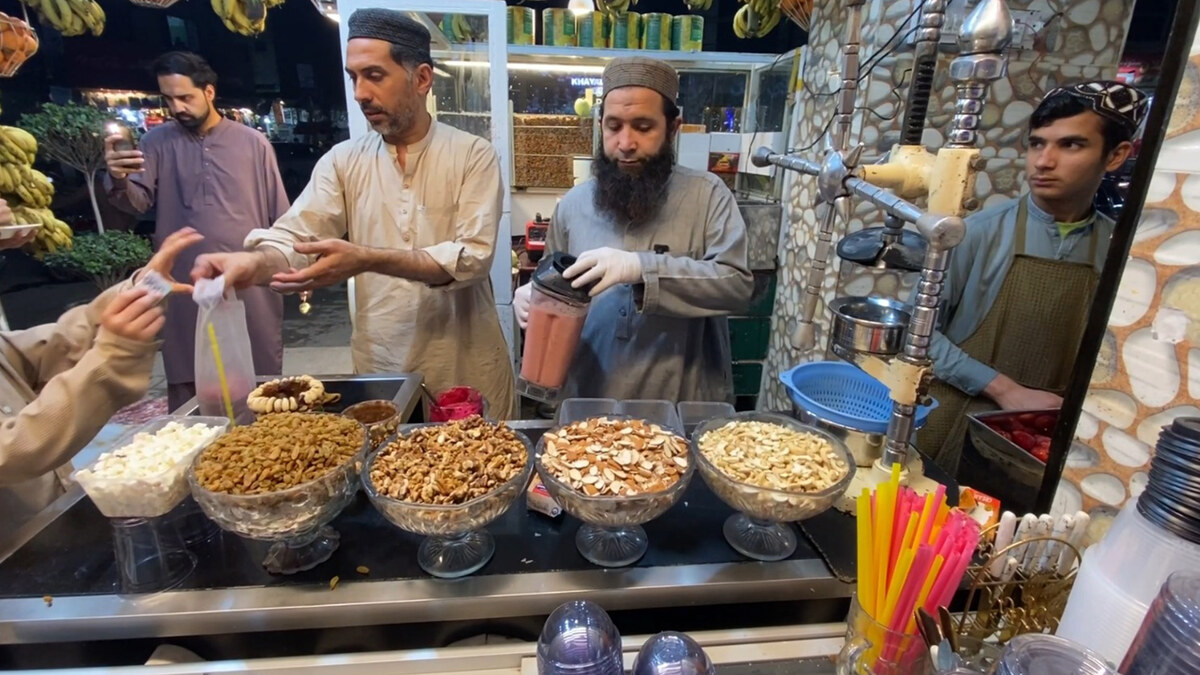


Muhammad Ibrahim (second from right) serves customers in his shop in Peshawar, Pakistan on March 21, 2025. (An Photo) 

Different sizes of the shakes retail for between $2-6, steep for a city like Peshawar, but which many people are still willing to pay due to the uniqueness of the drinks' presentation and taste. 

"People from different parts of the country come for this dried fruit juice,” Ibrahim said, saying he regularly served customers from cities across the KP province, of which Peshawar is the capital, as well as from the Punjab province and the federal capital, Islamabad. 

Ayub Sher, a resident of KP's Bajaur district who works in Peshawar, visited Ibrahim's shop last week and was all praise for the shakes.

“We came here to try this juice and to see if it has taste or not. When we tried it, we found it that it is fantastic,” he told Arab News as he scooped some thick shake out of the glass with a long spoon. 

“Forget about the taste, we haven’t seen any juice presented to us this beautifully.”


Pakistan launches first Hong Kong Convention-certified ship recycling yard

Updated 07 January 2026
Follow

Pakistan launches first Hong Kong Convention-certified ship recycling yard

  • Hong Kong International Convention aims to improve hazardous working conditions in ship recycling facilities worldwide
  • Maritime affairs minister says certification reflects Islamabad’s efforts in implementing global environmental standards

ISLAMABAD: Maritime Affairs Minister Junaid Anwar Chaudhry inaugurated Pakistan’s first ship recycling facility certified by the Hong Kong International Convention on Wednesday, saying the move would help Islamabad meet global benchmarks in environmentally friendly ship recycling.

Pakistan became a party to the 2009 Hong Kong Convention in December 2023, which aims to improve hazardous working conditions in ship recycling facilities worldwide. The ship recycling industry in Pakistan and globally faces pressure from calls to adopt safer and cleaner methods.

Shipbreaking is a significant industry in Pakistan, particularly in the coastal town of Gadani in southwestern Balochistan, which was once one of the world’s largest ship recycling hubs. However, business has declined in recent years as Islamabad grapples with a macroeconomic crisis.

Chaudhry inaugurated the Prime Green Recycling Yard in Gadani during a ceremony. He highlighted that the certification demonstrated Pakistan’s alignment with international maritime and environmental standards in a sector long criticized for hazardous working conditions.

“The success of the Prime Green Recycling Yard is a matter of national pride and a clear signal that Pakistan is meeting global benchmarks for environmentally friendly ship recycling,” the Maritime Affairs Ministry quoted him as saying.

“Pakistan is emerging as a responsible country in the global ship recycling industry.”

The statement highlighted that the government was working to modernize the Gadani Ship Recycling Zone, focusing on infrastructure upgrades, regulatory reforms, and improved oversight.

It added that worker safety would remain a top priority as the industry transitions to cleaner and safer methods.

Chaudhry said modernizing the ship recycling sector could create thousands of jobs and conserve foreign exchange by providing locally sourced steel and materials.

“With a responsible and sustainable approach, ship recycling can become a major contributor to economic growth,” he said.

“It will reduce dependence on imports and strengthen Pakistan’s industrial base.”

Pakistan’s maritime sector, anchored by its long coastline and strategic ports such as Karachi, Port Qasim, and Gwadar, holds vast potential for the blue economy. However, it remains underutilized due to infrastructure gaps, policy inconsistencies, and limited shipping capacity.