

Azerbaijan president calls for joint ventures with Pakistan to expand strategic partnership

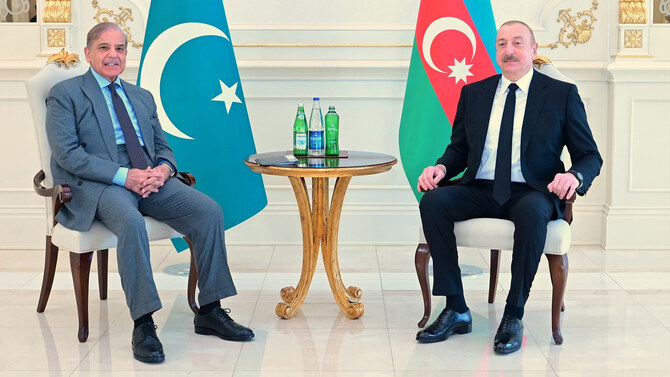
Pakistan's Prime Minister, Shehbaz Sharif (right) in a meeting with President of Azerbaijan Ilham Aliyev during his visit to Azerbaijan on February 24, 2025. (@PakPMO/X/File)
Short Url
Updated 24 March 2025
Follow

Azerbaijan president calls for joint ventures with Pakistan to expand strategic partnership

  • PM Sharif visited Baku in February and announced the two nations would sign deals for $2 billion investment in April
  • Multiple agreements for cooperation in trade, energy, tourism, education, other sectors were signed during Sharif’s visit

ISLAMABAD: Azerbaijan President Ilham Aliyev has called for joint ventures with Pakistan in the defense, energy, economy, logistics and transport sectors to expand Baku’s strategic partnership with Islamabad, state media reported on Sunday. 

Aliyev wrote a letter to Prime Minister Shehbaz Sharif on Sunday on the occasion of Pakistan’s 85th Republic Day. 

The letter comes weeks after Sharif visited Baku and announced that the two nations would sign deals in April to boost bilateral investments to $2 billion. Multiple agreements for cooperation in the trade, energy, tourism, education and other sectors were signed during the visit. 

In September last year, Azerbaijan bought JF-17 Block III fighter jets from Pakistan, reportedly in a $1.6bn deal.

During Aliyev’s Pakistan visit last year, a joint committee was set up to materialize projects in trade, commerce, information technology, tourism, telecommunication, mineral resources and other sectors. Sharif said at the time the current trade volume of $100 million did not reflect the “true” trade potential between the two countries.

“In a letter to Prime Minister Shehbaz Sharif, he [Aliyev] expressed his determination to further expand the strategic partnership and mutual cooperation between Pakistan and Azerbaijan,” Radio Pakistan reported. 

“Aliyev emphasized that successful joint efforts in areas such as the economy, transport, logistics, energy, investment, and the defense industry are crucial for strengthening bilateral relations.”

Cash-strapped Pakistan is currently under a $7 billion International Monetary Fund bailout program and navigating a tricky path to recovery. Pakistan is looking to generate revenue through investment deals with friendly nations and regional and international allies, and to focus on export-led growth. 

In 2023, Pakistan set up the Special Investment Facilitation Council (SIFC), a civil-military hybrid body, to fast-track foreign investment deals. 

The country has teetered on the brink of economic crisis for several years and economists and international financial institutions have called for major economic reforms.


IMF hails Pakistan privatization drive, calls PIA sale a ‘milestone’

Updated 10 January 2026
Follow

IMF hails Pakistan privatization drive, calls PIA sale a ‘milestone’

  • Fund backs sale of national airline as key step in divesting loss-making state firms
  • IMF has long urged Islamabad to reduce fiscal burden posed by state-owned entities

KARACHI: The International Monetary Fund (IMF) on Saturday welcomed Pakistan’s privatization efforts, describing the sale of the country’s national airline to a private consortium last month as a milestone that could help advance the divestment of loss-making state-owned enterprises (SOEs).

The comments follow the government’s sale of a 75 percent stake in Pakistan International Airlines (PIA) to a consortium led by the Arif Habib Group for Rs 135 billion ($486 million) after several rounds of bidding in a competitive process, marking Islamabad’s second attempt to privatize the carrier after a failed effort a year earlier.

Between the two privatization attempts, PIA resumed flight operations to several international destinations after aviation authorities in the European Union and Britain lifted restrictions nearly five years after the airline was grounded following a deadly Airbus A320 crash in Karachi in 2020 that killed 97 people.

“We welcome the authorities’ privatization efforts and the completion of the PIA privatization process, which was a commitment under the EFF,” Mahir Binici, the IMF’s resident representative in Pakistan, said in response to an Arab News query, referring to the $7 billion Extended Fund Facility.

“This privatization represents a milestone within the authorities’ reform agenda, aimed at decreasing governmental involvement in commercial sectors and attracting investments to promote economic growth in Pakistan,” he added.

The IMF has long urged Islamabad to reduce the fiscal burden posed by loss-making state firms, which have weighed public finances for years and required repeated government bailouts. Beyond PIA, the government has signaled plans to restructure or sell stakes in additional SOEs as part of broader reforms under the IMF program.

Privatization also remains politically sensitive in Pakistan, with critics warning of job losses and concerns over national assets, while supporters argue private sector management could improve efficiency and service delivery in chronically underperforming entities.

Pakistan’s Cabinet Committee on State-Owned Enterprises said on Friday that SOEs recorded a net loss of Rs 122.9 billion ($442 million) in the 2024–25 fiscal year, compared with a net loss of Rs 30.6 billion ($110 million) in the previous year.