

Youth arrested in France for suspected attack on rabbi

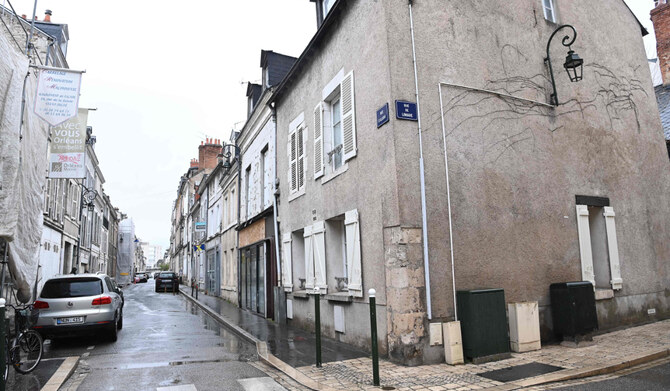
This photograph taken on March 23, 2025, in Orleans, central France, shows the location of an attack on the rabbi of Orleans a day earlier, for which a minor has been arrested. (AFP)
Short Url
Updated 24 March 2025
Follow

Youth arrested in France for suspected attack on rabbi

  • France is home to the largest Jewish population outside Israel and the United States, as well as the largest Muslim community in the European Union

ORLEANS, France: French police have arrested a 16-year-old on suspicion of attacking a rabbi in broad daylight, a prosecutor said Sunday, shocking the Jewish community and prompting a wave of condemnation.
The attack against the Rabbi of Orleans, Arie Engelberg, happened as he walked with his nine-year-old son from synagogue on Saturday afternoon in the city, about 110 kilometers (68 miles) south of Paris.
Engelberg told BFM television that his attacker asked if he was Jewish. “I said yes.”
“He started saying ‘all Jews are sons of...,” he said, adding that he wanted to film him with his phone as he hurled insults.
“I decided to act and I pushed his telephone away,” the rabbi said. His attacker then “started punching and I protected myself,” he added.
Engelberg said the suspect bit him until several people stepped in to help, he told the channel.
“I’m OK, thank God, my son, I’m getting better and better. We’ve had an enormous amount of support.”
Police were checking the identity of the person in custody since he did not have documents on him when he was detained, Orleans prosecutor Emmanuelle Bochenek-Puren said.
Another source with knowledge of the case said the suspect arrested on Saturday night was known under at least three identities, one Moroccan and two Palestinian.

France is home to the largest Jewish population outside Israel and the United States, as well as the largest Muslim community in the European Union.
Several EU nations have reported a spike in “anti-Muslim hatred” and “anti-Semitism” since the Gaza war started on October 7, 2023, according to the European Union Agency for Fundamental Rights.
On that date, Palestinian militant group Hamas launched a cross-border attack in Israel, resulting in the death of 1,205 people, mostly civilians, according to an AFP tally based on official Israeli figures.
Israel’s subsequent military offensive on Gaza has killed more than 50,000 people, the majority of them civilians, according to the health ministry in the Hamas-run occupied Palestinian territory. The United Nations deems the figures reliable.
Andre Druon, a Jewish community leader in Orleans, said there had not been any incident in Orleans since October 7, 2023 “apart from some graffiti” before the “very violent” attack on the rabbi.
He said the rabbi was profoundly shaken when he recounted his ordeal to the community on Sunday.
Yann Dhieux, a locksmith, told AFP he had intervened with his arms wide and helped stop the assault, but that it was shocking to see the rabbi attacked in front of his young son.
President Emmanuel Macron voiced solidarity with the rabbi’s family and all French people of Jewish faith.
“Anti-Semitism is a poison,” he wrote on X.
Israeli Foreign Minister Gideon Saar said he was “shocked” by the attack and called for “zero tolerance for anti-Semitism.”
France witnessed some 1,570 anti-Semitic acts last year, the interior ministry says. They made up 62 percent of all acts of hatred on the basis of religion.


Fossils of ‘Java Man,’ first known Homo erectus, return to Indonesia

Updated 6 sec ago
Follow

Fossils of ‘Java Man,’ first known Homo erectus, return to Indonesia

  • Netherlands to repatriate more than 28,000 items in Dubois collection in 2026
  • Fossils excavated in Indonesia were ‘removed against will of people’  

JAKARTA: Prehistoric bones belonging to “Java Man” — the first known fossil evidence of Homo erectus — went on display at Indonesia’s National Museum on Thursday, more than 130 years after they were taken to the Netherlands during Dutch colonial rule.

The parts of the skeleton — a skull fragment, molar and thigh bone — were uncovered along the Bengawan Solo River on Java island in the late 19th century by Dutch anatomist and geologist Eugene Dubois. 

The three items, and a related shell that was scratched by early Homo erectus, are the first in the planned repatriation of more than 28,000 fossils and natural history objects originating in Java and Sumatra that Dubois had removed. 

“Repatriation is a national priority,” Indonesian Culture Minister Fadli Zon said during an official handover ceremony in Jakarta. 

“We bear the responsibility to protect cultural heritage, restore historical narratives and ensure public access to the cultural and scientific heritage that belongs to Indonesia.” 

Fossils of the Java Man, which was hand-carried in a GPS-tracked, climate-controlled suitcase with a diplomatic seal, were some of the first pieces of evidence showing links between apes and humans. 

The fossils are part of the larger Dubois collection that was managed by Naturalis Biodiversity Center, a 200-year-old scientific institution in Leiden. 

The rest of the collection will be transferred to Indonesia in 2026, the Dutch Embassy in Jakarta said in a statement, adding that Indonesia’s National Research and Innovation Agency will take a lead role in preserving and managing the items. 

“This handover marks the beginning of the next phase. We intend to repatriate thousands of items excavated in Indonesia over 130 years ago,” said Marcel Beukeboom, general director of Naturalis Biodiversity Center. 

“This fossil bears witness to an important link in human evolution, while also representing part of Indonesian history and cultural heritage,” he said.

Jakarta started to campaign for the Dutch government to return stolen Indonesian artifacts after declaring independence in 1945, but the Netherlands started to return stolen items only in small numbers in the 1970s. 

Recent efforts by the Indonesian Repatriation Committee have brought back home hundreds of artifacts since 2023, bringing the number to more than 2,000 items so far. 

The repatriation of the Dubois collection was first announced in September, following recommendation by the Netherlands’ Colonial Collections Committee. 

“The Colonial Collections Committee has concluded … that the Dutch state never owned the Dubois collection,” the Dutch government said in a news release issued at the time. 

“The committee believes that the circumstances under which the fossils were obtained means it is likely they were removed against the will of the people, resulting in an act of injustice against them.

“Fossils held spiritual and economic value for local people, who were coerced into revealing fossil sites.” 

The returned fossils are now a centerpiece of “Early History,” a new permanent exhibit at the National Museum in Jakarta that opened to the public on Thursday. 

It explores the history of human civilization throughout Indonesia, with displays including a replica of one of the world’s oldest cave paintings from South Sulawesi and inscriptions from the 4th-century Hindu Kutai Martadipura Kingdom in East Kalimantan.