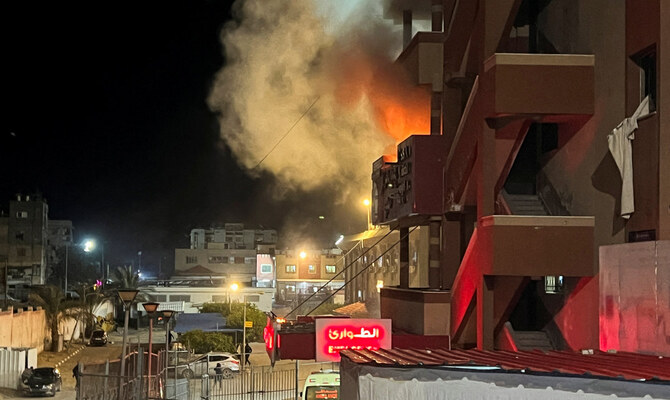
DEIR AL-BALAH, Gaza Strip: Israel’s military struck the largest hospital in southern Gaza on Sunday night, killing one person, wounding others and causing a large fire, the territory’s Health Ministry said.
The strike hit the surgical building of Nasser Hospital in the city of Khan Younis, the ministry said, days after the facility was overwhelmed with dead and wounded when Israel resumed the war in Gaza last week with a surprise wave of airstrikes.
Israel’s military confirmed the strike on the hospital, saying it hit a Hamas militant operating there. Israel blames civilian deaths on Hamas because it operates in densely populated areas.
Like other medical facilities around Gaza, Nasser Hospital has been damaged by Israeli raids and strikes throughout the war.
More than 50,000 Palestinians have now been killed in the war, the Health Ministry said earlier Sunday.
The military claimed to have “eliminated” dozens of militants since Israel ended a ceasefire Tuesday with strikes that killed hundreds of people on one of the deadliest days in the 17-month war.
Israel’s unrest over Gaza and political issues grew Sunday, with anger at Prime Minister Benjamin Netanyahu as his government voted to express no confidence in the attorney general, seen by many as a check on the power of his coalition.
“I’m worried for the future of this country. And I think it has to stop. We have to change direction,” said Avital Halperin, one of hundreds of protesters outside Netanyahu’s office. Police said three were arrested.
‘Displacement under fire’
Israel’s military ordered thousands of Palestinians to leave the heavily destroyed Tel Al-Sultan neighborhood in the southern city of Rafah. They walked to Muwasi, a sprawling area of squalid tent camps. The war has forced most of Gaza’s population of over 2 million to flee within the territory, often multiple times.
“It’s displacement under fire,” said Mustafa Gaber, a journalist who left with his family. He said tank and drone fire echoed nearby.
“The shells are falling among us and the bullets are (flying) above us,” said Amal Nassar, also displaced. “The elderly have been thrown into the streets. An old woman was telling her son, ‘Go and leave me to die.’ Where will we go?”
“Enough is enough. We are exhausted,” said a fleeing Ayda Abu Shaer, as smoke rose in the distance.
The Palestinian Red Crescent emergency service said it lost contact with a 10-member team responding to the strikes in Rafah. Spokesperson Nebal Farsakh said some were wounded.
Israel’s military said it had fired on advancing “suspicious vehicles” and later discovered some were ambulances and fire trucks.
In Gaza City, an explosion hit next to a tent camp where people had been told to evacuate. “My husband is blind and started running barefoot, and my children were running,” said witness Nidaa Hassuna.
Strikes kill Hamas leader
Hamas said Salah Bardawil, a well-known member of its political bureau, was killed in a strike in Muwasi that also killed his wife. Israel’s military confirmed it.
Hospitals in southern Gaza said they received a further 24 bodies from strikes overnight, including several women and children.
Gaza’s Health Ministry said 50,021 Palestinians have been killed in the war, including 673 people since Israel’s bombardment on Tuesday shattered the ceasefire.
Dr. Munir Al-Boursh, the ministry’s general director, said the dead include 15,613 children, with 872 of them under 1 year old.
The ministry does not distinguish between civilians and combatants in its count but says women and children make up over half the dead. Israel says it has killed around 20,000 fighters, without providing evidence.
Ceasefire in tatters
The ceasefire that took hold in January paused more than a year of fighting ignited by Hamas’ Oct. 7, 2023, attack into Israel, in which militants killed some 1,200 people, mostly civilians, and took 251 hostage. Most captives have been released in ceasefire agreements or other deals.
In the latest ceasefire’s first phase, 25 Israeli hostages and the bodies of eight others were released in exchange for nearly 2,000 Palestinian prisoners. Israeli forces allowed hundreds of thousands of people to return home. There was a surge in humanitarian aid until Israel cut off all supplies to Gaza earlier this month to pressure Hamas to change the ceasefire agreement.
The sides were supposed to begin negotiations in early February on the ceasefire’s next phase, in which Hamas was to release the remaining 59 hostages — 35 of them believed to be dead — in exchange for more Palestinian prisoners, a lasting ceasefire and an Israeli withdrawal. Those talks never began.
New settlements in the West Bank
Israel’s Cabinet passed a measure creating 13 new settlements in the occupied West Bank by rezoning existing ones, according to Bezalel Smotrich, Israel’s far-right finance minister, who is in charge of settlement construction.
This brings the number of settlements, considered illegal by the majority of the international community, to 140, said anti-settlement watchdog group Peace Now. They will receive independent budgets from Israel and can elect their own local governments, the group said.


![]()
![]()

Gaza’s Health Ministry says Israel has struck the largest hospital in the territory’s south

Short Url
https://arab.news/rzj3h
Gaza’s Health Ministry says Israel has struck the largest hospital in the territory’s south
- Like other medical facilities around Gaza, Nasser Hospital has been damaged by Israeli raids and strikes throughout the war


Latest updates


Recommended


© 2026 SAUDI RESEARCH & PUBLISHING COMPANY, All Rights Reserved And subject to Terms of Use Agreement.