In Turkiye, a vote of confidence for Istanbul’s embattled ex-mayor

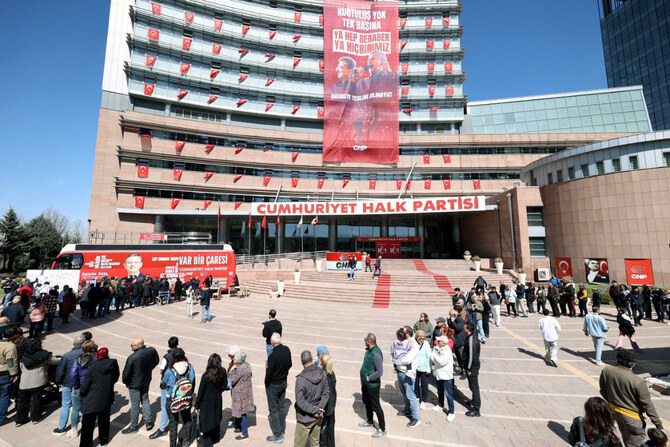
People queue to vote during the presidential primaries, with the only candidate of the opposition Republican People's Party (CHP) Ekrem Imamoglu, outside the party headquarters in Ankara on March 23, 2025. (AFP)
Short Url
Updated 24 March 2025
Follow

In Turkiye, a vote of confidence for Istanbul’s embattled ex-mayor

  • Of 15 million people who voted for Imamoglu, 13.2 mn were not members of the deposed mayor's opposition CHP party, said Istanbul city hall
  • The vote was a long-planned primary organized by the main opposition CHP to choose Iits challenger to President Erdogan

ISTANBUL: “We won’t give in to despair,” insisted 38-year-old Aslihan, referring to the massive protests sweeping across Turkiye since the arrest of Istanbul’s popular mayor Ekrem Imamoglu.
She was waiting in line to vote in a long-planned primary organized by the main opposition CHP to choose Imamoglu as its presidential candidate.
Following his arrest, the party opened the poll beyond its 1.7 million members to anyone who wanted to vote, turning it into a de facto referendum.
In the end, some 15 million people voted, of whom 13.2 million were not party members, said Istanbul city hall, which organized the vote. It extended voting by three-and-a-half hours because of the turnout.
Widely seen as the only politician capable of challenging President Recep Tayyip Erdogan, the 53-year-old’s lightning arrest and jailing has sparked Turkiye’s biggest protests in more than a decade.


Polling stations opened at 8 a.m. (0500 GMT) and voters of all ages began flocking to vote at 5,600 ballot boxes installed in 81 cities.
But the party said “millions” had turned out, pushing it to extend the closing time from 5 p.m. to 8:30 p.m. due “overwhelming turnout.”
“Whenever there’s a strong opponent (to Erdogan), they are always jailed,” shrugged a 29-year-old voter called Ferhat, who like many, did not want to give his surname.
“There is a dictatorship in Turkiye right now, nothing else, it’s politics in name only.”

“We’ve come to support our mayor,” said her neighbor Kadriye Sevim inside a tent set up outside City Hall, the epicenter of the massive protests since Imamoglu’s March 19 arrest.
“No power has the right to do this to Turkish youth or the people in Turkiye. We will stand against this until the end,” said Ece Nazoskoc, an 18-year-old student.
Similar crowds were seen waiting to vote in Kadikoy, a trendy district on the Asian side of the city, as well as in Kasimpasa, a working-class neighborhood on the Golden Horn estuary where Erdogan spent his childhood.
The scenes were repeated across the country, from the capital Ankara to Diyarbakir in the mainly-Kurdish southeast, and to Thrace in the far northwest near the Greek and Bulgarian borders.

“We all voted, it was like a party! The CHP people manning the ballot boxes said it was really busy with lots of people from other parties,” grinned Sevil Dogruguven, 51, who works in the private sector in the northwestern city of Edirne.
“In the countryside near Thrace, people even came to the town halls to cast their ballots,” she told AFP.


In Ankara, Nurcan Kabacioglu, a retired 57-year-old teacher, was defiant.
“There is no such thing as a hopeless situation, just discouraged people. I never gave up hope,” she said.
Others were feeling a new sense of hope.
“This is the first mass protest since the Gezi protests,” said Aslihan, referring to a small 2013 environmental protest against the destruction of a city park that snowballed into vast nationwide rallies in one of the biggest threats to Erdogan’s rule.
“After Gezi, we got used to the feeling of hopelessness but the injustice we’re seeing now (and the subsequent protests) have given us new hope,” she said.
“I feel much stronger and more hopeful. But I feel this is our last chance,” she told AFP.


Israeli approval of West Bank land registration draws outrage

Updated 57 min 12 sec ago
Follow

Israeli approval of West Bank land registration draws outrage

  • Israel’s government has approved a process to register land in the West Bank, drawing condemnation

JERUSALEM: Israel’s government has approved a process to register land in the West Bank, drawing condemnation from Arab nations and critics who labelled it a “mega land grab” that would accelerate annexation of the Palestinian territory.
Israel’s foreign ministry said the measure would enable “transparent and thorough clarification of rights to resolve legal disputes” and was needed after unlawful land registration in areas controlled by the Palestinian Authority.
But Egypt, Qatar and Jordan criticized the move as illegal under international law.
In a statement, the Egyptian government called it a “dangerous escalation aimed at consolidating Israeli control over the occupied Palestinian territories.”
Qatar’s foreign ministry condemned the “decision to convert West Bank lands into so-called ‘state property’,” saying it would “deprive the Palestinian people of their rights.”
The Palestinian Authority called for international intervention to prevent the “de facto beginning of the annexation process and the undermining of the foundations of the Palestinian state.”
Israeli anti-settlement watchdog Peace Now called Sunday’s measure a “mega land grab.”
According to public broadcaster Kan, land registration will be reopened in the West Bank for the first time since 1967 — when Israel captured the territory in the Middle East war.
The Israeli media reported that the process will take place only in Area C, which constitutes some 60 percent of West Bank territory and is under Israeli security and administrative control.
Palestinians see the West Bank as foundational to any future Palestinian state, but many on Israel’s religious right want to take over the land.
Last week, Israel’s security cabinet approved a series of measures backed by far-right ministers to tighten control over areas of the West Bank administered by the Palestinian Authority under the Oslo accords in place since the 1990s.
Those measures, which also sparked international backlash, include allowing Jewish Israelis to buy West Bank land directly and allowing Israeli authorities to administer certain religious sites in areas under the Palestinian Authority’s control.
Excluding Israeli-annexed east Jerusalem, more than 500,000 Israelis live in West Bank settlements and outposts, which are illegal under international law.
Around three million Palestinians live in the territory.