

UN raises alarm over wave of ‘arbitrary’ arrests in Libya

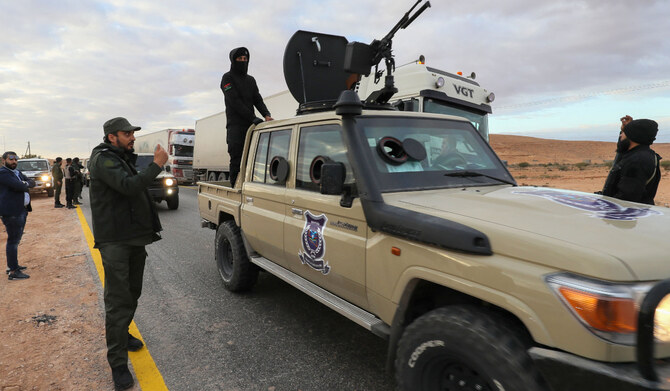
Libyan special forces in charge of illegal migration assemble in the southern region of Bani Walid, on January 14, 2023, ahead of their mission as part of a security plan to enforce inspections at points of entry through the desert borders. (AFP)
Short Url
Updated 23 March 2025
Follow

UN raises alarm over wave of ‘arbitrary’ arrests in Libya

  • UNSMIL expressed concern about the use of filmed confessions, “where individuals are detained and coerced into ‘confessing’ to alleged crimes with videos published online.”

TRIPLI: The UN Support Mission in Libya expressed concern over what it said were arbitrary arrests, including of lawyers and members of the judiciary, calling for their immediate release.
“UNSMIL is alarmed by the wave of arbitrary arrest and detentions across Libya by law enforcement and security actors,” it said in a statement.
“These actors are using their powers of arrest and detention to target individuals for their alleged political affiliations, to silence perceived dissent, and to undermine judicial independence.”
Libya has struggled to recover from the chaos that followed the 2011 uprising.
It remains split between a UN-recognized government in Tripoli and a rival authority in the east.
UNSMIL also expressed concern about the use of filmed confessions, “where individuals are detained and coerced into ‘confessing’ to alleged crimes with videos published online.”
It said the practice was used to “intimidate and humiliate” the individuals and must be deemed inadmissible.
Among those arrested was Judge Ali Al-Sharif, who was subjected to violence during his arrest in Tripoli on March 10, as well as lawyer Mounir Al-Orfi, detained in Benghazi since March 12.
UNSMIL said that two military prosecutors, Mansour Daoub and Mohammed Al-Mabrouk Al-Kar, have also been held in Tripoli since 2022.
The situation “undermines the environment necessary for Libya’s democratic transition and weakens Libyans’ trust in law enforcement and security entities that must work to protect and promote the rights of all people in Libya, not undermine them,” UNSMIL said.


Sudan once again tops International Rescue Committee crises watchlist

Updated 4 sec ago
Follow

Sudan once again tops International Rescue Committee crises watchlist

  • It is the third time in a row Sudan has headed the list, which was published on Tuesday
  • It highlights the 20 countries most at risk of new or worsened humanitarian emergencies
PORT SUDAN:Sudan has once again topped a watchlist of global humanitarian crises released by the International Rescue Committee (IRC) aid organization, as warring sides press on with a conflict that has killed tens of thousands of people.
It is the third time in a row Sudan has headed the list, which was published on Tuesday. It highlights the 20 countries most at risk of new or worsened humanitarian emergencies.
“What the IRC is seeing on the ground is not a tragic accident. The world is not simply failing to respond to crisis; actions and words are producing, prolonging, and rewarding it,” IRC CEO David Miliband said in a statement.
“The scale of the crisis in Sudan, ranking first on this year’s Watchlist for the third year in a row and now the largest humanitarian crisis ever recorded, is a signature of this disorder.”
War erupted in April 2023 from a power struggle between the Sudanese army and the paramilitary Rapid Support Forces ahead of a planned transition to civilian rule, and triggered the world’s largest displacement crisis. More than 12 million people have already been displaced by the ongoing war in Sudan, where humanitarian workers lack resources to help those fleeing, many of whom have been raped, robbed or bereaved by the violence.
Sudan is followed by the Palestinian territories, South Sudan, Ethiopia and Haiti, according to the list.
The IRC said although these countries are home to just 12 percent of the global population, they account for 89 percent of those in humanitarian need. It added that the countries are projected to host more than half of the world’s extreme poor by 2029.
The remaining countries on the list are Myanmar, Democratic Republic of Congo, Mali, Burkina Faso, Lebanon, Afghanistan, Cameroon, Chad, Colombia, Niger, Nigeria, Somalia, Syria, Ukraine and Yemen.