

Filipino Muslims flock to Manila food hub for halal meals during Ramadan

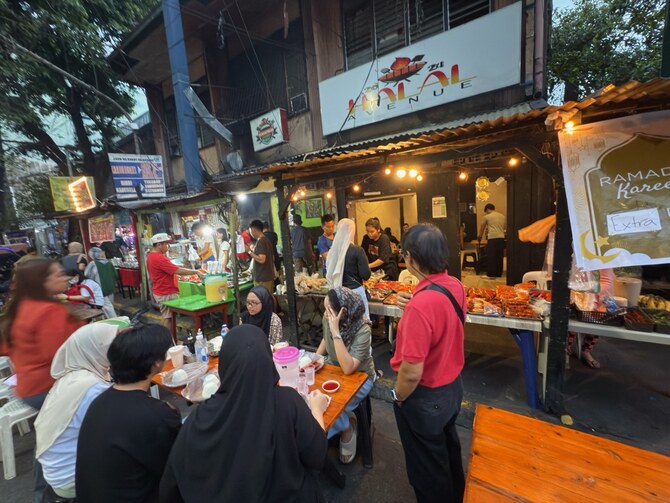
Filipinos eat at the Halal Avenue food stall on Padre Campa Street in Manila on March 21, 2025. (AN Photo)
Short Url
Updated 24 March 2025
Follow

Filipino Muslims flock to Manila food hub for halal meals during Ramadan

  • Philippine capital region is home to more than 173,000 Filipino Muslims
  • Food sellers on Manila’s Padre Campa Street offer halal meals, including Mindanao dishes

MANILA: In the heart of Manila’s bustling University Belt, a food street known for its diverse culinary offerings has grown into a go-to spot for Filipino Muslims during Ramadan, as they search for halal food that reminds them of home.

The halal eateries along Padre Campa Street, a hub for grub located near the capital’s top colleges and universities, have in recent years become a haven for Muslim minorities, including Hanan, who is from Mindanao’s Sultan Kudarat province.

“I miss a lot of food from home, especially the ones prepared by my mom for iftar,” Hanan, who gave only her first name, told Arab News.

As she spent the holy month in Manila to prepare for a licensing exam, Hanan said finding halal food to break the fast was not as easy as it was back home.

“Fasting here is a bit difficult for us because not all the stores here are certified halal. So, we can only pick certain stores, and this is the only specific store we know is safe for us to eat.”

There are about 12 million Muslims in the predominantly Catholic Philippines, making up around 10 percent of its entire population.

While most live on the island of Mindanao and the Sulu archipelago in the country’s south, the Metro Manila capital region is also home to over 173,000 Filipino Muslims.

Along with the government’s recent efforts to promote halal cuisine from Mindanao, such food has become increasingly available in the Philippines’ largest metropolitan area.

But on Padre Campa Street, the presence of halal food stalls has a longer history that can be traced to the owners’ desire to cater to the minority Muslim community.

“We serve native delicacies because there are many Muslims in this area,” Ferdanah Talib, who is from Mindanao’s Zamboanga Sibugay province, told Arab News.

Her brother opened the Halal Avenue food stall in 2017, selling dishes like barbecue chicken and grilled fish, as well as traditional meals like binaki, steamed corn dessert and snacks originating from Mindanao and Cebu.

“It’s our way of supporting our fellow Muslims here, especially during Ramadan. Our store opens at 4:30 p.m. until midnight,” Talib said.

Mary Ann Serra, a Filipina Christian who had worked in Malaysia and spent time in Mindanao, has kept her food shop halal since she opened it over a decade ago.

“We opened this store in 2012, and from the start, it has always been halal,” Serra told Arab News.

“We noticed that there were many Muslims in the area, but there were no halal places to eat. So, we thought, what if we try opening a halal restaurant? Especially during Ramadan, it’s hard for them because there’s nothing for them to eat.”

While her shop specializes in the delicacies of Tausug, one of the largest Muslim ethnic groups in southwestern Philippines, it also sells simple mainstream dishes.

“What our customers keep coming back for are the chicken barbecue, grilled fish, and squid. We also have dishes like tiyula itum, or black soup,” Serra said.

Many Filipino Muslims, even those who are in the capital for a short stay, have grown fond of the food street.

“This is my third time spending Ramadan here in Metro Manila … It really means a lot to us to have a place like this because as Muslims, what we’re really looking for is halal food. We don’t have many places to go for food,” Arsie Muin, who is from Zamboanga City, told Arab News.

“It’s also good because they serve some native delicacies,” he said. “We are really grateful that this place exists.”


Trump hopes North Carolina speech will bolster standing on US economy

Updated 5 sec ago
Follow

Trump hopes North Carolina speech will bolster standing on US economy

  • Trump works to turn around public opinion on economy
  • Opinion polls show Americans have doubts

ROCKY MOUNT, North Carolina: US President Donald Trump traveled to ​the “battleground” state of North Carolina on Friday, seeking to convince Americans that his handling of the economy is sound ahead of a midterm election year that could spell trouble for him and his ruling Republicans. With prices increasing and unemployment up, Trump has his work cut out for him. A Reuters/Ipsos poll released on Tuesday showed just 33 percent of US adults approve of how Trump has handled the economy. Trump is set to argue that the US economy is poised for a surge due to his policies and that any problems they are experiencing are the fault of ‌the Democrats. He contends ‌that he has lowered the price of gasoline, imposed tariffs ‌that ⁠are ​generating ‌billions of dollars for the US Treasury and attracted hundreds of billions of dollars in investment pledges by foreign governments.

Audience members hold signs as they wait for President Trump to take the stage for a rally on Dec. 19, 2025 in Rocky Mount, North Carolina. (Getty Images via AFP)

Republicans worry, however, that economic woes could jeopardize their chances in elections next November that will decide whether they will keep control of the House of Representatives and the Senate for the remaining two years of Trump’s term. The speech is taking place at a 9 p.m. rally (0200 GMT Saturday) at the convention center in Rocky Mount, North Carolina. The city is represented by a Democrat in the ⁠House, Don Davis, who faces a tough re-election fight in 2026 after the boundaries of his congressional district were redrawn. North Carolina ‌is considered a “battleground” state because its statewide elections are closely contested ‍between Democrats and Republicans. But Trump won the ‍state in 2016, 2020 and 2024. The North Carolina event is a stop on ‍the way to his oceanfront Mar-a-Lago club in Palm Beach, Florida, where he plans to spend the Christmas and New Year’s holidays.
The US president has repeatedly said that any economic pain Americans are experiencing should be blamed on policies he inherited from his predecessor, Democratic President Joe Biden.
“Eleven months ago, I inherited a ​mess, and I’m fixing it,” Trump said in a grievance-filled speech on Wednesday night that he delivered in a jarringly rapid-fire pace. Democrats have argued that Trump himself ⁠has bungled the economy, the central issue he campaigned on last year. Trump got some early holiday cheer on Thursday from the Consumer Price Index report for November. It said housing costs rose by the smallest margin in four years. Food costs rose by the least since February. Egg prices — a subject Trump raises regularly — fell for a second month, and by the most in 20 months. The report nonetheless showed that other prices, like beef and electricity, soared. Overall, prices rose 2.7 percent over the year prior. Asked what his message will be in North Carolina, Trump said it would be similar to his last two events, a prime-time address on Wednesday night and a visit to Pennsylvania last week. “We’ve had tremendous success. We inherited a mess, and part of what we inherited was the worst ‌inflation in 48 years,” Trump told reporters in the Oval Office on Thursday. “And now we’re bringing those prices down. I’ll be talking about that.”