

Pakistan urges international community to take decisive steps to end ‘genocide’ in Palestine

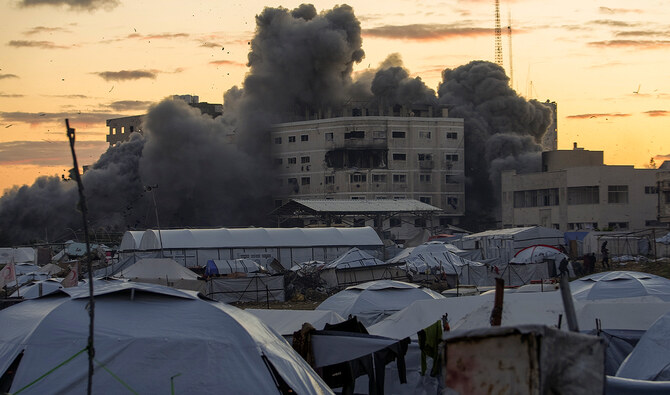
Behind a tent camp for displaced Palestinians, smoke rises from a building after it was targeted by an Israeli army strike, following evacuation orders for residents in Gaza City on March 22, 2025. (AP)
Short Url
Updated 23 March 2025
Follow

Pakistan urges international community to take decisive steps to end ‘genocide’ in Palestine

  • President Asif Ali Zardari’s statement comes in response to renewed military operations by Israel in Gaza
  • Pakistan does not recognize Israel, and its passport explicitly states it cannot be used for travel to country

ISLAMABAD: Pakistan President Asif Ali Zardari on Sunday demanded the international community take decisive steps to end the “genocide” in Palestine, reaffirming solidarity with the people of Gaza as tensions with Israel flare in the Middle East again. 

Zardari’s statement came following the disagreement between Hamas and Israel over the next steps in the Jan. 19 ceasefire, with the Jewish state resuming air strikes in Gaza this Tuesday followed by ground operations the day after.

On Friday, Israeli Defense Minister Israel Katz threatened to annex parts of Gaza unless Hamas frees the remaining Israeli hostages seized in the Oct. 7, 2023 attack.

“Here, we express solidarity with Palestine and reaffirm our resolve for their right to self-determination,” Zardari told participants of a military parade held in Islamabad to mark Pakistan’s republic day. 

“The international community must immediately take decisive steps to end Palestinian genocide. The Palestinian masses must have complete independence in their own country without any external interference,” he added. 

Hamas’ 2023 attack on Israel resulted in 1,218 deaths, mostly civilians, according to Israeli figures.
Nearly 50,000 people in Gaza have been killed in the war since then due to Israel’s retaliation, according to the Hamas-run territory’s health ministry.

Of the 251 Israeli hostages taken that day, 58 are still being held, including 34 the Israeli military says are dead.

Pakistan does not recognize the state of Israel, and its passport explicitly states that it cannot be used for travel to the country. 

Islamabad has repeatedly called for an independent Palestinian state based on “internationally agreed parameters” and pre-1967 borders with Al-Quds Al-Sharif as its capital. 


Pakistan vows to play active role against climate change on International Day of Clean Energy 

Updated 26 January 2026
Follow

Pakistan vows to play active role against climate change on International Day of Clean Energy 

  • Governments, civil societies every year mark Jan. 26 as International Day of Clean Energy, calling for inclusive transition to clean power
  • Pakistan ranks among nations most vulnerable to climate change, suffering from erratic weather patterns such as floods, heatwaves, storms

ISLAMABAD: Pakistan will play an active role in global efforts against climate change, President Asif Ali Zardari vowed on Monday as the world marks International Day of Clean Energy today. 

The International Day of Clean Energy is marked every year on Jan. 26 during which governments and civil societies around the world call for awareness on climate change impacts and demand action for a just and inclusive transition to clean energy for the benefit of the people.

Burdened by an energy crisis that has resulted in costly fuel imports over the past couple of years, Pakistan has sought to shift to clean energy to place less burden on its fragile economy. The South Asian country has emerged as one of the world’s fastest growing solar markets, with 12 gigawatts (GWs) of off-grid and over 6GWs of net-metered solar capacity by the end of 2025. In the last fiscal year, renewables accounted for a historic 53 percent of total electricity generation, according to the prime minister’s coordinator on climate change, Romina Khurshid Alam. 

“Pakistan will play an active role in global efforts against climate change,” Zardari was quoted in a statement released by his office. “Investment in safe technologies is essential for the protection of the planet.”
Zardari stressed that clean energy is essential for inclusive development, noting that Pakistan has made the transition toward it a “national priority.”

He said clean energy occupies a central place in the government’s policy framework, adding that Pakistan has set a target of electric vehicles comprising 30 percent of all passenger vehicles and heavy-duty truck sales by 2030. 

The Pakistani president cited air pollution as a major challenge to public health in the country, noting its social and economic costs for the government and the people. 

“Pakistan is committed to building a reliable and sustainable energy system,” he said. 

Pakistan ranks among nations most vulnerable to climate change and has seen erratic changes in its weather patterns that have led to frequent heatwaves, untimely rains, storms, cyclones, floods and droughts in recent years. 

In 2022, monsoon floods killed over 1,700 people, displaced another 33 million and caused over $30 billion losses. Over 1,000 people were killed in floods last year as well due to torrential monsoon rains and floods triggered by climate change impacts and excess water released by Indian dams.