

Japan, China, and South Korea agree to promote peace

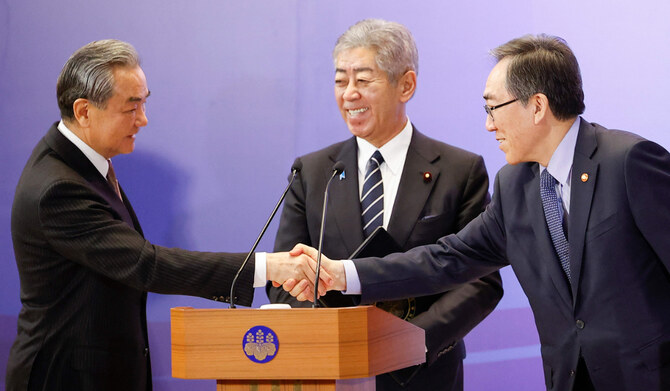
China's Foreign Minister Wang Yi (L) and South Korea's Foreign Minister Cho Tae-yul (R) shake hands as Japan's Foreign Minister Takeshi Iwaya looks on during a joint press conference after their meeting during the 11th Trilateral Foreign Minister's Meeting (Japan-China-ROK) in Tokyo on March 22, 2025. (AFP)
Short Url
Updated 23 March 2025
Follow

Japan, China, and South Korea agree to promote peace

  • Seoul and Tokyo typically take a stronger line against North Korea than China, which remains one of Pyongyang’s most important allies and economic benefactors

TOKYO: Japan, South Korea and China agreed Saturday that peace on the Korean Peninsula was a shared responsibility, Seoul’s foreign minister said, in a meeting of the three countries’ top diplomats in which they pledged to promote cooperation.
The talks in Tokyo followed a rare summit in May in Seoul where the three neighbors — riven by historical and territorial disputes — agreed to deepen trade ties and restated their goal of a denuclearised Korean peninsula.
But they come as US tariffs loom over the region, and as concerns mount over North Korea’s weapons tests and its deployment of troops to support Russia’s war against Ukraine.
“We reaffirmed that maintaining peace and stability on the Korean peninsula is a shared interest and responsibility of the three countries,” South Korea’s Cho Tae-yul told reporters after the trilateral meeting.
Seoul and Tokyo typically take a stronger line against North Korea than China, which remains one of Pyongyang’s most important allies and economic benefactors.
Japanese Foreign Minister Takeshi Iwaya said he, Cho, and China’s Wang Yi “had a frank exchange of views on trilateral cooperation and regional international affairs ... and confirmed that we will promote future-orientated cooperation.”
“The international situation has become increasingly severe, and it is no exaggeration to say that we are at a turning point in history,” Iwaya said at the start of Saturday’s meeting.
This makes it “more important than ever to make efforts to overcome division and confrontation,” he added.
Wang noted this year marks the 80th anniversary of the end of WWII, saying “only by sincerely reflecting on history can we better build the future.”
At two-way talks between Iwaya and Wang on Saturday, the Japanese minister said he had “frankly conveyed our country’s thoughts and concerns” on disputed islands, detained Japanese nationals and the situation in Taiwan and the South China Sea, among other contentious issues.
Ukraine was also on the agenda, with Iwaya warning “any attempt to unilaterally change the status quo by force will not be tolerated anywhere in the world.”
Climate change and aging populations were among the broad topics officials had said would be discussed, as well as working together on disaster relief and science and technology.
Iwaya said the trio had “agreed to accelerate coordination for the next summit” between the countries’ leaders.


Changes to US security strategy ‘largely consistent’ with Russia’s vision: Kremlin

Updated 07 December 2025
Follow

Changes to US security strategy ‘largely consistent’ with Russia’s vision: Kremlin

  • Kremlin’s spokesman Dmitry Peskov said that the current US administration was “fundamentally different from the previous ones”

MOSCOW: Russia has welcomed changes in the US National Security Strategy, saying the adjustments that marked a radical departure from Washington’s previous policy were “largely consistent” with Moscow’s vision.
Washington’s new National Security Strategy, published early Friday, took aim at allies in Europe, calling it over-regulated, lacking in “self-confidence” and facing “civilizational erasure” due to immigration.
The document stated that the United States would also prevent other powers from dominating but added: “This does not mean wasting blood and treasure to curtail the influence of all the world’s great and middle powers.”
Commenting on the new US strategy, the Kremlin’s spokesman Dmitry Peskov said that the current US administration was “fundamentally different from the previous ones.”
“The adjustments we’re seeing, I would say, are largely consistent with our vision,” Peskov said in an interview with state TV station Rossiya aired Sunday.
“President Trump is currently strong in terms of domestic political positions. And this gives him the opportunity to adjust the concept to suit his vision,” Peskov added.
The publication of the updated security strategy came as officials from Kyiv held talks in Florida with Trump’s envoys on the US-drafted plan to end the near four-year war in Ukraine.
Three days of talks produced no apparent breakthrough.
President Volodymyr Zelensky committed to further negotiations toward “real peace,” as Russia in the early hours of Saturday launched another series of drone and missile strikes at Ukraine.
Zelensky is due to meet with European leaders — French President Emmanuel Macron, British Prime Minister Keir Starmer and German Chancellor Friedrich Merz — in London on Monday to take stock of the negotiations.