

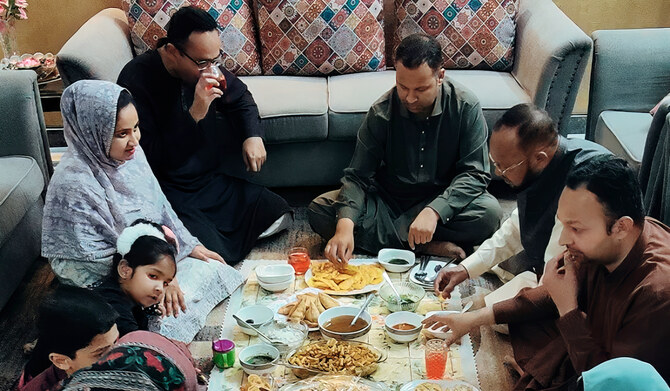

ISLAMABAD: The clatter of plates, spoons, and forks filled the air as Mahmood Ahmed Hashmi, 67, broke his fast earlier this week at his home in Islamabad, seated with his three sons, daughters-in-law and grandchildren around a large, colorful tablecloth spread on the floor.
Ramadan traditions and practices evolve across generations, influenced by changing demographics, lifestyles, media and digital apps, while retaining the core spiritual elements of fasting, prayer, and charity.
As in other parts of the world, the digital age has also significantly altered how Ramadan is observed by Pakistani families, offering new avenues for spiritual engagement, community connection, and resource access through apps, social media, and online platforms.
FASTFACT
Digital age has significantly altered how holy month is observed, offering spiritual engagement through apps, social media, and online platforms.
Hashmi, a retired civil servant, detailed how Ramadan has changed through the generations of his family, beginning with the tradition of Ramadan drummers walking through the streets, beating drums to wake people for the pre-dawn meal (sahoor) before fasting began for the day. Once a typical feature of the holy month, the tradition’s usefulness has been eclipsed by TV, mobile phones, and alarm clocks.
“In those days, the elders used to come out in the neighborhood to wake up people for sahoor,” Hashmi told Arab News at iftar. “They used to do some drumming and other things so that people could get up, but now you have everything in your cell phone.”
Mobile apps have become indispensable tools for Muslims around the world during Ramadan, offering features such as prayer time reminders, Qur’anic recitations, and fasting trackers, ensuring accurate timing and accessibility.
While many people used to visit neighborhood or community religious gatherings earlier, now platforms such as YouTube and TikTok host Islamic scholars and influencers who share daily Ramadan reflections, Qur’anic tafseer (exegesis), and tips for spiritual growth, making Islamic education more accessible, especially for younger Muslims.
Social media platforms have also become main avenues for sharing Ramadan greetings, exchanging recipes, and discussing spiritual reflections.
Handwritten Eid cards, once widely exchanged among friends and relatives ahead of the post-Ramadan Eid Al-Fitr festival, are now a rarity in the age of digital greeting cards shared on Whatsapp and other messaging platforms, Hashmi lamented.
“How good the feeling used to be to get Eid cards from your loved ones,” he said. “Your near and loved ones used to wait for them. People used to display them in their drawing rooms or bedrooms. Now a picture (card) will come (on mobile phone).”
Iftar and sahoor meals would also be made entirely at home, or with snacks and food bought from neighborhood eateries, and would be consumed as a family, while food was now increasingly ordered from online apps as per individual choices, Hashmi added.
While the retired official regrets the decline in many of the Ramadan customs of his youth, his son Miraj Mustafa Hashmi, a professor at the National University of Sciences and Technology, said digital innovations such as mobile apps have streamlined everyday rituals, while still nurturing cherished Ramadan traditions.
“Apps like FoodPanda have replaced traditional market trips for iftar (items),” Miraj said, explaining that this was beneficial for people who did not have the luxury of time due to jobs and other responsibilities.
“It is a digital era, things are going on like that and people are comfortable in it. I think it is a very positive change … because people like us have to stay in the office all day and work … Obviously, we want to go to the market but the pressure of work and the load is there.”
Digital platforms and apps have also made it easier for people to donate to charity and support those in need, a core aspect of the holy month, Miraj said.
For his 10-year-old son Ibrahim, a student who began fasting at the age of 7, Ramadan is about being able to order his favorite dishes online and checking the internet for iftar and sahoor timings.
“I love having noodles, pizza, macaroni, samosas, pakoras, and jalebis for iftar,” Ibrahim said.
But was there anything Miraj missed about the way Ramadan used to be observed?
Relatives and friends used to meet each other more often at Ramadan events when they did not have the luxury to connect through video calls, he said.
“When I think of my childhood, we used to go to social events, we used to go shopping with our grandparents, we used to do all these activities.
“If we see, our parents spent a very tough life due to limited facilities, but they made it a little easier (for us) and our children are living a much easier life and technology is helpful.”


