



ISLAMABAD: As the daylight fades and residents sit together to break their fast amid a call for Maghreb prayer in the Pakistani capital of Islamabad, Constable Malik Mohammed Ikram breaks his fast with a date and water while on duty.
The 47-year-old, who has been serving in the Islamabad police for 18 years and is currently part of their Dolphin patrolling squad, says he is proud of efficiently carrying out his duty, which takes on a different meaning during Ramadan, testing not only his endurance but also his devotion to faith.
Ikram’s schedule remains the same during Ramadan as any other day of the year, with an eight-hour shift varying between 7 a.m. to 3 p.m., 3 p.m. to 11 p.m. or 11 p.m. to 7 a.m. But the fatigue feels different while fasting, he said.
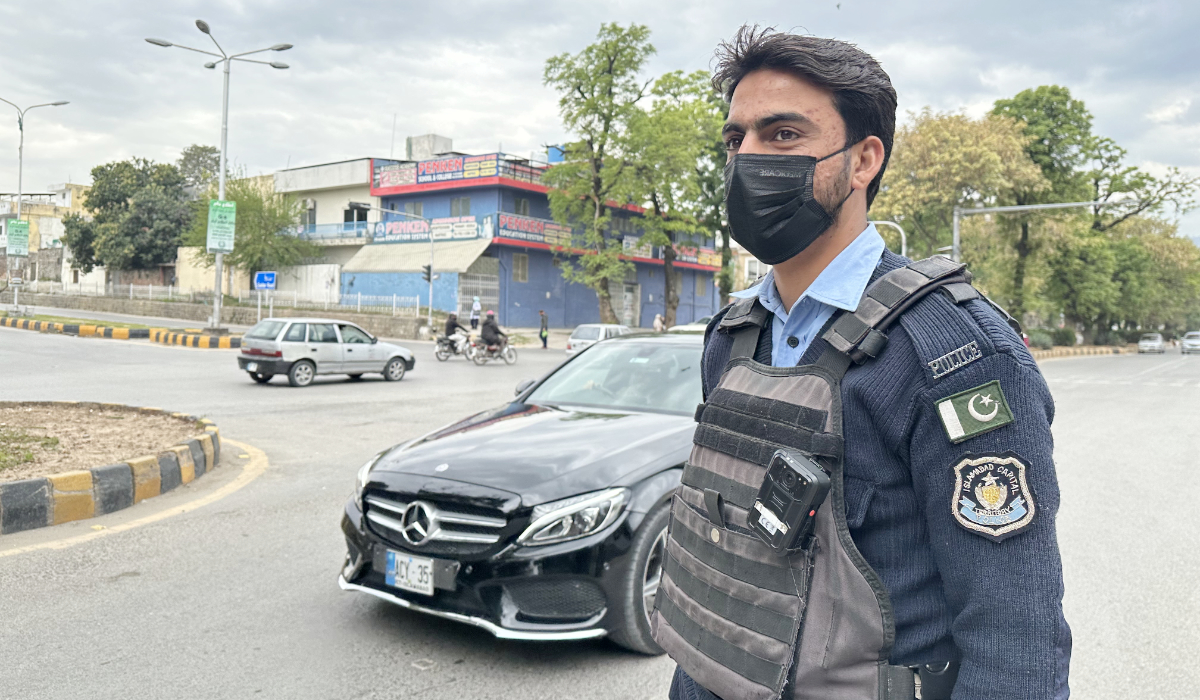
A police officer stands guard during the holy month of Ramadan in Islamabad. (AN photo)
“Indeed, performing our duties during Ramadan feels different,” he told Arab News, while on duty in Islamabad’s G-6 sector within the remits of the Aabpara Police Station.
“Nonetheless, it is our responsibility and our profession. We can choose to work with a positive attitude or do it out of obligation, so we try to do it happily.”
The capital city police department does not provide any formal iftar or sahoor meals but offers whatever it can to on-duty staff, according to Ikram. The policemen manage to have quick sahoor meals before heading out for duty on most days, and if not, they swing by a government mess or food stalls at the nearby G-6 market for a quick bite.
FASTFACT
According to Pakistani policeman Malik Mohammed Ikram, being patient is part of the job, particularly during Ramadan, as fatigue and hunger can flare up tempers that hamper their duty.
Ikram, who leads a team of three other cops, says the iftar hour is particularly “unpredictable” as they often break their fast with dates, water and fruit while being caught up in patrolling, chasing suspects or responding to emergency calls.
“If we’re on duty during iftar, we have to manage on our own,” he said. “If there’s a station nearby, we go there, but there are times when the adhan is being called and we’re going for some task.”
Ikram recalls how he received an emergency call from the police control room about an accident near Zero Point just as he was about to break his fast this month and had to rush to the site to respond to the situation.
“If we are having iftar and we get a call regarding an emergency case or an accident, we have to leave everything and respond to the call,” he explained. “We also need to report our response time to the control room, letting them know how long it took us to respond after receiving the call.”
He said he was able to save a young man’s life following that call from the police control room.
“I felt really happy from the bottom of my heart,” he said, reminiscing on moments like this that remind him why he joined the police force. “The life of the man was saved due to timely treatment.”
For policemen, being patient is part of the job, particularly during Ramadan, as fatigue and hunger can flare up tempers that hamper their duty, according to Ikram.
“Our profession and the nature of duties are such that anger cannot work here, and we have to be patient,” he said.
Recalling another incident, Ikram said they were stationed near a traffic signal in the G6 sector when his team signaled for two youths riding a bike to stop, but they sped up and were eventually stopped after a long chase.
“We verified and found out that their bike was stolen. That’s why they tried to flee,” he said, highlighting that his team calmly handled the situation even though it could have turned tense.
Ikram says he is often assigned to the Red Zone, a high-security area housing key government buildings, embassies and key institutions, where shifts can run up to 16 hours even during Ramadan, but he accepts it as part of his calling.
The officer, whose other family members have also served in the police, says he always wanted to contribute to society’s betterment, which was the reason he joined the force.
“If there is an emergency during Ramadan, duty comes first,” he said. “I took up this profession because firstly, it’s all about rizq (livelihood) — Allah had written our rizq in this profession. Secondly, it was my personal choice to join the Islamabad police.”
Looking back at his years of service, Ikram says he finds fulfillment in small yet powerful moments.
“Iftar and sahoor are secondary. Duty is our responsibility, and the government pays us for it. So, duty always comes first,” he said as he picked up his radio and moved on with the routine patrol while fasting.


