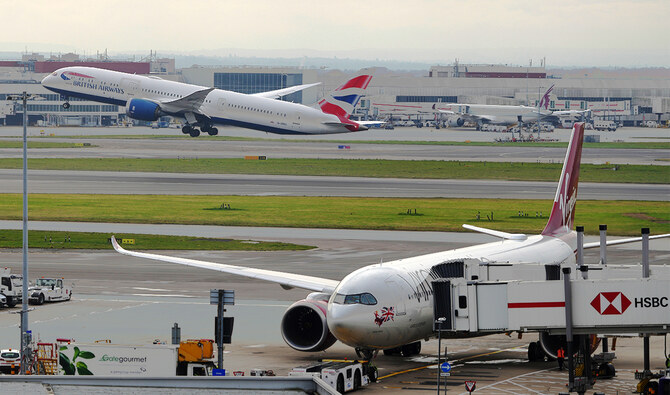
LONDON: London’s Heathrow Airport resumed full operations on Saturday, a day after a fire knocked out its power supply and shut Europe’s busiest airport, causing global travel chaos.
Some flights were canceled or delayed as the travel industry scrambled to reroute passengers and fix battered airline schedules after the huge fire at an electrical substation serving the airport.
Resumed flights had begun on Friday evening, but the shuttering of the world’s fifth-busiest airport for most of the day left tens of thousands searching for scarce hotel rooms and replacement seats while airlines tried to return jets and crew to bases.
Operations were normal on Saturday morning, but airlines were still dealing with the aftermath, said the airport’s chief executive, Thomas Woldbye.
“We don’t expect any major amount of flights to be canceled or delayed. There are some cancelations and there are some delays. We are handling them in the same way as we would normally do,” Woldbye told BBC radio.
The vast majority of scheduled morning flights departed successfully on Saturday morning, with a handful of delays and cancelations, Heathrow’s departures website showed.
British Airways, whose main hub is Heathrow, said it expected around 85 percent of its schedule of almost 600 departures and arrivals to proceed on Saturday.
“We are planning to operate as many flights as possible to and from Heathrow on Saturday, but to recover an operation of our size after such a significant incident is extremely complex,” the airline said in a statement.
“It is likely that all traveling customers will experience delays as we continue to navigate the challenges posed by Friday’s power outage at the airport.”
A Heathrow spokesperson said in an emailed statement that the airport had “hundreds of additional colleagues on hand in our terminals and we have added flights to today’s schedule to facilitate an extra 10,000 passengers traveling through the airport.”
The travel industry, facing the prospect of a financial hit costing tens of millions of pounds and a likely fight over who should pay, questioned how such crucial infrastructure could fail without backup.
“It is a clear planning failure by the airport,” said Willie Walsh, head of global airlines body IATA, who, as former head of British Airways, has for years been a fierce critic of the crowded hub.
Police said that after an initial assessment they were not treating the incident as suspicious, although enquiries remained ongoing. London Fire Brigade said its investigations would focus on the electrical distribution equipment.
The airport had been due to handle 1,351 flights on Friday, flying up to 291,000 passengers, but planes were diverted to other airports in Britain and across Europe, while many long-haul flights returned to their point of departure.
Woldbye, asked on Friday who would pay for the disruption, said there were “procedures in place,” adding “we don’t have liabilities in place for incidents like this.”
Restrictions on overnight flights were temporarily lifted by Britain’s Department of Transport to ease congestion, but British Airways Chief Executive Sean Doyle said the closure was set to have a “huge impact on all of our customers flying with us over the coming days.”
Virgin Atlantic said it expected to operate “a near full schedule” with limited cancelations on Saturday but that the situation remained dynamic and all flights would be kept under continuous review.
Airlines including JetBlue, American Airlines, Air Canada, Air India, Delta Air Lines, Qantas, United Airlines, British Airways and Virgin were diverted or returned to their origin airports in the wake of the closure, according to data from flight analytics firm Cirium.
Shares in many airlines fell on Friday.
Aviation experts said the last time European airports experienced disruption on such a large scale was the 2010 Icelandic volcanic ash cloud that grounded some 100,000 flights.
They warned that some passengers forced to land in Europe may have to stay in transit lounges if they lack the paperwork to leave the airport.
Prices at hotels around Heathrow jumped, with booking sites offering rooms for 500 pounds ($645), roughly five times the normal price levels.
Police said after an initial assessment, they were not treating the incident at the power substation as suspicious, although enquiries remained ongoing. London Fire Brigade said its investigations would focus on the electrical distribution equipment.
Heathrow and London’s other major airports have been hit by other outages in recent years, most recently by an automated gate failure and an air traffic system meltdown, both in 2023.


![]()

Heathrow resumes operations as global airlines scramble after shutdown
Short Url
https://arab.news/pmpwv
Heathrow resumes operations as global airlines scramble after shutdown
- Some flights were canceled or delayed as the travel industry scrambled to reroute passengers and fix battered airline schedules
- Operations were normal on Saturday morning, but airlines were still dealing with the aftermath, said the airport’s chief executive
Latest updates


Recommended


© 2026 SAUDI RESEARCH & PUBLISHING COMPANY, All Rights Reserved And subject to Terms of Use Agreement.