


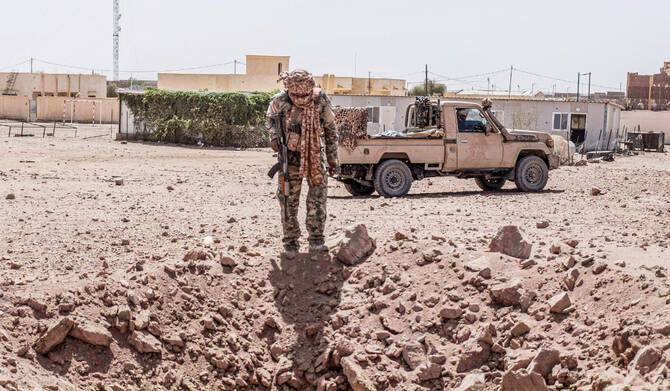
NEW YORK: The UN Security Council has condemned a series of attacks by Al-Qaeda-linked terrorists and Tuareg separatists that began late last month, and called for those responsible to be held accountable.
The council “condemned in the strongest terms the heinous and cowardly terrorist attacks in several locations across Mali on 25 April 2026 and in the days that followed,” it said in a statement.
The council also “underlined the need to hold perpetrators, organizers, financiers and sponsors of these reprehensible acts of terrorism accountable and bring them to justice.”
Under international humanitarian law, all parties to an armed conflict must always make a distinction between civilians and combatants.
Marceau Sivieude, Amnesty regional director
Mali has been gripped by uncertainty since the armed groups teamed up in April to target positions of the ruling junta.
A coordinated deadly offensive on April 25 and 26 targeted strategic towns and killed the country’s influential defense minister.
Kidal and other towns and villages in the north were captured and are now controlled by the terrorists, who have since imposed a blockade on the capital, Bamako.
Since 2012, Mali has faced a deepening security crisis driven by violence affiliated with Al-Qaeda and Daesh, as well as separatists and community-based criminal networks.
Amnesty International called on the extremists to respect civilian safety and freedom of movement in Mali.
“The ongoing siege of Bamako is having unacceptable consequences for civilians’ freedom of movement and may lead to serious violations of their rights to food security, health, and life,” Amnesty said in a statement.
It urged the extremists to “respect international humanitarian law and ensure the safety of civilians,” citing a May 6 attack on a convoy carrying civilian goods between Bamako and Bougouni in the south.
The trucks “were not under military escort and were not carrying military personnel or equipment,” the statement read.
“Attacks on civilian vehicles with a civilian purpose are unlawful,” Amnesty regional director Marceau Sivieude said in the statement.
“Under international humanitarian law, all parties to an armed conflict must always make a distinction between civilians and combatants.”
More than a dozen transport companies earlier this week announced they were suspending routes to and from Bamako due to the blockade.


