

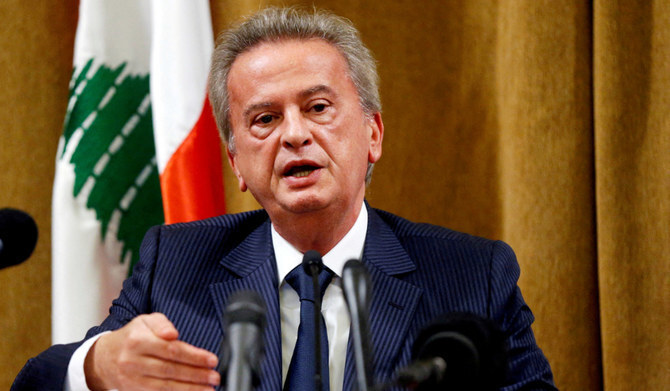
Former central bank governor Riad Salameh’s case referred to financial prosecution

The judiciary in Lebanon is awaiting the findings of the financial public prosecutor regarding the investigation into the bank’s former governor Riad Salameh (pictured). (Reuters/File Photo)
Short Url
Updated 21 March 2025
Follow

Former central bank governor Riad Salameh’s case referred to financial prosecution

  • PM Nawaf Salam announces Lebanon’s shift to digital governance
  • Former economy minister banned from travel on suspicion of corruption

BEIRUT: Lebanese Prime Minister Nawaf Salam announced on Friday that the government was working on establishing an executive mechanism to transition Lebanon into a digital state.

Lebanon is focused on using all its resources and connections to leverage external expertise in order to pursue the government’s development goals, he stated during a meeting with a delegation of business leaders.

The Cabinet approved a mechanism for administrative appointments in state institutions on Thursday, which Salam described as “transparent and competitive.”

Media reports in Beirut on Friday characterized this mechanism as a “theoretical qualitative leap and a reformative advancement in the selection of public sector employees. However, the critical factor remains its successful implementation.”

The position of governor of Lebanon’s central bank, the Banque du Liban, is currently vacant as President Joseph Aoun and Prime Minister Salam have not yet reached an agreement on the most suitable candidate. In the meantime, the judiciary is awaiting the findings of the financial public prosecutor regarding the investigation into the bank’s former governor Riad Salameh.

Salameh has been in pretrial detention for the past seven months on charges of embezzling public funds.

A judicial source told Arab News that Investigative Judge Bilal Halawi had concluded the investigation into Salameh’s case after issuing two in absentia arrest warrants for Salameh’s advisers.

The case has now been referred to Financial Prosecutor Judge Ali Ibrahim for review in preparation for issuing an indictment.

There is no specific deadline for the financial prosecution to respond.

Salameh — along with two lawyers, Michel Tueini and Marwan Issa Khoury, who served as advisers at the central bank — is being prosecuted for allegedly embezzling over $40 million from the bank’s funds. It is claimed that this amount was transferred to Salameh’s account with the assistance of Tueini and Issa Khoury.

In the ongoing pursuit of corruption cases, Judge Jamal Hajjar, the public prosecutor at the Court of Cassation, has moved to ban former Economy Minister Amin Salam from traveling.

The decision was made based on a report from the National Economy, Industry, Trade, and Planning Committee.

It also included his advisers Karim Salam and Fadi Tamim, as well as financial auditor Elie Abboud.

On Thursday, MP Farid Boustany, the committee’s chairman, lodged a complaint with the Public Prosecutor’s Office against the former minister, his advisers, and Abboud as a signatory.

The complaint alleges “bribery, influence-peddling, blackmailing insurance companies, mismanagement of public funds, and money laundering.”

In response to these accusations, Salam denied the charges, claiming they were part of a “systematic campaign of personal or political targeting” against him and his team.

Salam served as the economy minister for less than four years in the Najib Mikati government.

A report from the Parliamentary Observatory determined that Salam “misused his authority over the Insurance Control Commission, which oversees the insurance sector, for personal benefit at the expense of public funds.”

A judicial source informed Arab News that the travel ban was a preliminary measure aimed at ensuring that the suspects are notified about their upcoming interrogations, scheduled to occur soon at the Palace of Justice in Beirut.

The National Economy Committee of Parliament prepared a dossier detailing “violations” by Salam during his time in office.

The committee had previously summoned him to discuss the oversight of insurance companies by the ministry.

Salam did not attend three sessions, leading the committee to refer the case to the public prosecutor at the Court of Cassation and the financial prosecution for further action.

In 2023, sources said suspicions arose after his adviser, Tamim, was accused of blackmailing insurance companies for hundreds of thousands of dollars to prevent the revocation of the company’s license.

“Tamim was arrested, and it later came to light that Minister Karim Salam, the brother of the minister, had pressured insurance companies to pay large sums for mandatory solvency studies through a firm owned by Tamim. These actions resulted in accusations of abuse of power and blackmail.

“The National Economy Committee uncovered evidence that former Minister Salam misused public funds, spending over $50,000 a month on his office and engaging in questionable contracts.”


Arab Coalition announces ‘limited’ airstrike targeting two ships that smuggled weapons to Yemen

Updated 30 December 2025
Follow

Arab Coalition announces ‘limited’ airstrike targeting two ships that smuggled weapons to Yemen

  • Coalition urges evacuation of the Port of Mukalla, signaling that a major military operation to force an STC withdrawal could be imminent
  • Spokesman says the two ships transported weapons from the UAE port of Fujairah to Mukalla without getting permission from Coalition command

RIYADH: The Coalition to Support Legitimacy in Yemen on Tuesday said it conducted a “limited” airstrike targeting two ships that smuggled weapons and other military hardware into Mukalla in southern Yemen.

In a statement carried by the Saudi Press Agency (SPA), the Coalition Forces spokesman, Major General Turki Al-Maliki, said that two ships coming from the port of Fujairah in the United Arab Emirates entered the Port of Mukalla in Hadramaut without obtaining official permits from the Joint Forces Command of the Coalition. 

“The crews of the two ships disabled the tracking systems of the two ships and unloaded a large quantity of weapons and combat vehicles to support the Southern Transitional Council forces in the eastern governorates of Yemen (Hadramawt, Al-Mahra) with the aim of fueling the conflict. This is a clear violation of imposing a truce and reaching a peaceful solution, as well as a violation of UN Security Council Resolution No. (2216) of 2015 AD,” said the spokesman.

The coalition urged civilians and fishermen to evacuate the Port of Mukalla, signaling that a major military operation to force an STC withdrawal could be imminent.

Google map showing the location of Mukalla in southern Yemen

Al-Maliki said the Coalition Forces acted on a request by Rashad Al-Alimi, the president of the Yemeni Presidential Leadership Council, “to take all necessary military measures to protect civilians in the governorates of Hadramawt and Al-Mahra.”

Al-Alimi, the president of the Yemeni Presidential Leadership Council, warned last week that unilateral actions by the STC were pushing the country toward a dangerous tipping point.

“Given the danger and escalation posed by these weapons, which threaten security and stability, the Coalition Air Forces conducted a limited military operation this morning targeting weapons and combat vehicles unloaded from the two ships at the port of Al-Mukalla. This was done after documenting the unloading, and the military operation was carried out in accordance with international humanitarian law and its customary rules, ensuring no collateral damage occurred,”  spokesman Al-Maliki said on Tuesday.


READ MORE: Analysis: The risks of carving up Yemen


He affirmed the Coalition’s "continued commitment to de-escalation and enforcing calm in the governorates of Hadramawt and Al-Mahra, and to prevent any military support from any country to any Yemeni faction without coordination with the legitimate Yemeni government and the Coalition. This is aimed at ensuring the success of the Kingdom and the Coalition’s efforts to achieve security and stability and prevent the conflict from spreading.”

Disregarding previous agreements with the Coalition, the group calling itself Southern Transitional Council, or STC, launched a sweeping military campaign early in December, seizing the governorates of Hadramaut along the Saudi border and the eastern governorate of Al-Mahra in Yemen’s border with Oman.

The UAE-backed STC forces captured the city of Seiyun, including its international airport and the presidential palace. They also took control of the strategic PetroMasila oilfields, which account for a massive portion of Yemen’s remaining oil wealth.

CaptioYemenis members of the Sabahiha tribes of Lahj, who live along the strip between the south and north of the country, gather during a rally in the coastal port city of Aden on December 14, 2025, to show their support for the UAE-backed Southern Transitional Council (STC), which wants to revive an independent South Yemen. (AFP)

This prompted Saudi Arabia to issue a firm demand for the STC to withdraw and hand over the seized areas to the National Shield Forces, a Saudi-backed unit.

The coalition warned that any military movements undermining de-escalation efforts would be dealt with immediately to protect civilians, according to the Saudi Press Agency.

On Dec. 26, the UAE issued a statement welcoming Saudi Arabia’s efforts to support security and stability in Yemen.

The statement carried by state news agency WAM praised Saudi Arabia’s constructive role in advancing the interests of the Yemeni people and supporting their legitimate aspirations for stability and prosperity.