

‘I need to be home’: Pakistanis among stranded Heathrow passengers separated from loved ones

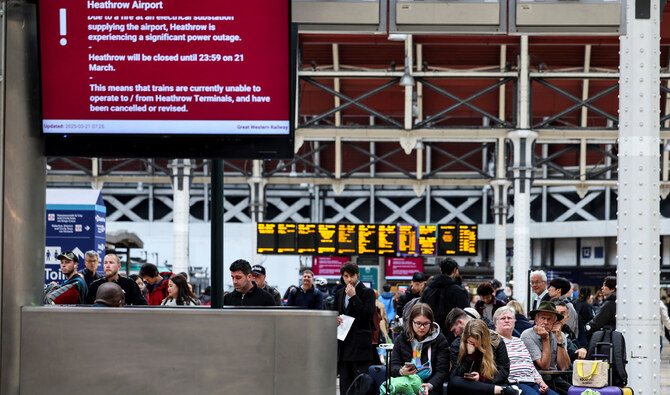
People wait at the Paddington railway station, after a fire at a nearby electrical substation wiped out power at the Heathrow International Airport, in London, Britain on March 21, 2025. (REUTERS)
Short Url
Updated 21 March 2025
Follow

‘I need to be home’: Pakistanis among stranded Heathrow passengers separated from loved ones

  • Europe’s busiest airport has been shut down due to a blaze at a nearby electric substation causing power outage
  • Travel experts say the disruption will extend far beyond Heathrow, and global flight schedules will be affected

LONDON: Thousands of travelers stranded by a huge fire near London’s Heathrow, Europe’s busiest airport, scrambled to find ways to get home and reunite with their families on Friday as they faced what could be days of disruptions.
Heathrow was shut as around 70 firefighters sought to put down the blaze at a nearby electrical substation in the west of London that knocked out power at the airport as well as the area’s back-up power system.
Airlines advised passengers not to travel to the airport, and Britain’s energy minister Ed Miliband warned it would take time to recover from the “catastrophic” fire.
Waiting at central London’s Paddington station, which normally offers express train service to Heathrow, US traveler Tyler Prieb contacted airlines Friday morning, hoping to find a new flight back to his home in Nashville, Tennessee.
“I’m sure everybody is going to need a new flight somewhere, somehow. So I’m just trying to get ahead of that the best I can,” said Prieb, 36, who was in London for work and to see friends.
“Hopefully, it will just take me an extra day to get back to my wife and my daughter. And they are probably wishing I would be home already,” he said.
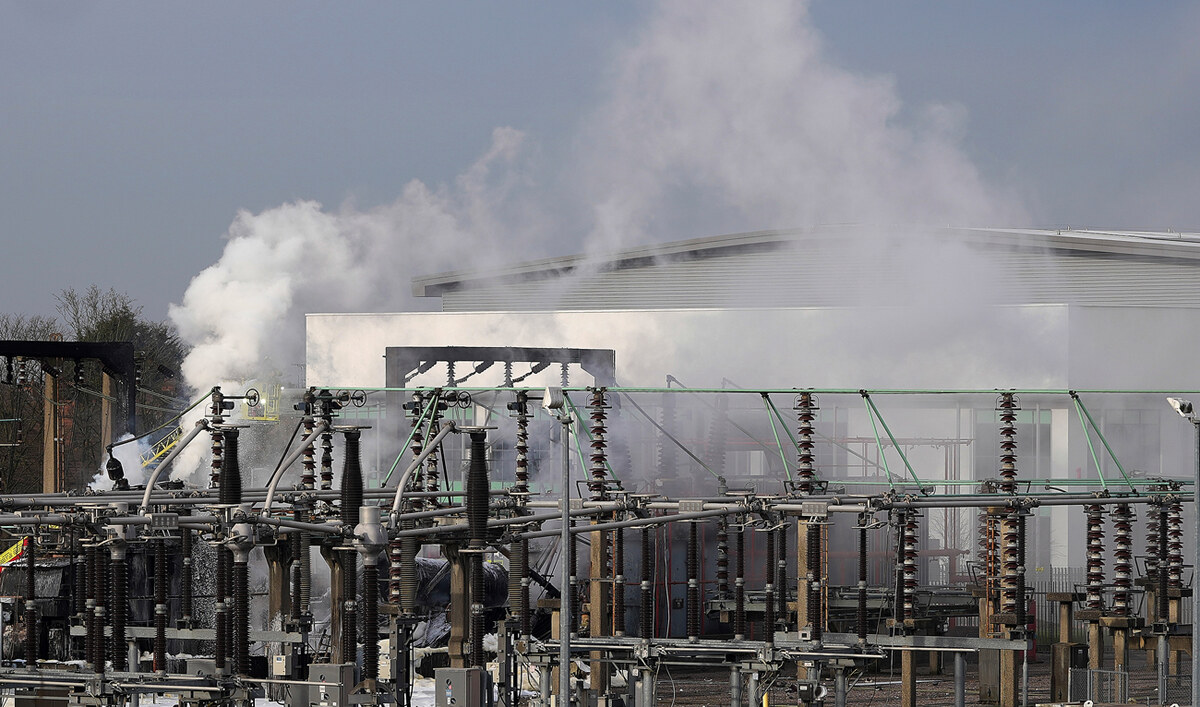


Firefighters extinguish the fire at the North Hyde electrical substation, which caught fire Thursday night and led to a closure of Heathrow Airport in London, Britain on March 21, 2025. (AP)

In the meantime, Prieb said he had asked OpenAI’s chatbot ChatGPT for ways to pass the time.
“I thought maybe I’d go explore another city somewhere,” he said.
Heathrow was due to handle 1,351 flights during the day, flying up to 291,000 passengers.
A Heathrow spokesperson told Reuters in an email that there was no clarity on when power would be restored, and they expected significant disruption over the coming days.
John Moriarty, another US traveler, listened attentively to his phone’s speaker, hoping to get through to his airline’s customer service helpline.
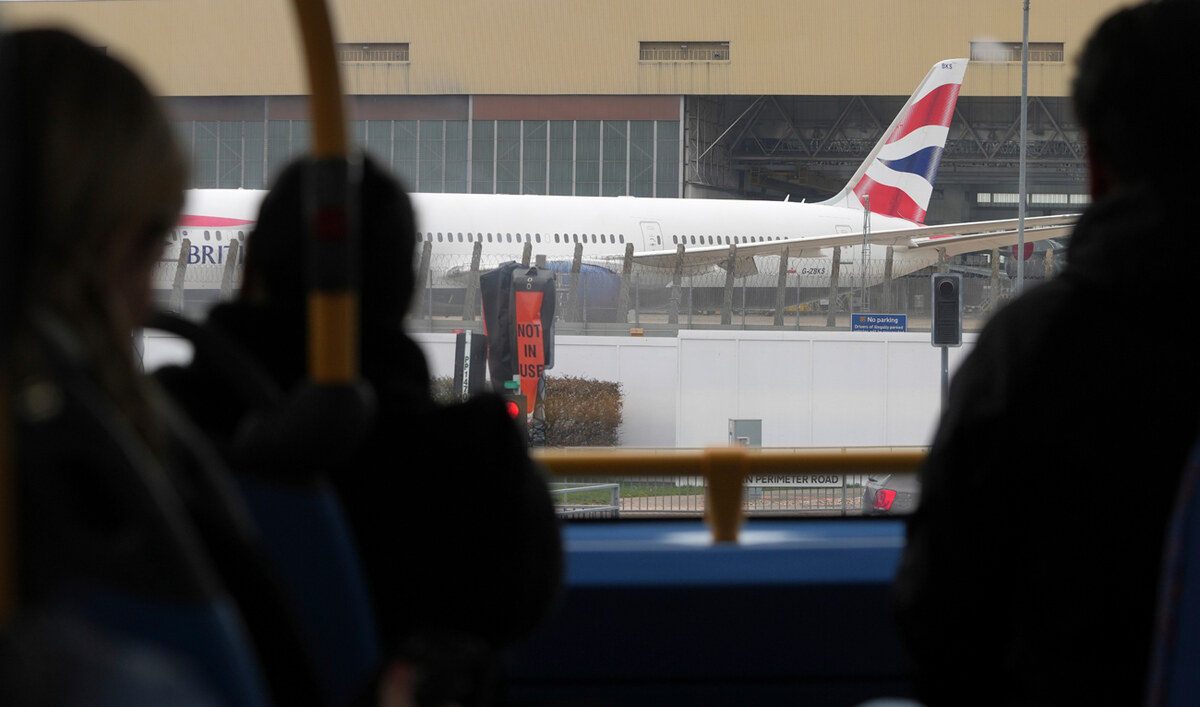


Passengers on a bus look at a parked plane as Britain’s Heathrow Airport has closed for the full day Friday after an electrical substation fire knocked out its power, disrupting flights for hundreds of thousands of passengers at one of Europe’s biggest travel hubs in London, Britain on March 21, 2025. (AP)

The 75-year-old said he was anxious to return to Boston to see his daughter, who had traveled from New York to visit him.
“All the lines are busy, so I might be here another day. Not the worst thing in the world. (London) is my favorite city, but I need to be home,” 75-year-old John Moriarty said.
Travel experts said the disruption would extend far beyond Heathrow, and global flight schedules will be affected more broadly, as many aircraft will now be out of position.
Mahmoud Ali, 40, an employee of Domino’s Pizza in London, had been due to fly to his native Pakistan to be with his wife and children, who he has not seen since last summer.
“They are waiting for me. I’m trying to call the airline and Heathrow (to find out) what time the situation will be resolved,” he said.
The fire has also forced the rerouting of incoming flights, leaving passengers unsure of where they will land.
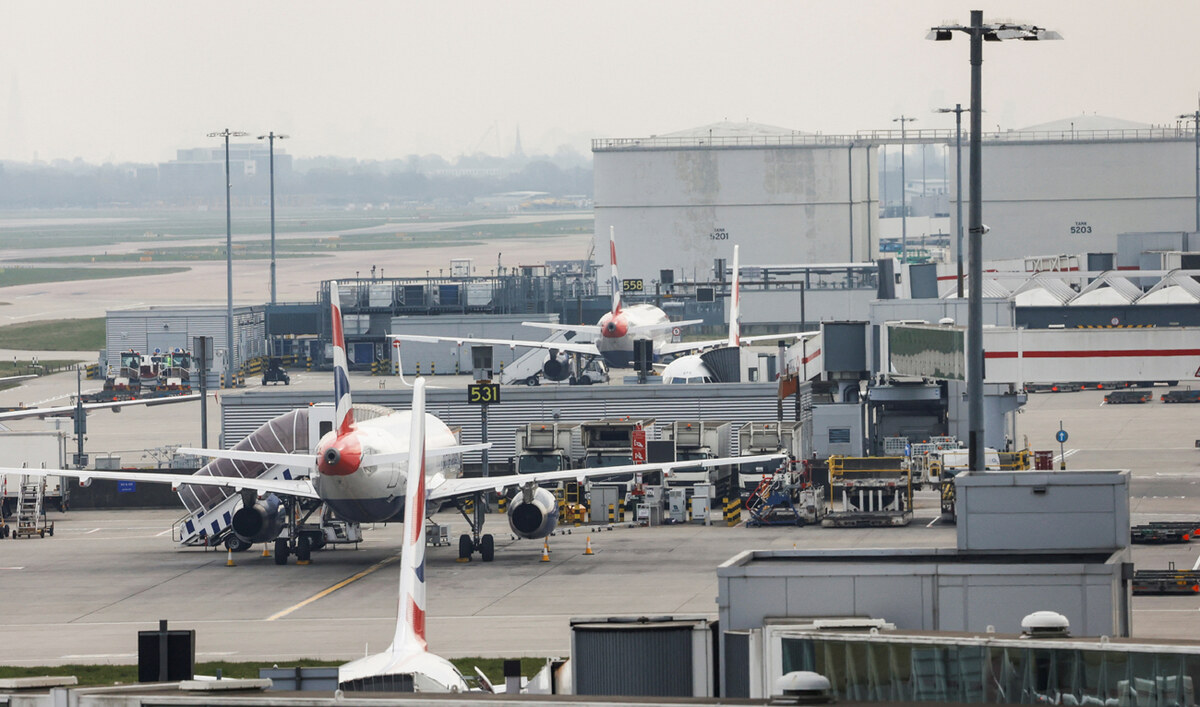


Airplanes remain parked on the tarmac at Heathrow International Airport after a fire at a nearby electrical substation wiped out the power at the airport, near London, Britain on March 21, 2025. (REUTERS)

Some flights from the United States were turning around mid-air and returning to their point of departure.
Adrian Spender, who works at British retailer Tesco, said in a post on X that he was on an Airbus A380 that had been headed for Heathrow.
“#Heathrow no idea where we are going yet. Currently over Austria,” he wrote.


What Bangladesh’s election means for India, China and Pakistan ties

Bangladesh Nationalist Party supporters gather for a rally ahead of the upcoming national election, in Sylhet on Jan. 22, 2026.
Updated 8 sec ago
Follow

What Bangladesh’s election means for India, China and Pakistan ties

  • Bangladeshis will vote on Feb. 12, almost two years after the 2024 student-led uprising
  • After nearly 2 years of tensions, experts expect a thaw with India under elected government

DHAKA: As Bangladesh prepares to hold its first elections since the 2024 ouster of Sheikh Hasina, its longest-serving prime minister, the outcome will define Dhaka’s relations with the most important regional powers — China, India, and Pakistan.

Nearly 128 million Bangladeshis will head to the polls on Feb. 12 to bring in new leadership after an 18-month rule of the current caretaker administration.

The interim government, led by Nobel laureate Muhammad Yunus, took control following a student-led uprising that ended 15 years in power of Hasina and her Awami League party.

The two main parties out of the 51 competing for power are the Bangladesh Nationalist Party and Jamaat-e-Islami. The Awami League, which for decades has had close ties with India, was excluded from the election ballot over its role in the deadly crackdown on the 2024 student-led protests, in which 1,400 people were killed.

While Bangladesh’s relationship India has deteriorated since the fall of Hasina, who has been in self-exile in New Delhi, the period of diplomatic strain is expected to ease when the new government takes office.

“Whoever comes to power in Bangladesh, due to domestic pressure in the country, relationships with India need a resetting,” Humayun Kabir, former ambassador to the US, told Arab News.

“It’s anticipated that India will also engage with the new government, but they will protect their interests, and we also have to do the same. It’s most likely that the India-Bangladesh relationship will be normalized under the new, elected, government.”

Since 2024, India has suspended key transshipment access that allowed Bangladeshi exports to go via Indian ports and airports. It also put on hold most normal visa services for Bangladeshis, who were among its largest groups of medical tourists.

From Hasina’s heavy pro-India orientation, the interim government has tried to rebalance Bangladesh’s foreign policy toward the two other key regional players — China and Pakistan — who at the same time are India’s main rivals. 

If New Delhi regains its importance, it should not deal a blow to the newly expanded relations with Pakistan, with whom Bangladesh has recently increased exchanges, especially economic, and last month resumed direct flights — after a 14-year gap.

Since the relations have been expanded under the caretaker government, Prof. Delwar Hossain from the International Relations Department at Dhaka University forecast that they would only further improve, no matter who comes to power, and there is no likelihood of a sudden change.

“For Pakistan, any political coalition — whether BNP or Jamaat — will be positive. The BNP has a long history of having good relations with Pakistan during their rule ... Jamaat also has a strong and very positive influence in Pakistan,” he said.

“For Pakistan, the new regime or new government is not the issue. The issue is what the (India) policy of the new government would be and to what extent it would actually support Pakistan’s view.”

Both the BNP and Jamaat have repeatedly said they wanted friendly relations with India, and Hossain expected that they would, at the same time, continue the balanced approach introduced by the caretaker administration.

“India is a reality as a neighbor. At the same time, India is also showing interest in mending relations or adopting a more cooperative approach after the vote, with the government that will be elected ... I think there will be pragmatism from both sides,” he said.

“I don’t see there is a long-term threat to Bangladesh-India relations ... When China and Pakistan were trying to create a trilateral cooperative system or some kind of coalition — China, Bangladesh and Pakistan — we have seen that Bangladesh opted out. It seems that Bangladesh is going to continue its policy of maintaining a balance among these great powers.”

Bangladesh’s relations with China have not changed since the ouster of Hasina, whose government signed several economic agreements with Beijing. Yunus’s administration has continued this cooperation, and China was among the very few countries he officially visited during his term.

During the visit, he secured about $2.1 billion in Chinese investments, loans and grants, including funding for infrastructure like Mongla Port and a special economic zone in Chattogram — Bangladesh’s largest port. China has also eased visa rules for Bangladeshi businesspeople, medical travelers and tourists.

According to Munshi Faiz Ahmed, Bangladesh’s former ambassador to Beijing, China’s importance for Bangladesh cannot be substituted by any other country, especially as over the past few years it has emerged not only as its key investor, but also the largest trade partner.

In the fiscal year 2024-25, Bangladesh’s trade with China was over $21.3 billion, according to National Board of Revenue data. With India, it was about $11.5 billion.

The trade — especially import — dependence on Beijing started long before the regime change. In terms of trade volume, China overtook India already in 2018.

“Even when people thought that we had very close relations with India, our relations with China continued to grow in terms of trade and commerce ... Our trade with China has surpassed India’s, and China is a much bigger investor in Bangladesh’s development projects,” Ahmed said.

“Bangladesh will continue to cooperate with China for a long time to come because what China can provide, no other country can.”