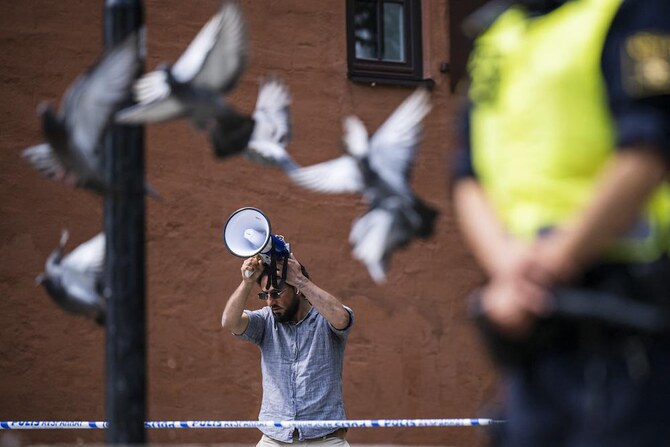
STOCKHOLM: Five men arrested in Sweden over the killing of Salwan Momika, who repeatedly burned copies of the Qur’an in 2023, have been dismissed as suspects, a prosecutor said on Friday.
Momika, a 38-year-old Iraqi Christian whose actions sparked outrage in several Muslim countries, was shot on January 29 in an apartment in Sodertalje, south of Stockholm. He died soon after in hospital.
Momika was killed just hours before a Stockholm court was due to rule whether he and co-defendant Salwan Najem were guilty of inciting ethnic hatred.
According to daily Aftonbladet, police had placed Momika in a secret location ahead of the verdict for his protection and he was streaming an address live on TikTok when intruders burst in.
Five men were arrested just hours after the shooting but were all released two days later.
They were formally dismissed as suspects on Friday.
“We have a fairly good idea of how events unfolded but no-one is currently in custody or a formal suspect,” prosecutor Rasmus Oman said.
“We are working broadly and I can’t go into which leads we are following,” he added.
After Momika’s murder, the Stockholm court postponed its ruling for several days.
It ultimately convicted 50-year-old Najem, also of Iraqi origin, of inciting ethnic hatred during four Qur’an burnings in 2023.
No ruling was pronounced for Momika.
Relations between Sweden and several Middle Eastern countries were strained by the pair’s actions.
Iraqi protesters stormed the Swedish embassy in Baghdad twice in July 2023, starting fires within the compound on the second occasion.
In August 2023, Sweden’s intelligence service Sapo raised its threat level to four on a scale of one to five, saying the Qur’an burnings had made the country a “prioritized target.”
Deputy Prime Minister Ebba Busch called Momika’s murder “a threat to our free democracy,” while Prime Minister Ulf Kristersson said there was “a risk that there is also a link to a foreign power.”


![]()

Five suspects dismissed over Qur’an burner’s murder in Sweden
Short Url
https://arab.news/v3e4h
Five suspects dismissed over Qur’an burner’s murder in Sweden
- Salwan Momika was shot on January 29 in an apartment in Sodertalje, south of Stockholm
- Five men were arrested just hours after the shooting but were all released two days later


Latest updates


© 2026 SAUDI RESEARCH & PUBLISHING COMPANY, All Rights Reserved And subject to Terms of Use Agreement.