BRUSSELS: Russian President Vladimir Putin’s key peace demand that Western allies stop providing military aid and intelligence to Ukraine is quietly being ignored by the European Union.
As US-led talks with Russia and Ukraine progress, without the Europeans at the table, the 27-nation bloc is pressing ahead with a steel “porcupine strategy” aimed at building the Ukrainian armed forces, and the country’s defense industry, into an even more formidable opponent.
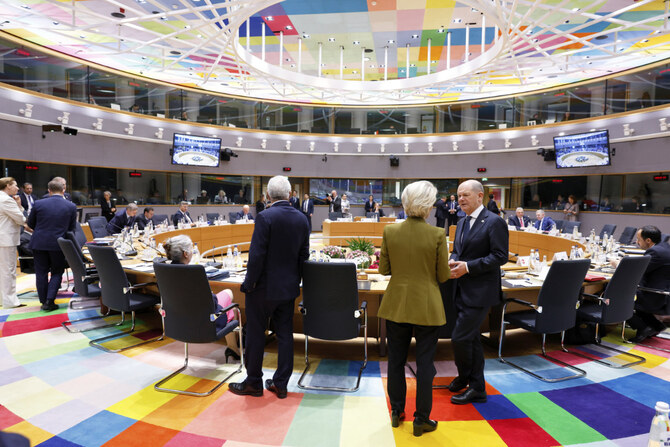
At an EU summit on Thursday, German Chancellor Olaf Scholz said that it’s “central” that Ukraine should remain an independent democratic nation that can continue its journey toward EU membership and “that it also has a strong army of its own after a peace agreement.”
“For us, it will be important to continue to support Ukraine significantly — as the European Union as a whole, as allies and friends and as individual countries,” Scholz told reporters in Brussels.
A few hours after he spoke, Scholz’s EU counterparts — with the exception of Hungary, which opposes the bloc’s “peace through strength” stance — called on member countries “to urgently step up efforts to address Ukraine’s pressing military and defense needs.”
Mindful of Russian deception in the past — the “little green men ” who annexed the Crimean Peninsula in 2014, or the troop buildup in 2021 that Moscow denied would lead to any invasion — the Europeans are deeply skeptical about Putin’s intentions and whether he would accept any peace terms.
With the UK and other partners, some European countries are working on a deterrence force to police any future peace. At the same time, Ukraine’s best security guarantee, apart from the NATO membership that the US refuses, is that its own army is strong and well supplied.
In a defense blueprint unveiled on Wednesday, the European Commission set out how it plans to meet Ukraine’s security needs, with EU money available to help bolster its defense industry, which produces arms and ammunition more cheaply and closer to the battlefield.
“Ukraine is currently the front line of European defense, resisting a war of aggression driven by the single greatest threat to our common security,” the document says. “The outcome of that war will be a determinative factor in our collective future for decades ahead.”
At the heart of the EU’s strategy is a commitment to provide air defense systems and missiles — including long-range precision warheads. In groups, countries would jointly purchase the equipment and financially back Ukraine’s own effort to obtain them.
Drones are a major advantage on the battlefield, and the EU intends to back Ukraine’s procurement of them and help it build its own production capacity, including through joint ventures between European and Ukrainian industries.
Another aim is to provide at least 2 million rounds of large-caliber artillery shells each year, and to continue a training effort that has helped to prepare more than 75,000 Ukrainian troops so far. In return, European troops will learn from Ukraine’s front-line experience.
Ukraine would also be able to take part in the EU’s space program, with access to the services provided by national governments in the area of global positioning, navigation, surveillance and communications.
Financially, and beyond the estimated 138 billion euros ($150 billion) already provided to Ukraine, the government in Kyiv would be able to secure cheap loans for defense purposes — as can EU countries and Norway — from a new fund worth 150 billion euros ($162 billion).


![]()

EU presses on with steel ‘porcupine strategy’ for Ukraine as Russia tries to end Western support
Short Url
https://arab.news/vuzmz
EU presses on with steel ‘porcupine strategy’ for Ukraine as Russia tries to end Western support
- The 27-nation bloc aims to build the Ukrainian armed forces and defense industry into an even more formidable opponent
- With the UK and other partners, some European countries are also working on a deterrence force to police any future peace


Latest updates


© 2026 SAUDI RESEARCH & PUBLISHING COMPANY, All Rights Reserved And subject to Terms of Use Agreement.