Trump says US will sign Ukraine minerals deal soon

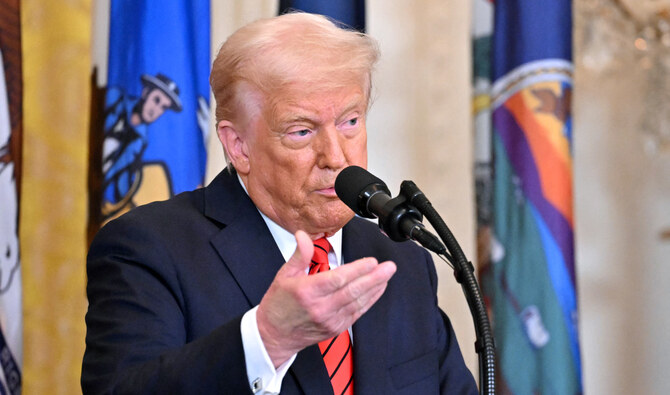
President Donald Trump said on Thursday the United States will sign a minerals and natural resources deal with Ukraine shortly. (AFP)
Short Url
Updated 21 March 2025
Follow

Trump says US will sign Ukraine minerals deal soon

  • Trump says peace talks going ‘pretty well’
  • Ukraine minerals deal seen as repayment for US aid

WASHINGTON: President Donald Trump said on Thursday the United States will sign a minerals and natural resources deal with Ukraine shortly and that his efforts to achieve a peace deal for the country were going “pretty well” after his talks this week with the Russian and Ukrainian leaders.
Trump made the comments at a White House event after signing an order to increase US production of critical minerals.
“We’re doing very well with regard to Ukraine and Russia. And one of the things we are doing is signing a deal very shortly with respect to rare earths with Ukraine.”
Trump referred to his separate discussions this week with Russian President Vladimir Putin and Ukrainian President Volodymyr Zelensky aimed at ending Russia’s war in Ukraine.
Those talks, which fell short of Trump’s aim to secure a full 30-day ceasefire, resulted in Putin agreeing to stop Russian attacks on energy infrastructure for 30 days and Zelensky saying he would also accept such a pause.
“We would love to see that (war) come to an end, and I think we’re doing pretty well in that regard,” Trump said.
“So hopefully we’d save thousands of people a week from dying. That’s what it’s all about. They’re dying so unnecessarily, and I believe we’ll get it done.”
Ukraine and the US said this month they had agreed to conclude as soon as possible a comprehensive agreement for developing Ukraine’s critical mineral resources, which Trump sees as a means to pay back the United States for its assistance to Kyiv. Efforts to seal the deal stumbled after a disastrous White House meeting between Trump and Zelensky at the end of last month.
Trump and Zelensky agreed on Wednesday to work together to end Russia’s war with Ukraine, in what the White House described as a “fantastic” one-hour phone call, their first conversation since their Oval Office shouting match that resulted in a short-term cutoff in US military aid and intelligence to Kyiv.
It was unclear if the deal has changed. An earlier version did not include the explicit security guarantees Ukraine has sought, but gave the US access to revenues from Ukraine’s natural resources.
It also envisaged the Ukrainian government contributing 50 percent of monetized amounts for state-owned natural resources to a US-Ukraine managed reconstruction investment fund.
Asked how the current version of the minerals deal differs from the earlier draft, a senior US official said it was “more detailed and comprehensive,” declining to elaborate.
Ukraine’s embassy in Washington did not immediately respond to a request for comment. In Brussels on Thursday, European Union leaders said they would continue to support Ukraine, but did not immediately endorse a call by Zelensky to approve a package of at least 5 billion euros for artillery purchases.


Bangladesh’s Tarique Rahman poised to be PM as Jamaat-e-Islami concedes election

Updated 8 sec ago
Follow

Bangladesh’s Tarique Rahman poised to be PM as Jamaat-e-Islami concedes election

  • Election Commission figures showed Bangladesh Nationalist Party won a landslide victory in Thursday’s polls
  • Jamaat-e-Islami chief Shafiqur Rahman says ‘we recognize the overall outcome, and we respect the rule of law’

Dhaka: Bangladesh’s largest religious party conceded defeat in elections on Saturday, despite earlier alleging problems with the vote count, clearing the way for nationalist leader Tarique Rahman to become prime minister.

Election Commission figures showed Rahman’s Bangladesh Nationalist Party (BNP) had won a landslide victory in the elections on Thursday, the first since a deadly 2024 uprising ousted the iron-fisted rule of Sheikh Hasina.

The success of BNP chief Rahman, 60, marks a remarkable turnaround for a man who only returned to Bangladesh in December after 17 years in exile in Britain, far from Dhaka’s political storms.

Rahman, the scion of one of Bangladesh’s most powerful political dynasties, is expected to make a victory speech later on Saturday.

His father, president Ziaur Rahman, was assassinated in 1981, while his mother, Khaleda Zia, served three terms as prime minister and dominated national politics for decades.

Nobel laureate Muhammad Yunus, who has led the country of 170 million as interim leader since the uprising, said Rahman “would help guide the country toward stability, inclusiveness, and development.”

The BNP alliance won 212 seats compared with 77 for the Jamaat-e-Islami-led alliance, according to the Electoral Commission.

VERDICT OF THE PEOPLE’

Jamaat-e-Islami chief Shafiqur Rahman, 67, had said on Friday he would “seek redress” from the commission, with his party alleging “inconsistencies and fabrications.”

But a day later, he conceded defeat.

“In any genuine democratic journey, the true test of leadership is not only how we campaign, but how we respond to the verdict of the people,” the Jamaat leader said in a statement.

“We recognize the overall outcome, and we respect the rule of law.”

Hasina’s Awami League party was barred from taking part. Hasina, 78, who was sentenced to death in absentia for crimes against humanity, issued a statement from hiding in India decrying an “illegal and unconstitutional election.”

The US embassy congratulated Rahman and the BNP for a “historic victory,” while neighboring India praised Rahman’s “decisive win,” a notable shift after deeply strained ties.

China and Pakistan, which both grew closer to Bangladesh since the 2024 uprising and the souring of ties with India, where Hasina has sheltered since her ouster, also congratulated the BNP.

International election observers said the polls had been a success, with the European Union saying Saturday they had been “credible.”

The International Republican Institute noted that while “election administration was technically sound, the broader political environment remains fragile.”

SUCCESSFUL’

Jamaat’s Rahman said his party “will serve as a vigilant, principled, and peaceful opposition, holding the government to account.”

Election Commissioner Md Anwarul Islam Sarker told AFP that the vote had been a success.

“It was by far the best election,” he said, noting that voting was canceled at only one of the more than 42,000 polling centers.

“People had doubts about whether a successful election could be held under these circumstances, but we have done it,” he said Saturday. “If anyone still has any issues, they can go to court.”

The Election Commission said turnout was 59 percent across 299 constituencies out of 300 in which voting took place.

Only seven women were elected, although a further 50 seats in parliament reserved for women will be named from party lists.

Shafiqur Rahman stressed the significant gains his Islamist party had made compared with past elections, after years of being crushed under Hasina.

“With 77 seats, we have nearly quadrupled our parliamentary presence and become one of the strongest opposition blocs in modern Bangladeshi politics,” he said. “That is not a setback. That is a foundation.”

Voters on Thursday also endorsed proposals in a referendum for a sweeping democratic reform charter backed by Yunus, to overhaul what he called a “completely broken” system of government and to prevent a return to one-party rule.

Those include prime ministerial term limits, a new upper house of parliament, stronger presidential powers and greater judicial independence.

Crisis Group analyst Thomas Kean warned that the incoming government now faced “daunting challenges,” including “boosting the economy, ensuring security and continuing the reform process.”