

MINA: Hundreds of thousands of pilgrims have returned to Mina after midnight, moving from Muzdalifah to continue the next stage of Hajj ahead of Eid Al-Adha on the 10th day of Dul Hijjah, which falls on May 27.
The movement followed the pilgrims’ stay in Arafat on Tuesday, the most important stage of Hajj, before they were taken by Saudi authorities to Muzdalifah after sunset on the ninth day, where most prefer to spend the night.
The movement of pilgrims from Arafat to Muzdalifah was successful, according to Minister of Hajj and Umrah Tawfiq Al-Rabiah.
• Hajj 2026: Pilgrims perform ritual stoning in Mina
The operation involved extensive crowd management and transport plans, with pilgrims moved according to organized schedules and designated routes to ensure smooth flow and reduce travel time between the holy sites.
Security and traffic authorities reinforced their presence along roads leading to Muzdalifah, deploying field teams, and regulating crowd movement in line with the large numbers of pilgrims leaving Arafat.
The transport system in the holy sites, which includes a fleet of thousands of buses and the Mashaer Metro Line, facilitated movement between the holy sites.

Pilgrims on the way to Muzdalifah late on Tuesday from Arafat. (SPA photo)
The metro line operates through nine stations “under a precise operational system aligned with the Hajj rituals, ensuring the efficient and orderly transport of pilgrims between the holy sites,” the Saudi Railways said in a post on X.
The metro helped streamline the movement of pilgrims between the holy sites, ease traffic congestion, and support crowd management efforts.
Whether aboard buses or the metro, pilgrims were accompanied by guides and health personnel who provided medical assistance, shared essential information, and ensured the guests of Allah remained in good health.
Service agencies used integrated digital systems, surveillance cameras, and 24-hour command and control centers to support crowd management operations and enable real-time monitoring of pilgrim movements, enhancing operational efficiency and ensuring rapid response to field developments.
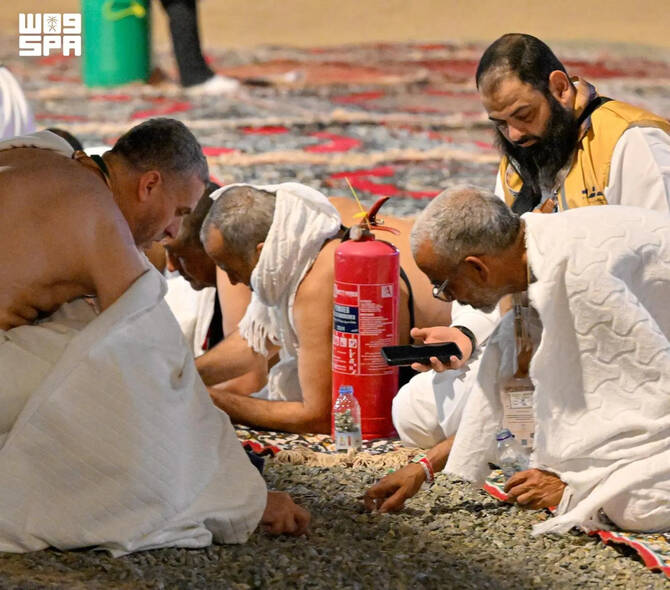
In Muzdalifah, pilgrims collected small pebbles for the stoning ritual at Jamrat al-Aqabah in Mina, also known as Al-Jamrah al-Kubra, before proceeding to the next rites of animal sacrifice, with male pilgrims shaving their heads and exiting ihram.
They later perform Tawaf around the Kaaba in Makkah, followed by Sa’i, the ritual of walking seven times between the hills of Al-Safa and Al-Marwah, as part of the final stages of Hajj.
Pilgrims expressed their joy at performing Hajj and voiced their gratitude to the Saudi government for the services provided.
Speaking to Arab News from Muzdalifah, Mohammed Azam, an Indian pilgrim, said he is glad to have arrived from Arafat and expressed his appreciation to the services provided.
“We are going to pick some pebbles — about 70 of them — and then we will move to Mina after Fajr prayer,” he said.
He added that he previously performed Hajj about 15 years ago, but this year he noticed significant and well-organized improvements.
“The arrangement is very good, starting from the tents with the air conditioning, with the food services, everything is perfect, even the bathrooms are very neat and well maintained,” he said.
“The Saudi government has taken a lot of care. You know they have put carpets here. We never used to have carpets before and I am very happy and may Allah bless them,” he concluded.
Palestinian pilgrim Ezzuddine Idrees said he performed Hajj in 2012, in addition to performing Umrah three times.
“In the past, it used to take 8 to 10 hours by bus to travel from Mount Arafat to Muzdalifah. Now, it only takes five minutes. The case is also the same from here to Mina,” he said.
He said the services were very good and that security personnel provided strong support to pilgrims.
This year’s Hajj has drawn 1,707,301 pilgrims, according to Saudi authorities, up 2.04 percent from 2025.
Of those, 1,546,655 arrived from outside Saudi Arabia, while 160,646 are domestic pilgrims and residents. Most international pilgrims traveled by air.
Saudi officials have attributed the increase to expanded services, digitalized pilgrimage systems and tighter coordination among security, health and logistics agencies.
The Kingdom also expanded its Makkah Route initiative, which allows pilgrims to complete immigration and customs procedures before departure from their home countries. Nearly 389,000 pilgrims used the program this year, up almost 24 percent from last year.
Authorities said more than 441,000 personnel were deployed to support Hajj operations this season, overseeing crowd management, transportation networks, medical care and emergency response as pilgrims move through the final major stages of the pilgrimage.