

‘Walking Guide’ volunteer service introduced for Grand Mosque pilgrims

1 / 3
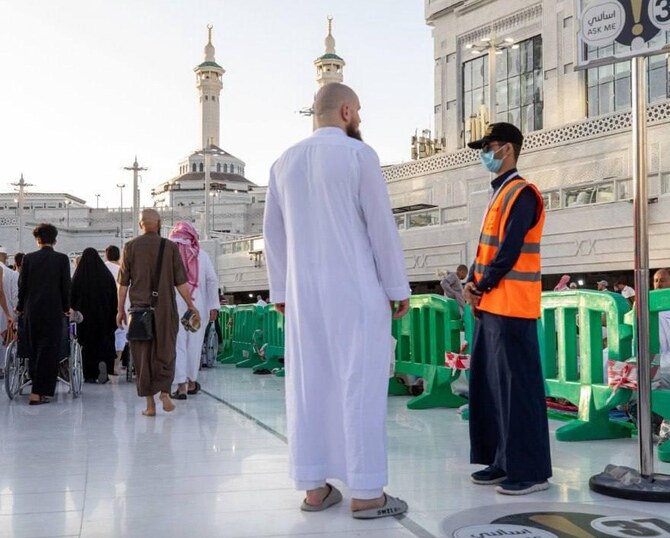
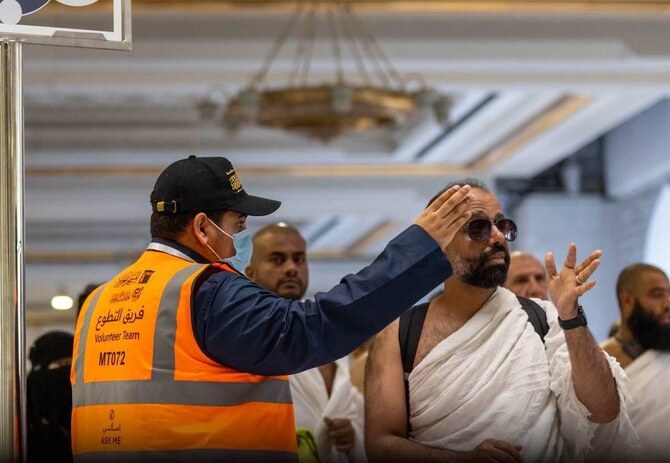
A volunteer guides assists a pilgrim as part of a new program by the General Authority for the Care of the Grand Mosque and the Prophet’s Mosque. (@alharamainSA)
2 / 3
A volunteer guides assists a pilgrim as part of a new program by the General Authority for the Care of the Grand Mosque and the Prophet’s Mosque. (@alharamainSA)
3 / 3
A volunteer guides assists a pilgrim as part of a new program by the General Authority for the Care of the Grand Mosque and the Prophet’s Mosque. (@alharamainSA)
Short Url
Updated 21 March 2025
Follow

‘Walking Guide’ volunteer service introduced for Grand Mosque pilgrims

  • Service provides assistance to those with mobility difficulties
  • Guides facilitate movement throughout the mosque complex

MAKKAH: A new volunteer assistance service has been introduced at Saudi Arabia’s two holy mosques to aid pilgrims, particularly the elderly and disabled.

The General Presidency for the Affairs of the Two Holy Mosques announced the program as part of broader efforts to improve the pilgrimage experience.

Speaking to Arab News, the initiative’s director, Bassem Wahbo, explained that guides are identifiable through prominent signage and floor markers that pinpoint their locations.

“This system creates effective connections between locations and nearby services, representing a critical advancement in our visitor assistance capabilities, supporting the initiative’s goals of providing effective and direct assistance to (visitors),” Wahbo said.

“We provide precise guidance to ensure all visitors enjoy a comfortable and smooth experience, with special focus on elderly and disabled pilgrims by directing them to dedicated pathways and services that facilitate easy access to their destinations,” he added.

The initiative serves multiple purposes, mainly facilitating movement throughout the mosque complex, providing assistance to worshippers navigating to prayer areas and services, supporting vulnerable visitors to ensure their comfort during religious rituals, and directing people to optimal routes and available amenities.

The authority emphasized its ongoing commitment to supporting elderly and disabled visitors through specialized guidance services to help them reach their destinations with ease.

Hajj and Umrah specialist Saad Al-Sharif praised the initiative as “exceptional,” noting its comprehensive approach to visitor assistance.

“The guides provide crucial field direction to circumambulation areas, Sa’i, prayer halls, entrances, exits, and service locations. They reunite lost individuals — particularly children and elderly pilgrims — with their proper destinations and offer multilingual assistance to international visitors,” Al-Sharif explained.

Umrah performer Abdulrahman Faisal highlighted the teams’ importance in emergency response situations.

“They provide immediate assistance to visitors experiencing difficulties such as heat stress or exhaustion and coordinate with relevant authorities when necessary,” he said.

He explained that it is particularly important to guide Umrah performers and tourists toward correct behaviors inside the mosque to preserve the sanctity of the place and maintain orderly movement, which the authorities are working hard to achieve.

Faisal noted that guides operate within a mobile system, patrolling the mosque complex with identification badges and communication devices.

They are strategically positioned at key locations including entrances, the Tawaf area, the Sa’i walkway, and main gates.

“Their use of smart applications and digital mapping technology to deliver accurate, instant information is particularly impressive,” he added.

The service has already reportedly reduced instances of disorientation among visitors while improving the ritual experience and enhancing overall organization.


Foreign ministers chair Saudi-Omani coordination council meeting in Muscat

Updated 23 December 2025
Follow

Foreign ministers chair Saudi-Omani coordination council meeting in Muscat

MUSCAT: Saudi Foreign Minister Prince Faisal bin Farhan met with Oman’s Foreign Minister Sayyid Badr bin Hamad Al-Busaidi on Monday.

They reviewed bilateral relations between their nations and ways to enhance and develop them across various fields. Additionally, they discussed regional and international developments.

The ministers co-chaired the third meeting of the Saudi-Omani Coordination Council in the Omani capital, Muscat, with the participation of the heads of the Council’s subsidiary committees and the two heads of the Council’s General Secretariat teams.

The meeting comes as an affirmation of the keenness of Saudi and Omani leaders to strengthen ties and advance them toward greater prosperity for both nations.

In his remarks during the meeting, Prince Faisal affirmed that gathering builds on the previous council meeting, held last year in AlUla, and on its positive and fruitful outcomes within the framework of the approved recommendations and initiatives. 

He stressed the importance of continuing the work of the council’s subsidiary committees to complete the necessary procedures to implement the remaining initiatives, and of the General Secretariat’s role in follow-up and in addressing any challenges that may hinder implementation.

He also underscored the importance of developing and enhancing trade relations, stimulating investment, and strengthening cooperation between the public and private sectors.

He also praised the ongoing work to establish and launch the Coordination Council’s electronic platform, which aims to connect all committee work and initiatives to facilitate follow-up on the Council’s progress. 

Al-Busaidi affirmed in his remarks the qualitative progress in relations between the two countries and the notable development witnessed across numerous sectors toward achieving economic integration and enhancing intra-trade and joint investments. 

The Omani foreign minister also highlighted deeper cooperation in the security and judicial fields, as well as the cultural and tourism sectors, noting the advanced and continuous political cooperation, consultation, and coordination on regional and international issues.