REVIEW: Harrowing drama ‘Adolescence’ is already this year’s best TV

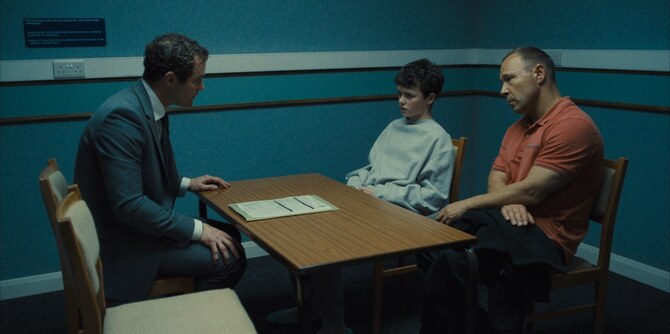
The four-part series tells the story of 13-year-old Jamie Miller, accused of the murder of a schoolmate. (Supplied)
Short Url
Updated 20 March 2025
Follow

REVIEW: Harrowing drama ‘Adolescence’ is already this year’s best TV

  • Netflix show stars Stephen Graham as the father of an accused school kid 

LONDON: It might only be March, but we’ve already been treated to the TV highlight of 2025. And I write this fully aware that shows including “Andor,” “A Knight of the Seven Kingdoms,” “The Bear,” “The Last of Us,” “Stranger Things,” and many more are still to come. None, though, will be better than “Adolescence,” created by actor Stephen Graham and writer Jack Thorne and directed by Philip Barantini. 

The four-part series tells the story of 13-year-old Jamie Miller, accused of the murder of a schoolmate. Each episode is shot in real time, in a single take, and follows a different aspect of the investigation and its fallout. Graham plays Jamie’s father Eddie, with Ashley Walters and Faye Marsay as investigating officers Bascombe and Frank, and Erin Doherty (recently seen opposite Graham in “A Thousand Blows”) as child psychologist Briony Ariston. Jamie is played by Owen Cooper, putting in a debut performance that is as astonishing as it is harrowing.  

“Adolescence” is not a whodunnit — Jamie’s guilt is made plain early. Rather, it’s a whydunnit, which also explores the impact it has on his family and friends. Thorne and Graham don’t hold back, hurling viewers into a world that picks at ideas of toxic masculinity (it’s no surprise Andrew Tate gets a namedrop), bullying, parental pressure, and teenage attitudes to dating. It’s a heady mix of horrifying revelations — about modern teenage pressure, about Jamie’s mindset and temper, about the effect it has on his parents as they try to come to terms with the shocking things their beloved son has done. 

Technically, “Adolescence” is a masterpiece. The balletic production processes that must have been involved are simply staggering, but they suck the audience in and refuse to let them go, demanding we share in every uncomfortable second. And the cast are even better. Cooper is terrifyingly convincing, and Graham is astonishing as a father trying to look with love at a son he no longer recognizes. But, across the board, the performances are staggeringly good. 

 “Adolescence” may be one of the most upsetting shows released this year — at times, it’s excruciating — but it is also a remarkable work of art.  


Nationalist Bollywood hit ‘Dhurandhar’ ignites India-Pakistan controversy

Updated 08 January 2026
Follow

Nationalist Bollywood hit ‘Dhurandhar’ ignites India-Pakistan controversy

  • Movie stars Ranveer Singh as an Indian intelligence agent who infiltrates alleged criminal networks in Karachi
  • Film has drawn sharp criticism from Pakistani officials while becoming one of the year’s biggest hits in India

A Bollywood spy thriller set in Pakistan has sparked heated debate across both countries over its portrayal of cross-border tensions, even as the film breaks box office records in India amid a surge in nationalist cinema.

“Dhurandhar,” starring Ranveer Singh as an Indian intelligence agent infiltrating criminal networks in Pakistan’s Karachi, has drawn sharp criticism from Pakistani officials and some international critics while becoming one of the year’s biggest commercial hits in India.

The 3.5-hour film, directed by Aditya Dhar, weaves real historical events including the 1999 plane hijacking, the 2001 Parliament attack, and the 2008 Mumbai attacks into a fictional narrative about an Indian spy’s mission to dismantle alleged links between Karachi gangs and terror networks.

Released Dec. 5 with minimal publicity, “Dhurandhar” has grossed more than 12.15 billion rupees ($134.76 million) in ticket sales, making it the highest-grossing Bollywood film last year. 

“It is a unique thing. Most films are set in India, but in this film, a RAW agent infiltrates Pakistan and is living there, hiding his identity, and the film portrays all of that through this setup, about Karachi and everything. That’s why it is such a good film. I mean, it is very important to watch this film,” said movie-goer Naresh Kumar.

The film represents a growing trend in Indian cinema toward nationalist blockbusters that align with Prime Minister Narendra Modi’s policies, following controversial hits like “The Kashmir Files” and “The Kerala Story” that sparked debates over historical accuracy while achieving commercial success.

In India, some film critics faced online harassment for negative reviews, prompting the Film Critics Guild to condemn “targeted attacks” against reviewers.

“Films that evoke patriotic fervor among audiences generally do well, but that is not to say that any film with this kind of subject would have done well,” said Bollywood film analyst Komal Nahta. “Everything seems to have gone right with the film.” 

The controversy highlights how cinema continues to reflect decades-old tensions between the nuclear-armed neighbors, who have fought four wars since partition in 1947. Fighting erupted between the countries in May following an attack on tourists in Kashmir that India blamed on Pakistan-backed militants.

In Pakistan’s Lyari neighborhood, which was depicted in the film, residents criticized the portrayal as inaccurate.

“It is a completely baseless movie because our neighboring country doesn’t know anything about our country,” said Mohammad Zohaib, a Lyari resident and burger shop owner. “They don’t know anything about Lyari, so how can they make a completely realistic film about someone?” 

The Pakistan Peoples Party filed legal action in a Karachi court last month over the film’s unauthorized use of assassinated former Prime Minister Benazir Bhutto’s image and its portrayal of party leaders as terrorist sympathizers.

“About 10 percent of what has been shown in the movie is reality, 90 percent is not real,” said Khizer Abdul Wahid, a Lyari resident and beauty salon owner.

Pakistan banned Indian films in 2019, but Bollywood remains popular there with audiences using VPNs or illegal downloads to watch new releases.

Theatre admissions in India have fallen 45 percent since their 2018 peak of 1.58 billion, according to Ernst and Young, as streaming services offer content that complements cheap mobile data available to most Indians.

Even global hits like the latest Avatar film struggled to secure screens due to “Dhurandhar’s” strong showing, analysts said.