HELSINKI: The United States fell to its lowest happiness ranking ever partly due to a rise in the number of Americans eating their meals alone, an annual UN-sponsored report said Thursday.
Finland ranked as the world’s happiest country for the eighth straight year in the World Happiness Report, with locals and experts thanking its grand lakes and strong welfare system for boosting its mood.
Afghanistan, plagued by a humanitarian catastrophe since the Taliban regained control in 2020, once again ranked as the unhappiest country in the world.
The United States fell to 24th place, its lowest score since the report was first published in 2012, when it recorded its highest showing at number 11.
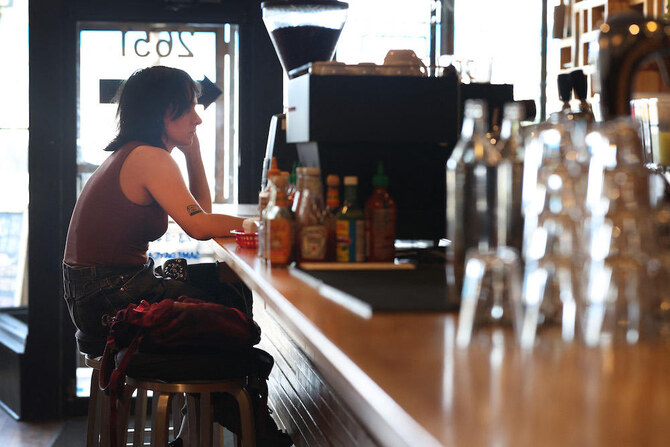
“The number of people dining alone in the United States has increased 53 percent over the past two decades,” the authors said, noting that sharing meals “is strongly linked with well-being.”
In 2023, roughly one in four Americans reported eating all their meals alone the previous day, the report said.
“The increasing number of people who eat alone is one reason for declining well-being in the United States,” it said.
It also noted that the United States was one of few countries to see a rise of so-called “deaths of despair” – from suicide or substance abuse – at a time when those deaths are declining in a majority of countries.
The report surveyed people worldwide in 2022-2024, before US President Donald Trump’s shakeup of national and global affairs since returning to the White House in January.
Nordic countries all stayed among the 10 happiest, with Denmark, Iceland and Sweden trailing Finland, which slightly extended its lead over runner-up Denmark.
Meanwhile, Costa Rica and Mexico entered the top 10 for the first time, at the sixth and 10th spot respectively.
The happiness ranking is based on a three-year average of individuals’ self-assessed evaluations of life satisfaction, as well as GDP per capita, social support, healthy life expectancy, freedom, generosity and corruption.
“It seems that Finnish people are relatively satisfied with their lives,” Frank Martela, an assistant professor specialized in well-being and happiness research at Aalto University, said.
It could largely be explained by Finns living in “quite a well-functioning society,” he said.
“Democracy is functioning well, we have free elections, free speech, low levels of corruption and all of these have shown to predict higher levels of national well-being,” Martela said.
He added that the Nordic countries also all have relatively strong welfare systems – with parental leave, unemployment benefits and mostly universal health care – which also contribute to higher levels of well-being on average.
Eveliina Ylitolonen, a 23-year-old student in Helsinki, said she believed that Finns’ focus on enjoying beautiful nature could help explain the consistently high level of happiness in the Nordic country, known for its deep forests and over 160,000 lakes.
“Nature is an important part of this happiness,” Ylitolonen said.
Jamie Sarja-Lambert, a professional video gamer who moved to Finland from the United Kingdom, agreed.
“Seems like everyone is a lot more in touch with nature, going outside and socializing, more of a community,” he said.
This year, the authors of the happiness report said new evidence indicates that engaging in acts of generosity and believing in the kindness of others are “significant predictors of happiness, even more so than earning a higher salary.”
They also noted that in general “people are too pessimistic about the kindness of their communities,” and that “the return rate of lost wallets is much higher than people expect.”
Nordic countries also “rank among the top places for expected and actual return of lost wallets.”

US happiness sinks as more Americans eat alone: survey
https://arab.news/p5nbq
US happiness sinks as more Americans eat alone: survey
- Finland ranked as the world’s happiest country for the eighth straight year in the World Happiness Report
- The United States fell to 24th place, its lowest score since the report was first published in 2012
As an uncertain 2026 begins, virtual journeys back to 2016 become a trend
- Over the past few weeks, millions have been sharing throwback photos to that time on social media, kicking off one of the first viral trends of the year
LONDON: The year is 2016. Somehow it feels carefree, driven by Internet culture. Everyone is wearing over-the-top makeup.
At least, that’s how Maren Nævdal, 27, remembers it — and has seen it on her social feeds in recent days.
For Njeri Allen, also 27, the year was defined by the artists topping the charts that year, from Beyonce to Drake to Rihanna’s last music releases. She also remembers the Snapchat stories and an unforgettable summer with her loved ones. “Everything felt new, different, interesting and fun,” Allen says.
Many people, particularly those in their 20s and 30s, are thinking about 2016 these days. Over the past few weeks, millions have been sharing throwback photos to that time on social media, kicking off one of the first viral trends of the year — the year 2026, that is.
With it have come the memes about how various factors — the sepia hues over Instagram photos, the dog filters on Snapchat and the music — made even 2016’s worst day feel like the best of times.
Part of the look-back trend’s popularity has come from the realization that 2016 was already a decade ago – a time when Nævdal says she felt like people were doing “fun, unserious things” before having to grow up.
But experts point to 2016 as a year when the world was on the edge of the social, political and technological developments that make up our lives today. Those same advances — such as developments under US President Donald Trump and the rise of AI — have increased a yearning for even the recent past, and made it easier to get there.
2016 marked a year of transition
Nostalgia is often driven by a generation coming of age — and its members realizing they miss what childhood and adolescence felt like. That’s certainly true here. But some of those indulging in the online journeys through time say something more is at play as well.
It has to do with the state of the world — then and now.
By the end of 2016, people would be looking ahead to moments like Trump’s first presidential term and repercussions of the United Kingdom leaving the EU after the Brexit referendum. A few years after that, the COVID-19 pandemic would send most of the world into lockdown and upend life for nearly two years.
Janelle Wilson, a professor of sociology at the University of Minnesota-Duluth, says the world was “on the cusp of things, but not fully thrown into the dark days that were to come.”
“The nostalgia being expressed now, for 2016, is due in large part to what has transpired since then,” she says, also referencing the rise of populism and increased polarization. “For there to be nostalgia for 2016 in the present,” she added, “I still think those kinds of transitions are significant.”
For Nævdal, 2016 “was before a lot of the things we’re dealing with now.” She loved seeing “how embarrassing everyone was, not just me,” in the photos people have shared.
“It felt more authentic in some ways,” she says. Today, Nævdal says, “the world is going downhill.”
Nina van Volkinburg, a professor of strategic fashion marketing at University of the Arts, London, says 2016 marked the beginning of “a new world order” and of “fractured trust in institutions and the establishment.” She says it also represented a time of possibility — and, on social media, “the maximalism of it all.”
This was represented in the bohemian fashion popularized in Coachella that year, the “cut crease” makeup Nævdal loved and the dance music Allen remembers.
“People were new to platforms and online trends, so were having fun with their identity,” van Volkinburg says. “There was authenticity around that.”
And 2016 was also the year of the “boss babe” and the popularity of millennial pink, van Volkinburg says, indications of young people coming into adulthood in a year that felt hopeful.
Allen remembers that as the summer she and her friends came of age as high school graduates. She says they all knew then that they would remember 2016 forever.
Ten years on, having moved again to Taiwan, she said “unprecedented things are happening” in the world. “Both of my homes are not safe,” she said of the US and Taiwan, “it’s easier to go back to a time that’s more comfortable and that you felt safe in.”
Feelings of nostalgia are speeding up
In the last few days, Nævdal decided to hide the social media apps on her phone. AI was a big part of that decision. “It freaks me out that you can’t tell what’s real anymore,” she said.
“When I’ve come off of social media, I feel that at least now I know the things I’m seeing are real,” she added, “which is quite terrifying.”
The revival of vinyl record collections, letter writing and a fresh focus on the aesthetics of yesterday point to nostalgia continuing to dominate trends and culture. Wilson says the feeling has increased as technology makes nostalgia more accessible.
“We can so readily access the past or, at least, versions of it,” she said. “We’re to the point where we can say, ‘Remember last week when we were doing XYZ? That was such a good time!’”
Both Nævdal and Allen described themselves as nostalgic people. Nævdal said she enjoys looking back to old photos – especially when they show up as “On This Day” updates on her phone, She sends them to friends and family when their photos come up.
Allen wished that she documented more of her 2016 and younger years overall, to reflect on how much she has evolved and experienced since.
“I didn’t know what life could be,” she said of that time. “I would love to be able to capture my thought process and my feelings, just to know how much I have grown.”


