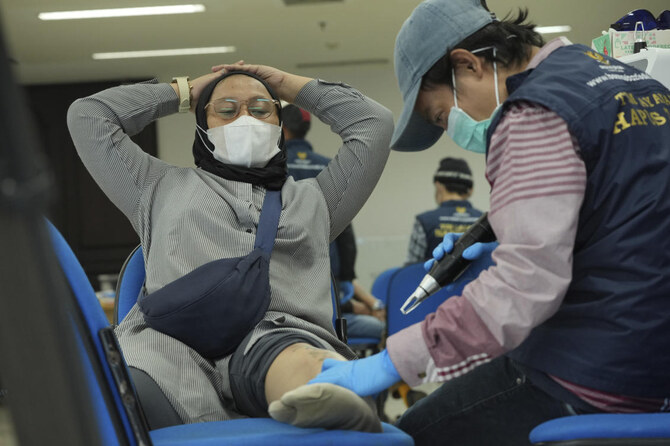
JAKARTA, Indonesia: Teguh Islean Septura groans in pain as each staccato rat-a-tat-tat of the laser fires an intense beam at the elaborate tattoos on his arm. But the former musician’s determination to “repent” in the holy month of Ramadan is enough to keep him going.
The 30-year-old guitarist got his back, arms and legs tattooed to “look cool” when he was performing in a band. But these days Septura has a newfound zeal for Islam, including the conviction that Muslims should not alter the body that God gave them.
“As humans, sometimes we make mistakes. Now I want to improve myself by moving closer to God,” Seputra said, as a health worker aimed the white laser wand at Septura’s skin, blasting the red, green and black pigments with its penetrating light. “God gave me clean skin and I ruined it, that’s what I regret now.”
Septura is among a growing number of people in Indonesia’s capital who have signed up for free tattoo removal services offered by Amil Zakat National Agency, an Islamic charity organization, during Ramadan to give practicing Muslims an opportunity to “repent.”
Launched in 2019, the tattoo removal program is now held every Ramadan, a month of fasting, increased worship, religious reflection and good deeds. Some 700 people have signed up for the services this year, and in total nearly 3,000 people have taken part.
“We want to pave the way for people who want to hijrah (to move closer to God), including those who want to remove their tattoos” said Mohammad Asep Wahyudi, a coordinator of the event. He added that many people cannot afford to remove their tattoos or know where and how they can do so safely.
Laser removal, which takes repeated treatment and may not be completely successful, could cost thousands of dollars for tattoos as extensive as Septura’s.
Tattooing remains strongly associated with gangs and criminality in some Asian cultures. In addition to the religious prohibitions in Muslim-majority Indonesia, ideas about tattoos also reveal oppressive attitudes toward women, who if tattooed can be labeled as promiscuous or disreputable and not worth marrying.
Sri Indrayati, 52, said she tattooed the name of her first daughter on her hand shortly after she gave birth to her at the age of 22. She said she regretted it when her two grandchildren kept asking her to erase it because it looked like dirty, thick marker writing.
“When I take my grandson to school, (the children) whisper to each other: ‘look at that grandma, she has a tattoo!” she said.
Another woman, Evalia Zadora, got a tattoo of a large star on her back and the words “Hope, Love and Rock & Roll” on her upper chest as a teen to gain acceptance into a gang. She wants to remove them now to move closer to God and out of consideration for her family.
“Bad image (against people with tattoos) is not a big deal for me, but it affected my husband and son,” said Zadora, 36. “They are not comfortable with my tattoos and I respect their feelings, so I want to remove it.


![]()

Muslims with tattoo regrets flock to free removal service during Ramadan
Short Url
https://arab.news/rjs4q
Muslims with tattoo regrets flock to free removal service during Ramadan
- A growing number of people in Indonesia’s capital have signed up for free tattoo removal services offered by Amil Zakat National Agency
- Launched in 2019, the tattoo removal program is now held every Ramadan, a month of fasting, increased worship, religious reflection and good deeds


UK minister warns Iran crisis could last months
LONDON, March 5 : British foreign office minister Hamish Falconer said on Thursday there were indications the Iranian crisis could run into weeks or possibly months.
“The situation is evolving, but there are indications that this is a crisis, not of days, but of weeks and possibly months,” Falconer told parliament.
“The situation is evolving, but there are indications that this is a crisis, not of days, but of weeks and possibly months,” Falconer told parliament.
Latest updates


© 2026 SAUDI RESEARCH & PUBLISHING COMPANY, All Rights Reserved And subject to Terms of Use Agreement.