

Pakistan monitoring energy supplies as Iran war raises economic risks — finance minister

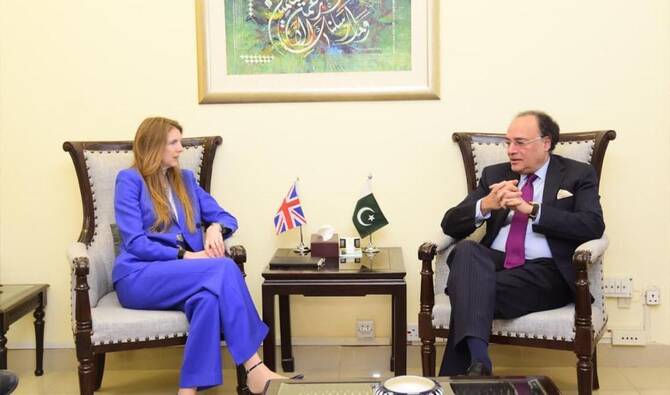
Pakistan Finance Minister Muhammad Aurangzeb in a meeting with Jane Marriott, British High Commissioner to Pakistan, at the Finance Division in Islamabad on March 5, 2026. (Finance Minister)
Short Url
Updated 05 March 2026
Follow

Pakistan monitoring energy supplies as Iran war raises economic risks — finance minister

  • Aurangzeb tells the top British diplomat about steps taken by the government to track international markets
  • British high commissioner reaffirms the UK’s support for Pakistan’s economic stabilization, long-term growth

KARACHI: Pakistan is closely monitoring global energy markets and supply chains and has set up a high-level committee to assess the possible economic impact of escalating conflict in the Middle East, Finance Minister Muhammad Aurangzeb told the British High Commissioner on Thursday.

The interaction comes as Pakistan’s fragile economic recovery faces new uncertainty from the widening war involving Iran, which has raised fears of disruptions to global energy supplies and trade routes critical for the country’s import-dependent economy.

Pakistan has only recently stabilized its finances after years of economic turmoil marked by high inflation, dwindling foreign exchange reserves and a balance-of-payments crisis.

Tensions surged after the United States and Israel launched airstrikes on Iran amid negotiations over Tehran’s nuclear program, triggering retaliation against US military installations in the Gulf and raising concerns about broader regional escalation.

“Prime Minister has constituted a high-level committee comprising key federal ministries and the State Bank of Pakistan to closely monitor developments and undertake daily stock-taking of critical sectors, particularly energy supplies and global commodity markets,” the finance minister told the top British diplomat, according to a statement by the finance division.

“The committee is reviewing supply chains, price movements, and potential disruptions in petroleum products, crude oil, coal, and gas, while also assessing broader implications for inflation, external accounts, and financial stability,” he added.

Aurangzeb said Pakistan currently maintains adequate reserves and supply arrangements but the government is conducting scenario planning and sensitivity analysis should the regional conflict persist.

He also briefed the British high commissioner on Pakistan’s economic reform agenda and progress under its International Monetary Fund program, including measures aimed at broadening the tax base, improving compliance and strengthening governance.

Marriott welcomed Pakistan’s reform efforts and reaffirmed the United Kingdom’s support for the country’s economic stabilization and long-term growth, according to the statement.

Both sides also discussed the importance of maintaining investor confidence and promoting investment in sectors such as mining and minerals development while strengthening economic cooperation between the two countries.



Government says Pakistan preparing Cyber Security Act as digital expansion raises risks

Updated 10 sec ago
Follow

Government says Pakistan preparing Cyber Security Act as digital expansion raises risks

  • The proposed legislation will create Cyber Security Authority to oversee the country's cyber defenses
  • IT minister warns misuse of genetic and digital data could enable targeted cyber and biological threats

ISLAMABAD: Pakistan is preparing a Cyber Security Act and a dedicated regulatory authority to strengthen defenses against rising digital threats as the country rapidly digitizes government services and economic systems, IT Minister Shaza Fatima said while addressing a ceremony in the federal capital on Wednesday.

The planned legislation is part of Islamabad’s broader “Digital Nation Pakistan” initiative, which aims to expand e-governance, a cashless economy and online public services while safeguarding national cyber infrastructure.

“The more we move toward digitization, with the kind of opportunities that are opening up for us, it is also bringing an equal, or even greater, set of challenges,” the minister said. “This does not mean that we stop digitization. It means that we must make our cybersecurity systems robust.”

She said Pakistan had already activated its National Computer Emergency Response Team (CERT) and provincial CERTs to detect and respond to cyber incidents, while a multi-agency digital monitoring framework known as the National Threat Intelligence System (NTIS) operates around the clock.

“We have a Cyber Security Act coming up, under which a Cyber Security Authority will be established.”

The minister said cybersecurity was not a “generic” concept and required multiple technical specializations as well as comprehensive monitoring and regulation. She warned that the rapid expansion of data-driven technologies was creating new risks even as it opened opportunities in areas such as health and biotechnology.

Referring to advances in genomics and precision medicine, she said the same technologies that help treat diseases could also pose security risks if sensitive biological data were misused. She warned that access to large-scale genetic data could potentially allow hostile actors to develop targeted viruses or other biological threats against populations.

The minister also highlighted Pakistan’s cyber defense capabilities, saying government and military systems remained secure during last year's war with India despite sustained cyber warfare attempts.

She said multiple institutions, including the IT ministry, the National Telecommunication Corporation (NTC), national cybersecurity teams and the armed forces’ cyber command structures, worked together to defend critical systems.

“Despite that massive war ... we did not face a single communication breakdown and we did not allow any penetration into our government systems,” she said, adding that the experience demonstrated the need to further strengthen cybersecurity coordination across institutions.