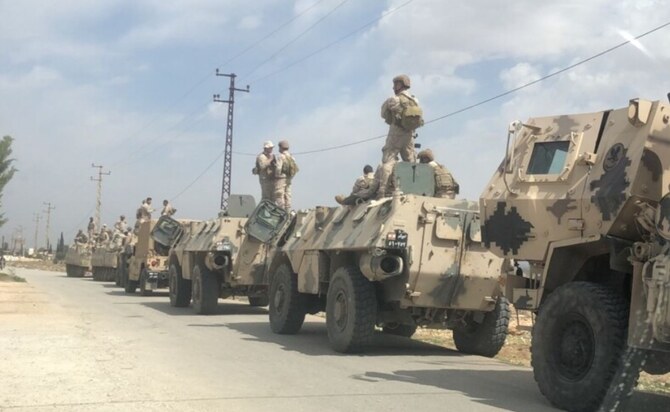
BEIRUT: The Lebanese army on Wednesday entered the town of Hawsh Al-Sayyid Ali, on Lebanon’s eastern border with the Syrian Arab Republic.
Its vehicles reached the town’s administrative border as established in official Lebanese state maps.
According to these maps, the town is divided into two: one part in Syrian territory, inhabited by Lebanese citizens; and the other in Lebanese territory.
The development follows communications between the Syrian and Lebanese sides to halt armed clashes that began last Sunday as a result of disputes among smugglers in an area teeming with illegal crossings.
The conflict escalated on Monday after the killing of three Syrian gunmen, and evolved into a broader confrontation between Lebanese tribes and armed members of the new Syrian authorities.
According to the Lebanese Ministry of Health, the clashes and killings resulted in “the death of seven Lebanese citizens and the injury of 52 others.”
Additionally, property and buildings suffered heavy damage in the exchange of shelling between Syrian forces and Lebanese tribes.
Forces affiliated with the Syrian Ministry of Defense entered the Syrian part of the Lebanese town on Monday night.
Negotiations between the Lebanese and Syrian sides over deployment zones, based on border maps between the two countries, delayed the Lebanese army’s deployment for several hours, when a Lebanese army convoy of 60 vehicles arrived on the outskirts of Hawsh Al-Sayyid Ali.
An official source in the area said the Lebanese army’s deployment “was not smooth, as it faced protests related to the confiscation of weapons belonging to local clans. However, the situation soon returned to normal, allowing the army to continue its mission.
The Lebanese army command announced that its units “commenced implementing security measures in the Hawsh Al-Sayyid Ali area of Hermel, including the deployment of patrols, to maintain security and ensure stability in the border region.”
It said the army has taken measures “to close illegal crossings between Lebanon and Syria,” adding: “As part of the efforts to monitor and secure the borders in light of the current situation, and to prevent infiltration and smuggling activities, a unit of the army has closed the illegal crossings, which include Al-Matlaba in the Qasr-Hermel area, as well as Al-Fatha, Al-Maarawiya, and Shahit Al-Hujairi in the Mashari’ Al-Qaa-Baalbek region.”
President Joseph Aoun monitored the security developments along the northeastern border through a series of communications with army chief Gen. Rodolphe Haikal.
According to the presidency, Haikal briefed the president on “the measures being implemented by the army to restore calm and stability to the area.”
Aoun underlined “the importance of consolidating the ceasefire, halting aggression, and controlling the borders adjacent to the villages.”
On Monday he said that the situation on the eastern and northeastern borders cannot persist and that “the army will not allow the chaos to continue.” He then ordered the Lebanese army to respond to the sources of fire.
Subsequently, communications between Lebanon and Syria intensified, including talks between the two countries’ foreign ministers to find solutions to the escalation in border incidents.
These efforts led to a ceasefire agreement between the intelligence services of the two countries after a call between Lebanese Defense Minister Michel Menassa and his Syrian counterpart, Murhaf Abu Qasra.
Syrian media outlets on Tuesday night reported that “Syrian forces seized a Hezbollah operations room in Hawsh Al-Sayyid Ali, which contained large quantities of weapons, ammunition, drugs and equipment used to manufacture counterfeit tobacco.”
After the army’s deployment, displaced families from Hawsh Al-Sayyid Ali on Wednesday started preparing to return to their homes.
Hezbollah has firmly denied any involvement in the border clashes with Syria.


![]()

Lebanese army begins securing border with Syria, closes illegal crossings
Short Url
https://arab.news/654z8
Lebanese army begins securing border with Syria, closes illegal crossings
- Lebanese Army vehicles reached the town’s administrative border as established in official Lebanese state maps
- The development follows communications between the Syrian and Lebanese sides to halt armed clashes that began last Sunday


Latest updates


© 2026 SAUDI RESEARCH & PUBLISHING COMPANY, All Rights Reserved And subject to Terms of Use Agreement.