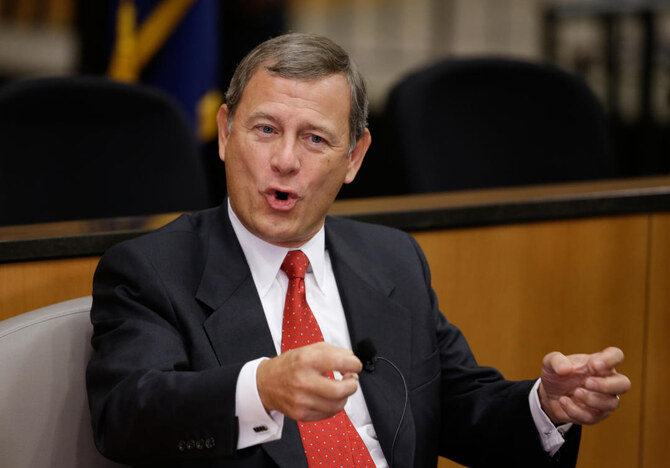
WASHINGTON: Donald Trump’s rumbling conflict with the judiciary burst into open confrontation on Tuesday as Supreme Court Justice John Roberts issued a rare public rebuke of a US president over his call for the impeachment of a federal judge.
“For more than two centuries, it has been established that impeachment is not an appropriate response to disagreement concerning a judicial decision,” Roberts said in a brief statement.
“The normal appellate review process exists for that purpose.”
Roberts’s extraordinary rebuke of the president came after Trump called for the impeachment of District Judge James Boasberg, who ordered the suspension over the weekend of deportation flights of alleged illegal migrants.
The White House has been sharply critical of district courts that have blocked some of the president’s executive actions.
However, this was the first time Trump has personally called for a judge’s impeachment since he took office in January, saying that Boasberg was a “Radical Left Lunatic of a Judge, a troublemaker and agitator who was sadly appointed by Barack Hussein Obama.”
“This judge, like many of the Crooked Judges’ I am forced to appear before, should be IMPEACHED!!!” he said in a Truth Social post earlier Tuesday.
Hours later, Brandon Gill, a Republican lawmaker from Texas, announced on social media platform X that he had introduced articles of impeachment in the House against Boasberg, whom he described as a “radical activist judge.”
Following Roberts’s rare statement, Trump said in another post: “If a President doesn’t have the right to throw murderers, and other criminals, out of our Country because a Radical Left Lunatic Judge wants to assume the role of President, then our Country is in very big trouble, and destined to fail!”
Federal judges are nominated by the president for life and can only be removed by being impeached by the House of Representatives for “high crimes or misdemeanors” and convicted by the Senate.
Impeachment of federal judges is exceedingly rare and the last time a judge was removed by Congress was in 2010.
Trump, the first convicted felon to serve in the White House, has a history of attacking the judges who presided over his civil and criminal cases.
Carl Tobias, a University of Richmond law professor, described Roberts’s intervention as “extremely rare” and recalled that the chief justice made similar remarks after Trump criticized the rulings of federal judges during his first term.
Roberts was compelled to respond at the time by saying the federal bench “does not have Obama judges or Trump judges, Bush judges, or Clinton judges,” Tobias said.
Boasberg ordered a suspension on Saturday to the deportation flights taking alleged members of the Venezuelan gang Tren de Aragua to El Salvador, where they were put in prison.
The White House invoked little-used wartime legislation known as the Alien Enemies Act of 1798 as legal justification for the move.
However, no evidence has been made public to confirm the deportees were gang members or even in the country illegally.
Boasberg held a hearing on Monday on whether the White House had deliberately ignored his orders by carrying out the flights.
Justice Department lawyers told the judge the more than 200 Venezuelan migrants had already left the United States when he issued a written order barring their departure.
Boasberg no longer had jurisdiction once the planes had left US airspace, they claimed.
The Justice Department had previously filed a motion with an appeals court seeking to have the judge removed from the case for allegedly interfering with the president’s lawful “conduct of foreign policy.”
Trump, in his Truth Social post earlier Tuesday, said Boasberg “was not elected President.”
“I WON FOR MANY REASONS, IN AN OVERWHELMING MANDATE, BUT FIGHTING ILLEGAL IMMIGRATION MAY HAVE BEEN THE NUMBER ONE REASON FOR THIS HISTORIC VICTORY,” he wrote.
The Yale-educated Boasberg, 62, was appointed to the DC Superior Court by president George W. Bush, a Republican, and later named a district court judge by Obama, a Democrat.
The White House has repeatedly lashed out following court rulings it disagrees with, such as the rejection of Trump’s attempt to end birthright citizenship.
Trump’s bid to amass power in the executive has increasingly raised fears he will openly defy the judiciary, triggering a constitutional crisis.


Supreme Court chief rebukes Trump over call for judge’s impeachment
https://arab.news/py4mp
Supreme Court chief rebukes Trump over call for judge’s impeachment

- Supreme Court Justice John Roberts issues a rare public rebuke of a US president
- Impeachment of federal judges is exceedingly rare and the last time a judge was removed by Congress was in 2010


In show of support, Canada, France open consulates in Greenland
- Decisions taken in a strong show of support for Greenland government amid threats by US President Trump to seize the island
COPENHAGEN, Denmark: Canada and France, which both adamantly oppose Donald Trump’s wish to control Greenland, will open consulates in the Danish autonomous territory’s capital on Friday, in a strong show of support for the local government.
Since returning to the White House last year, Trump has repeatedly insisted that Washington needs to control the strategic, mineral-rich Arctic island for security reasons.
The US president last month backed off his threats to seize Greenland after saying he had struck a “framework” deal with NATO chief Mark Rutte to ensure greater American influence.
A US-Denmark-Greenland working group has been established to discuss ways to meet Washington’s security concerns in the Arctic, but the details of the talks have not been made public.
While Denmark and Greenland have said they share Trump’s security concerns, they have insisted that sovereignty and territorial integrity are a “red line” in the discussions.
“In a sense, it’s a victory for Greenlanders to see two allies opening diplomatic representations in Nuuk,” said Jeppe Strandsbjerg, a political scientist at the University of Greenland.
“There is great appreciation for the support against what Trump has said.”
French President Emmanuel Macron announced Paris’s plans to open a consulate during a visit to Nuuk in June, where he expressed Europe’s “solidarity” with Greenland and criticized Trump’s ambitions.
The newly-appointed French consul, Jean-Noel Poirier, has previously served as ambassador to Vietnam.
Canada meanwhile announced in late 2024 that it would open a consulate in Greenland to boost cooperation.
The opening of the consulates is “a way of telling Donald Trump that his aggression against Greenland and Denmark is not a question for Greenland and Denmark alone, it’s also a question for European allies and also for Canada as an ally, as a friend of Greenland and the European allies also,” Ulrik Pram Gad, Arctic expert at the Danish Institute of International Studies, told AFP.
“It’s a small step, part of a strategy where we are making this problem European,” said Christine Nissen, security and defense analyst at the Europa think tank.
“The consequences are obviously not just Danish. It’s European and global.”
Recognition
According to Strandsbjerg, the two consulates — which will be attached to the French and Canadian embassies in Copenhagen — will give Greenland an opportunity to “practice” at being independent, as the island has long dreamt of cutting its ties to Denmark one day.
The decision to open diplomatic missions is also a recognition of Greenland’s growing autonomy, laid out in its 2009 Self-Government Act, Nissen said.
“In terms of their own quest for sovereignty, the Greenlandic people will think to have more direct contact with other European countries,” she said.
That would make it possible to reduce Denmark’s role “by diversifying Greenland’s dependence on the outside world, so that it is not solely dependent on Denmark and can have more ties for its economy, trade, investments, politics and so on,” echoed Pram Gad.
Greenland has had diplomatic ties with the European Union since 1992, with Washington since 2014 and with Iceland since 2017.
Iceland opened its consulate in Nuuk in 2013, while the United States, which had a consulate in the Greenlandic capital from 1940 to 1953, reopened its mission in 2020.
The European Commission opened its office in 2024.


