

Fear at Antarctica base as researcher assaults colleague and makes threats

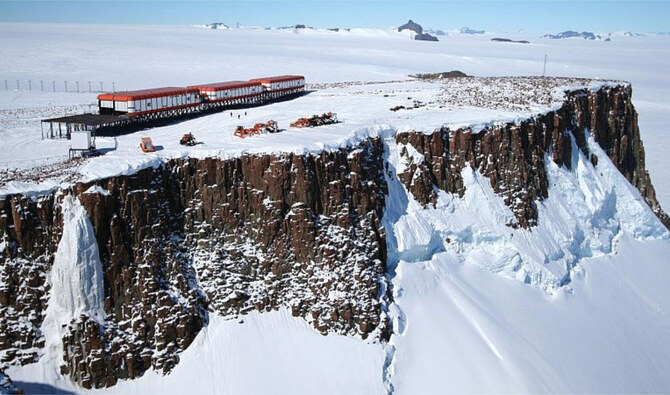
The SANAE IV base is more than 2,500 miles from South Africa’s closest point. (Wikimedia)
Short Url
Updated 19 March 2025
Follow

Fear at Antarctica base as researcher assaults colleague and makes threats

  • ‘His behavior has escalated to a point that is deeply disturbing,’ said an email sent to South Africa’s Sunday Times newspaper

CAPE TOWN: A member of a South African research team that is confined for more than a year at an isolated Antarctica base was put under psychological evaluation there after he allegedly assaulted and sexually harassed colleagues, government officials said.

The problems at the SANAE IV base were first reported by South Africa’s Sunday Times newspaper, which said it had seen an email from a team member to authorities last month claiming the man had attacked the base leader and made threats.

The email pleaded for help.

“His behavior has escalated to a point that is deeply disturbing,” the email said, according to The Sunday Times. “I remain deeply concerned about my own safety, constantly wondering if I might become the next victim.” The report said the man allegedly made a death threat.

South Africa’s Ministry of Environment, which oversees the research missions, said in a statement that the alleged assault on the base leader was reported on Feb. 27, and officials and counselors intervened remotely “to mediate and restore relationships at the base.” They were speaking with team members almost daily, it said.

“The alleged perpetrator has willingly participated in further psychological evaluation, has shown remorse and is willingly cooperative,” the ministry said, adding that he had written a formal apology to the victim of the alleged assault. It said the allegations were being investigated. No one was identified.

The nine-member team, which includes scientists, a doctor and engineers, is expected to stay at the base for about 13 months until next year, authorities said, living in close quarters through the hostile Antarctic winter, whose six months of darkness begin in June.

The base is on a cliff in Queen Maud Land and is surrounded by a glacial ice sheet, more than 4,000 km, from South Africa.

The next planned visit by a supply ship is in December, according to the South African National Antarctic Program. It takes the ship around 10 days to travel from Cape Town.

Authorities said they had decided not to evacuate anyone from SANAE IV, where the onset of unpredictable weather conditions meant the team was now confined to the base.

The ministry said all team members had undergone evaluations ahead of the trip to ensure they can cope with the “extreme nature of the environment in Antarctica” and the isolation and confinement, and no problems were identified.

“It is not uncommon that once individuals arrive at the extremely remote areas where the scientific bases are located, an initial adjustment to the environment is required,” it said.

Previous problems have been reported at another of South Africa’s remote research bases on Marion Island, a South African territory near Antarctica.

In 2017, a member of a research team there smashed a colleague’s room with an ax over an apparent love triangle, according to a report to South Africa’s parliament. Lawmakers said it appeared the researchers were living in highly stressful conditions.

The National Science Foundation, the federal agency that oversees the US Antarctic Program, published a report in 2022 in which 59 percent of women in the US program said they’d experienced harassment or assault while on research trips in Antarctica.


Trump says he asked Putin not to target Kyiv for 1 week during brutal cold spell

Updated 7 sec ago
Follow

Trump says he asked Putin not to target Kyiv for 1 week during brutal cold spell

  • “I personally asked President Putin not to fire on Kyiv and the cities and towns for a week during this ... extraordinary cold,” Trump said
  • Zelensky, for his part, thanked Trump for his effort and welcomed the “possibility” of a pause

KYIV: US President Donald Trump said Thursday that President Vladimir Putin has agreed not to target the Ukrainian capital and other towns for one week as the region experiences frigid temperatures.
There was no immediate confirmation from the Kremlin that Putin has agreed to such a pause.
Russia has been pounding Ukraine’s critical infrastructure, hoping to wear down public resistance to the war while leaving many around the country having to endure the dead of winter without heat.
“I personally asked President Putin not to fire on Kyiv and the cities and towns for a week during this ... extraordinary cold,” Trump said during a Cabinet meeting at the White House, adding that Putin has “agreed to that.”
Kremlin spokesman Dmitry Peskov was asked earlier Thursday whether a mutual halt on strikes on energy facilities was being discussed between Russia and Ukraine, and he refused to comment on the issue.
Ukrainian President Volodymyr Zelensky late Wednesday had warned that Moscow was planning another large-scale barrage despite plans for further US-brokered peace talks at the weekend.
Trump said he was pleased that Putin has agreed to the pause. Kyiv, which has grappled with severe power shortages this winter, is forecast to enter a brutally cold stretch starting Friday that is expected to last into next week. Temperatures in some areas will drop to minus 30 degrees Celsius (minus 22 Fahrenheit), the State Emergency Service warned.
“A lot of people said, ‘Don’t waste the call. You’re not going to get that.’” the Republican US president said of his request of Putin. “And he did it. And we’re very happy that they did it.”
Zelensky, for his part, thanked Trump for his effort and welcomed the “possibility” of a pause in Russian military action on Kyiv and beyond. “Power supply is a foundation of life,” Zelensky said in his social media post.
Trump did not say when the call with Putin took place or when the ceasefire would go into effect. The White House did not immediately respond to a query seeking clarity about the scope and timing of the limited pause in the nearly four-year war.
Russia has sought to deny Ukrainian civilians heat and running water over the course of the war, which began with Russia’s full-scale invasion on Feb. 24, 2022. Ukrainian officials describe the strategy as “weaponizing winter.”
Last year was the deadliest for civilians in Ukraine since 2022 as Russia intensified its aerial barrages behind the front line, according to the UN Human Rights Monitoring Mission in the country.
The war killed 2,514 civilians and injured 12,142 in Ukraine — 31 percent higher than in 2024, it said.