ISLAMABAD: Pakistan’s Parliamentary Committee on National Security on Tuesday stressed the need for a national consensus to counter militancy, calling for a unified political stance to confront the threat with “full force of the state.”
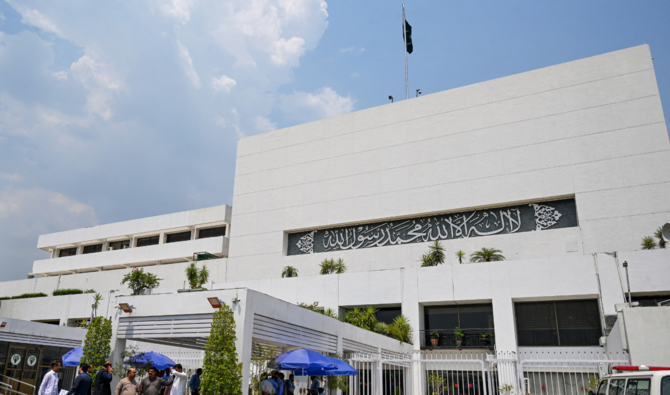
The statement came after a meeting of Pakistan’s top civilian and military leaders at the Parliament House days after the hijacking of a passenger train by the Baloch Liberation Army (BLA) separatist group in Pakistan’s southwestern Balochistan province, holding hundreds of passengers hostage. The military launched an operation and, after a day-long standoff, rescued 354 captives and killed 33 insurgents. A final count showed 23 soldiers, three railway employees and five passengers had died in the attack.
Militant violence has persisted in the province following the incident, with three paramilitary soldiers among five people killed in a suicide attack in Balochistan’s Nushki district on Sunday. The escalation in attacks prompted National Assembly Speaker Sardar Ayaz Sadiq to convene a session of the parliamentary committee on Tuesday at Prime Minister Shehbaz Sharif’s advice.
Tuesday’s meeting at the Parliament House was attended by Prime Minister Shehbaz Sharif, members of the parliamentary committee, political leaders, Army Chief General Asim Munir, federal ministers and senior intelligence officials. The military leadership and intelligence officials briefed the participants on the security situation, while political leaders expressed their views on how to deal with the prevailing situation. At the end of the meeting, PM Sharif read out a communiqué that was later adopted by the committee unanimously.
“The committee stressed the need for a national consensus on counter-terrorism, emphasizing strategic and a unified political commitment to confront this threat with the full force of the state,” Sharif said.
“It also called for the immediate implementation of the National Action Plan and the Azm-e-Istahkam strategy to dismantle terrorist networks, counter logistical support, and eliminate the nexus between terrorism and crime.”
Sharif said the committee expressed concern over the “increasing misuse of social media platforms” by militant groups for propaganda, recruitment and coordinating attacks.
“It emphasized the need for immediate measures to curb this threat and called for a clear framework to counter terrorists’ digital presence and activities,” he added.
The committee reiterated that no institution, individual or group collaborating with enemy forces would be allowed to jeopardize Pakistan’s peace and stability, according to the premier. It expressed regret over the absence of some opposition members.
An alliance of opposition parties, led by jailed former prime minister Imran Khan’s Pakistan Tehreek-e-Insaf (PTI) party, declined to participate in the meeting, objecting to Khan’s absence from the moot.
Pakistan ranks as the second-most affected country by terrorism, according to The Global Terrorism Index 2025. Militancy-related deaths surged by 45 percent, rising from 748 in 2023 to 1,081 in 2024, marking one of the steepest global increases.
Militant attacks in Pakistan more than doubled, from 517 in 2023 to 1,099 in 2024. Balochistan and Khyber Pakhtunkhwa, bordering Afghanistan, remained the hardest-hit provinces, accounting for over 96 percent of attacks and fatalities.
‘GOVERNANCE GAPS’
Speaking at the forum, Army Chief Gen. Munir said no agenda, no movement and no personality was greater than the security of the country, according to the Inter-Services Public Relations (ISPR), the military’s media wing.
“For sustainable development, all elements of national power will have to work in harmony. This is a battle of our survival and that of our future generations,” he was quoted as saying.
The army chief stressed the need for “better governance” in the country and making Pakistan a “hard state.”
“How long will we continue to sacrifice countless lives in the style of a soft state,” he asked. “How long will we continue to fill the governance gaps with the blood of the armed forces of Pakistan and the martyrs?“
The general urged religious scholars to expose the distorted interpretation of Islam by the religiously motivated militant groups.
“We exist only if the country exists,” he said. “There is nothing more important for us than the security of the country.”
Defense Minister Khawaja Muhammad Asif said Pakistan was planning a “decisive action” against militants.
“Civilian and military leadership are working to unite the entire nation against the terrorist enemy,” he said on X after the meeting. “The ranks have been formed, victory will be Pakistan’s.”
The minister criticized the PTI for its absence from the key security meeting: “No Khan, No Pakistan, is PTI standing by this slogan?”
Khan’s party said the ex-premier should have been invited to the meeting.
“No representative from us will attend the meeting and Khyber Pakhtunkhwa Chief Minister Ali Amin Gandapur would attend the meeting as the KP chief minister, not the party representative,” PTI Secretary General Salman Akram Raja announced at a press conference earlier in the day, saying Khan should have been invited by releasing him on parole.
Sayed Zulfikar Bukhari, a close Khan close aide and spokesperson for the international media, told Arab News the government and military wanted to use the PTI for its “upcoming adventures.”
“The government and army just want to use PTI for their upcoming misadventures in Balochistan and Afghanistan,” he told Arab News, questioning how the largest party in the country could attend the meeting without directions from their leader.
“Give us access to Khan to get directions as he is the only unifying figure in the country.”
Mahmood Khan Achakzai, an opposition leader, said instead of such meetings a joint session of parliament should have been called to discuss this important issue.
“Pakistan’s dire circumstances call for a joint session of parliament, where everyone must be given the opportunity to speak,” he said.


Pakistan’s top military, political leaders call for national consensus, political unity amid militancy surge
https://arab.news/5b67u
Pakistan’s top military, political leaders call for national consensus, political unity amid militancy surge

- Country’s top civilian and military leaders assembled at Parliament House on Tuesday to discuss measures to curb militancy
- Meeting of Parliamentary Committee on National Security called after hijacking of train by separatists in Balochistan province

Death toll in Pakistan shopping plaza fire rises to 67, officials say
- Rescue teams still searching for damaged Gul Plaza in Karachi where blaze erupted on Saturday, says police surgeon
- Karachi has a long history of deadly fires, often linked to poor safety standards, weak regulatory enforcement
KARACHI: The death toll from a devastating fire at a shopping plaza in Pakistan’s southern port city of Karachi jumped to 67 on Thursday after police and a hospital official confirmed that the remains of dozens more people had been found.
Police surgeon Dr. Summaiya Syed said rescue teams were still searching the severely damaged Gul Plaza in the Karachi, where the blaze erupted on Saturday.
Most remains were discovered in fragments, making identification extremely difficult, but the deaths of 67 people have been confirmed, she said. Asad Raza, a senior police official in Karachi, also confirmed the death toll. Authorities previously had confirmed 34 deaths.
Family members of the missing have stayed near the destroyed plaza and hospital, even after providing their DNA for testing. Some have tried to enter the building forcibly, criticizing the rescue efforts as too slow.
“They are not conducting the search properly,” said Khair-un-Nisa, pointing toward the rescuers. She stood outside the building in tears, explaining that a relative who had left to go shopping has been missing since the blaze.
Another woman, Saadia Saeed, said her brother has been trapped inside the building since Saturday night, and she does not know what has happened to him.
“I am ready to go inside the plaza to look for him, but police are not allowing me,” she said.
There was no immediate comment from authorities about accusations they have been too slow.
Many relatives of the missing claim more lives could have been saved if the government had acted more swiftly. Authorities have deployed police around the plaza to prevent relatives from entering the unstable structure, while rescuers continue their careful search.
Investigators say the blaze erupted at a time when most shop owners were either closing for the day or had already left. Since then, the Sindh provincial government has said around 70 people were missing after the flames spread rapidly, fueled by goods such as cosmetics, clothing, and plastic items.
The cause of the fire remains under investigation, though police have indicated that a short circuit may have triggered the blaze.
Karachi has a long history of deadly fires, often linked to poor safety standards, weak regulatory enforcement, and illegal construction.
In November 2023, a shopping mall fire killed 10 people and injured 22. One of Pakistan’s deadliest industrial disasters occurred in 2012, when a garment factory fire killed at least 260 people.


