

Egypt Suez Canal monthly revenue losses at around $800m, El-Sisi says

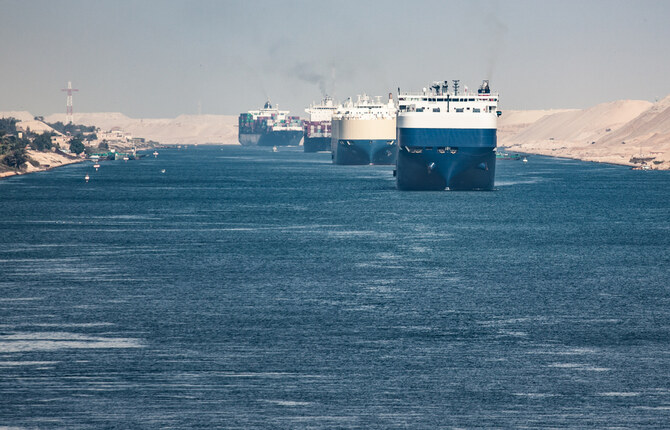
The Suez Canal is a vital shipping route. Shutterstock
Short Url
Updated 18 March 2025
Follow

Egypt Suez Canal monthly revenue losses at around $800m, El-Sisi says

CAIRO: Egypt’s President Abdel Fattah El-Sisi has announced that the monthly losses of the Suez Canal revenues reached around $800 million due to the regional “situation,” as Yemen’s Houthis have been attacking vessels in the Red Sea.

The Iran-backed Houthis have attacked vessels in the Red Sea area since November 2023 in support of Palestinians in Gaza during the war with Israel, disrupting global shipping by forcing vessels to avoid the nearby Suez Canal and reroute trade around Africa, raising shipping costs.

The Egyptian presidency statement did not directly refer to the Houthis, but El-Sisi said in December the disruption cost Egypt around $7 billion in less revenue from the Suez Canal in 2024.

The Yemeni group recently vowed to resume attacking US vessels in the Red Sea, in response to deadly US strikes on Yemen that killed at least 53 people on Saturday, in the biggest US military operation in the Middle East since President Donald Trump took office in January.

They also said last week they would resume attacks on Israeli ships passing through the Red Sea if Israel did not lift a block on aid entering Gaza.


Islamic banks’ market share in Turkiye rises to 9.2%: Fitch Ratings

Updated 18 February 2026
Follow

Islamic banks’ market share in Turkiye rises to 9.2%: Fitch Ratings

RIYADH: Islamic banks in Turkiye lifted their asset market share to 9.2 percent in 2025 from 8.1 percent a year earlier, as financing and deposits outpaced the broader banking sector, a new analysis showed. 

In its latest report, Fitch Ratings said financing and deposit market shares rose to 7.9 percent and 10.4 percent, respectively, by the end of 2025, compared with 7.3 percent and 9.4 percent in 2024.

The agency noted that new digital Islamic banks are emerging in the country, with investment from Gulf Cooperation Council countries expected to continue. 

Turkiye’s strong ties with Islamic countries across the Balkans, Africa and the Middle East support the development of its Islamic banking sector, attracting investors and contributing to the industry’s growth.

In its latest report, Fitch stated: “Three recently established private Islamic banks (two digital) grew rapidly in the first nine months of 2025. Investment in digital participation banking from the Gulf Cooperation Council countries underscores the potential for further investment from the region.” 

It added: “Planned establishment of new participation banks, and rapid growth of recently established banks – albeit from small bases – means that the segment landscape may be reshaped in 2026.” 

Dubai Islamic Bank PJSC’s investment in digital bank TOM underscores the potential for further GCC investment. 

Turkish regulators have approved the establishment of Halk Katilim Bankasi A.S. and Adil Katilim Bankasi A.S. (digital), while BIM Birlesik Magazalar A.S.’s application is pending. 

Fitch added that state-owned participation banks may merge or pursue initial public offerings, potentially reshaping the banking landscape. 

The report predicts Islamic banks’ market share will rise further in 2026, supported by strong internal capital generation and growth appetite. However, the non-performing financing ratio may increase moderately due to high inflows. 

“The segment’s non-performing financings ratio deteriorated to 2 percent at end-2025 compared to 1.2 percent in 2024 but remained below the sector average of 2.5 percent,” said Fitch. 

It added: “We expect pressure to persist given still-high financing rates, high but declining inflation, and the sensitivity of unsecured retail (lower share than conventional banks) and SME segments to economic cycles. We forecast a moderate increase in the segment NPF ratio in 2026.”