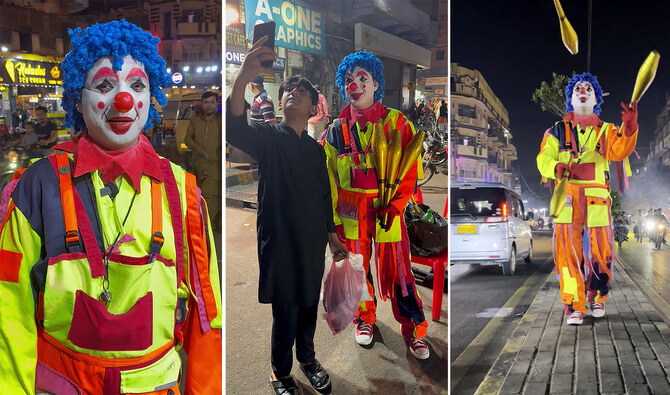
KARACHI: As dusk falls over Burns Road, Karachi’s busy food street, a man in a bright blue curly wig and neon-yellow jacket steps into the crowd, a red clown nose perched on his face. His hands, covered in red gloves, juggle colorful balls, drawing the attention of people, particularly children who watch with excitement.
This is Jamal Shah, a street performer whose journey from stage artist to roadside entertainer is a tale of resilience and a deep desire to connect with people through his passion for performance.
Before the coronavirus pandemic shuttered theaters and circuses, Shah was a seasoned performer, traveling across Pakistan’s four provinces and receiving praise for his magic shows and juggling acts.
Since 1998, the 41-year-old has led a life of artistic fulfillment. But the pandemic changed everything, leaving him and countless others jobless.
“Before COVID, I used to perform in theaters, circuses, variety shows, magic shows, and festivals,” Shah said, his voice cutting through the noise. “I am not just a street artist. I am a trained theater and stage performer.”
Yet, circumstances forced him out of familiar settings, leaving him to perform on the streets, where passersby are often too absorbed to notice his skillful acts.
“I turned to street performances after [theater] shows were shut down,” he said. “Without these shows, I had to find a way to survive with a wife and five children. I live on rent, so I had no choice but to perform on the streets.”
Every evening, Shah leaves Quaidabad on his motorcycle, making a 25-kilometer journey to the Burns Road in heart of Saddar, which has been his lifeline for the past five years.
During Ramadan, he performs from Iftar to Suhoor, his efforts barely enough to cover his family’s basic needs.
“My family is struggling,” Shah told Arab News. “One of my children is unwell, I am also unwell, and so is my wife. But I decided that I would not beg from anyone. Instead, I would use my skills here.”
But the street is a harsh stage where sometimes speeding motorcyclists crash into him and passersby occasionally hurl mocking remarks. Despite the hardships, Shah takes comfort in the smiles he brings to children’s faces.
“When I see children smiling, my personal sorrows fade away,” he said. “I never bring my grief to the public. As for my tears, I know when they well up and when I hide them. When I am performing, the character I embody requires me to conceal my tears, which I do, while striving to keep people happy and smiling.”
His children, who once went to school, now attend a seminary for religious education. Shah said his greatest desire was to provide them with a brighter future.
“I want to support my family and children so that my children can also go to school and study, educate themselves, play a positive role in society and become its valuable members,” he said. “If my children get an education, they will develop a good character.”
Shah’s dedication to his craft is unwavering, making him pledge to perform until there is strength in his body.
“One must fight for survival,” he added. “Whether it’s scorching heat or cold, I am here.”
Shah said performers like him felt duty-bound to spread joy among people.
“Every person deprived of happiness should find joy in watching us, and their sadness should be transformed into smiles and happiness,” he said, his eyes reflecting the flickering lights of the food street and hope for a better future.


![]()

Karachi street performer juggles hardships, clowns around from iftar to suhoor
Short Url
https://arab.news/9wwuk
Karachi street performer juggles hardships, clowns around from iftar to suhoor
- Jamal Shah began performing in theater as a teenager but lost his job during the coronavirus pandemic
- He says survival is a battle, as he navigates the harsh stage of the streets to support his five children
Latest updates


© 2026 SAUDI RESEARCH & PUBLISHING COMPANY, All Rights Reserved And subject to Terms of Use Agreement.