

EU warns Trump’s freeze of US-funded media risks aiding enemies

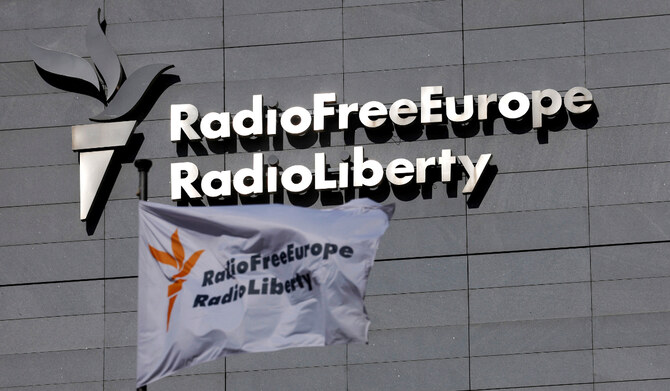
A flag and a sign of Radio Free Europe/Radio Liberty are shown at its headquarters in Prague, Czech Republic, March 17, 2025. (REUTERS)
Short Url
Updated 18 March 2025
Follow

EU warns Trump’s freeze of US-funded media risks aiding enemies

  • The US-funded media have since focused on countries like Russia, China, Iran and Belarus
  • Trump has already eviscerated the United States’ aid agency and its education department

BRUSSELS, Belgium: The EU on Monday warned that President Donald Trump’s freeze on US-funded media outlets, including Radio Free Europe, risked “benefitting our common adversaries.”
Trump’s administration at the weekend started laying off staff at Voice of America and other broadcasters including Prague-based Radio Free Europe/Radio Liberty (RFE/RL) after freezing their funding.
“We see these media outlets really as beacons of truth, of democracy, and of hope for millions of people around the world,” said European Commission spokeswoman Paula Pinho.
“Freedom of the press... is critical for democracy. And this decision risks benefitting our common adversaries,” she said without naming countries, groups or individuals.
Founded by the United States during the Cold War to counter Soviet propaganda, RFE/RL was banned across the communist bloc, where regimes regularly jammed its signal.
The US-funded media have since focused on countries like Russia, China, Iran and Belarus.
EU foreign ministers discussed the freeze and ways to make up for it in Brussels on Monday.
The bloc’s foreign policy chief Kaja Kallas said the EU would not “automatically... fill the void that the US is leaving.”
“We have a lot of organizations who are coming with the same request to us,” Kallas told reporters.
“But there was really a push from the foreign ministers to discuss this and find the way, so this is the tasking to our side to see what can we do,” she added.
Czech Foreign Minister Jan Lipavsky, whose country has been the home of RFE/RL since its 1995 move from Munich, said after the talks Europe should take care of the radio.
“I raised this question to see whether our partners see value in keeping RFE/RL running. We certainly do, and if we see value in it, then it makes sense to consider ways to secure its future, including the possibility of buying it,” he told AFP.
Lipavsky said earlier that the costs of running RFE/RL would reach up to $120 million a year.
His Polish counterpart Radoslaw Sikorski said Monday the EU could raise the budget of the European Endowment for Democracy, an NGO founded to boost democracy in the bloc’s neighbors, and thus help finance the radio.
Trump has already eviscerated the United States’ aid agency and its education department.

Iran, China and Russia have all invested heavily in state media outlets created to compete with Western narratives and to push out government lines to foreign audiences.


Archbishop of York says he was ‘intimidated’ by Israeli militias during West Bank visit

Archbishop of York Stephen Cottrell poses for a photograph with York Minster’s Advent Wreath.
Updated 26 December 2025
Follow

Archbishop of York says he was ‘intimidated’ by Israeli militias during West Bank visit

  • “We were … intimidated by Israeli militias who told us that we couldn’t visit Palestinian families in the occupied West Bank,” the archbishop said

LONDON: The Archbishop of York has revealed that he felt “intimidated” by Israeli militias during a visit to the Holy Land this year.

“We were stopped at various checkpoints and intimidated by Israeli militias who told us that we couldn’t visit Palestinian families in the occupied West Bank,” the Rev. Stephen Cottrell told his Christmas Day congregation at York Minster.

The archbishop added: “We have become — and really, I can think of no other way of putting it — we have become fearful of each other, and especially fearful of strangers, or just people who aren’t quite like us.

“We don’t seem to be able to see ourselves in them, and therefore we spurn our common humanity.”

He recounted how YMCA charity representatives in Bethlehem, who work with persecuted Palestinian communities in the West Bank, gave him an olive wood Nativity scene carving.

The carving depicted a “large gray wall” blocking the three kings from getting to the stable to see Mary, Joseph and Jesus, he said.

He said it was sobering for him to see the wall in real life during his visit.

He continued: “But this Christmas morning here in York, as well as thinking about the walls that divide and separate the Holy Land, I’m also thinking of all the walls and barriers we erect across the whole of the world and, perhaps most alarming, the ones we build around ourselves, the ones we construct in our hearts and minds, and of how our fearful shielding of ourselves from strangers — the strangers we encounter in the homeless on our streets, refugees seeking asylum, young people starved of opportunity and growing up without hope for the future — means that we are in danger of failing to welcome Christ when he comes.”