

Every attempt for peace with Pakistan met with ‘hostility, betrayal,’ says Modi

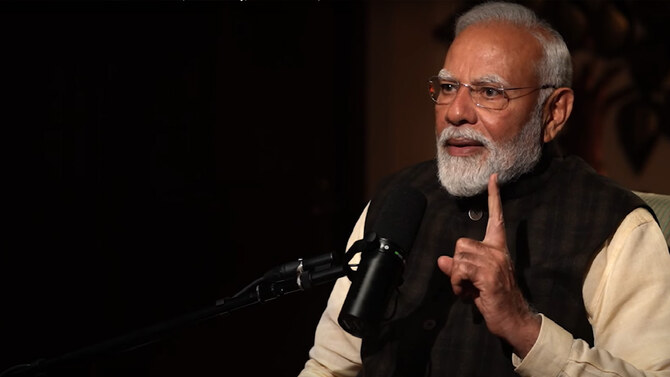
Indian Prime Minister Narendra Modi speaks to American podcast host Lex Fridman in an interview released on March 17, 2025. (Lex Fridman/YouTube/Screengrab)
Short Url
Updated 17 March 2025
Follow

Every attempt for peace with Pakistan met with ‘hostility, betrayal,’ says Modi

  • In podcast with American computer scientist Lex Fridman, Modi hopes Pakistan chooses “path of peace“
  • Indian premier praises US President Trump, says he seems “far more prepared than before” in second term

NEW DELHI: Indian Prime Minister Narendra Modi said US President Donald Trump was ‘far more prepared’ for his second term, furnished with a clear roadmap, speaking in a podcast interview weeks ahead of reciprocal tariffs planned by Washington.
India is among the trading partners set to face the tariffs from April, which threaten to cause distress to its exporters in industries from automobiles to agriculture.
After Modi and Trump met last month, the two nations agreed to resolve tariff rows and work on the first segment of a deal by the fall of 2025, aiming to reach two-way trade of $500 billion by 2030.
“This time, he seems far more prepared than before,” Modi said in a podcast with American computer scientist and podcaster Lex Fridman released on Sunday, referring to Trump’s second term, which began in January.
“He has a clear roadmap in his mind with well-defined steps, each one designed to lead him toward his goals,” he added.
During the discussion, which ran more than three hours, Modi spoke on issues from diplomacy and artificial intelligence to his early life, in a conversation Fridman called one of the most “powerful” of his life.
Modi praised Trump for his graciousness and humility, underscoring a strong bond between the leaders.
“His (Trump’s) reflection showed his ‘America First’ spirit, just as I believe in nation first. I stand for India first, and that’s why we connect so well,” Modi said.

INDIA’S NEIGHBOURS

India’s relations with neighbor China improved last year after striking a milestone pact to lower military tension on their Himalayan border following talks between Modi and Chinese President Xi Jinping in Russia.
“Slowly but surely, trust, enthusiasm, and energy will return,” Modi said during the podcast, as the two countries work to restore relations to their state before a military border skirmish in 2020.
“But of course, it will take some time, since there’s been a five-year gap,” he said, adding that the focus of the two nations was to ensure their differences “do not turn into disputes.”
On ties with archfoe Pakistan, Modi expressed hope for peaceful relations.
“Every noble attempt at fostering peace was met with hostility and betrayal,” he said, adding, “we sincerely hope that wisdom prevails upon them and they choose the path of peace.”
The foreign ministries of China and Pakistan did not respond to Reuters requests for comment.


Security forces kill four militants in Pakistan’s volatile southwest, military says

Updated 13 January 2026
Follow

Security forces kill four militants in Pakistan’s volatile southwest, military says

  • Balochistan, Pakistan’s largest province by land area bordering Iran and Afghanistan, has long been the site of a low-level insurgency
  • The Balochistan government has recently established a threat assessment center to strengthen early warning, prevent ‘terrorism’ incidents

ISLAMABAD: Pakistani security forces gunned down four militants in an intelligence-based operation in the southwestern Balochistan province, the military said on Tuesday.

The operation was conducted in Balochistan’s Kalat district on reports about the presence of militants, according to the Inter-Services Public Relations (ISPR), the Pakistani military’s media wing.

The “Indian-sponsored militants” were killed in an exchange of fire during the operation, while weapons and ammunition were also recovered from the deceased, who remained actively involved in numerous militant activities.

“Sanitization operations are being conducted to eliminate any other Indian-sponsored terrorist found in the area,” the ISPR said in a statement.

There was no immediate response from New Delhi to the statement.

Balochistan, Pakistan’s largest province by land area bordering Iran and Afghanistan, has long been the site of a low-level insurgency involving Baloch separatist groups, including the Balochistan Liberation Army (BLA) and the Balochistan Liberation Front (BLF).

Pakistan accuses India of supporting these separatist militant groups and describes them as “Fitna Al-Hindustan.” New Delhi denies the allegation.

The government in Balochistan has also established a state-of-the-art threat assessment center to strengthen early warning and prevention against “terrorism” incidents, a senior official said this week.

“Information that was once scattered is now shared and acted upon in time, allowing the state to move from reacting after incidents to preventing them before they occur,” Balochistan Additional Chief Secretary Hamza Shafqaat wrote on X.

The development follows a steep rise in militancy-related deaths in Pakistan in 2025. According to statistics released by the Pakistan Institute for Conflict and Security Studies (PICSS) last month, combat-related deaths in 2025 rose 73 percent to 3,387.

These included 2,115 militants, 664 security forces personnel, 580 civilians and 28 members of pro-government peace committees, the think tank said.