Families of Syrians who disappeared during its civil war say the search must go on

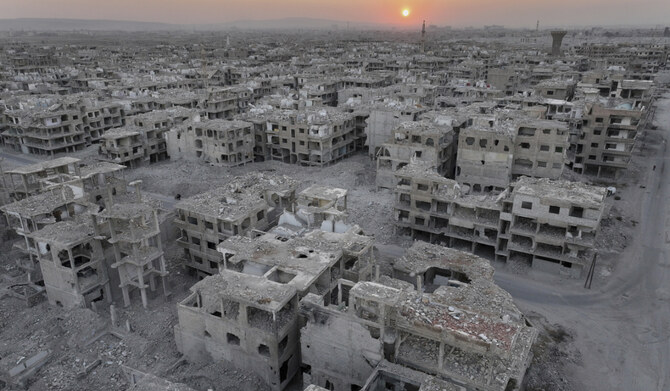
An aerial view of remaining buildings is seen which were not only destroyed during the civil war, they were also demolished by the government or stripped by thieves, at the Palestinian refugee camp of Yarmouk, outside Damascus, Syria, Saturday, Dec. 14, 2024. (AP)
Short Url
Updated 17 March 2025
Follow

Families of Syrians who disappeared during its civil war say the search must go on

  • A United Nations-backed commission on Friday urged the interim government led by Ahmad Al-Sharaa to preserve evidence and anything they can document from prisons in the ongoing search for the disappeared

DARAA, Syria: Family members of Syrians who disappeared in the country’s 14-year civil war gathered in the city of Daraa on Sunday to urge the newly installed interim government to not give up on efforts to find them.
The United Nations in 2021 estimated that over 130,000 Syrians were taken away and disappeared during the war, many of them detained by former President Bashar Assad’s network of intelligence agencies as well as by opposition fighters and the extremist Daesh group. Advocacy group The Syrian Campaign says some 112,000 are still missing.
When rebels led by the Islamist group Hayat Tahrir Al-Sham overthrew Assad in December, they stormed prisons and released detainees from the ousted government’s dungeons. Families of the missing quickly rushed to the prisons seeking their loved ones. While there were some reunions, rescue services also discovered mass graves around the country and used whatever remains they could retrieve to identify the dead.


Family members hold pictures of their relatives who disappeared in the nearly 14-year Syrian civil war, during a protest calling on the interim government to not give up on efforts to find them, in the city of Daraa, Syria, Sunday, March 16, 2025. (AP)

On Sunday, the 14th anniversary of the countrywide uprisings that spiraled into civil war, Wafa Mustafa held a placard of her father, Ali, who was detained by the Assad government’s security forces in 2013. She fled a week later to Germany, fearing she would also be detained, and hasn’t heard from him since.
Like many other Syrians who fled the conflict or went into exile for their activism, she often held protests and rallied in European cities. Now, she has returned twice since Assad’s ouster, trying to figure out her father’s whereabouts.
“I’m trying, feeling both hope and despair, to find any answer on the fate of my father,” she said. “I searched inside the prisons, the morgues, the hospitals, and through the bodies of the martyrs, but I still couldn’t find anything.”
A United Nations-backed commission on Friday urged the interim government led by Ahmad Al-Sharaa to preserve evidence and anything they can document from prisons in the ongoing search for the disappeared. The commission also urged the new government to pursue perpetrators.
Some foreign nationals are missing in Syria as well, notably American journalist Austin Tice, whose mother visited Syria in January and met with Al-Sharaa. Tice has not been heard from other than a video released weeks after his disappearance in 2012 that showed him blindfolded and held by armed men.
Syria’s civil war began after Assad crushed largely peaceful protests in 2011, one of the popular uprisings against Arab rulers known as the Arab Spring. Half a million people were killed during the conflict, and more than 5 million left the country as refugees.


IMF approves reviews, unlocks $240m in funding for Jordan

Updated 11 sec ago
Follow

IMF approves reviews, unlocks $240m in funding for Jordan

  • The decision allows Jordan to draw about $130 million under the EFF and about $110 million under the RSF

AMMAN: The International Monetary Fund’s executive board has completed the fourth review of Jordan’s Extended Fund Facility and the first review under the Resilience and Sustainability Facility, unlocking immediate access to about $240 million to support the Kingdom’s economic program.

The decision allows Jordan to draw about $130 million under the EFF and about $110 million under the RSF, bringing total disbursements under the IMF arrangement to about $733 million.

In a statement issued on Saturday, the IMF said Jordan’s economy “remains resilient,” supported by sound macroeconomic policies and strong international backing.

Growth accelerated to 2.7 percent in the first half of 2025 and is expected to reach about 3 percent in the coming years, driven by major investment projects, deeper regional integration and continued structural reforms.

Inflation remains anchored at about 2 percent, while the current account deficit is projected to narrow to below 5 percent of GDP over the medium term. The IMF also noted that Jordan’s banking sector is stable and international reserves remain strong.

Fiscal performance continues to align with program targets, underpinned by robust revenue collection and disciplined current spending. The authorities remain committed to reducing public debt to 80 percent of GDP by 2028 through gradual fiscal consolidation, while protecting social and development spending and reducing losses at public utilities.

The IMF said progress under the RSF is ongoing, with reforms addressing vulnerabilities in the water and electricity sectors and strengthening health emergency preparedness. All reform measures scheduled for the current review have been completed.

Commenting after the board discussion, IMF Deputy Managing Director Kenji Okamura said Jordan’s continued macroeconomic stability amid persistent external headwinds reflects the authorities’ commitment to sound policies, supported by strong international assistance.

He said growth continues to recover, inflation remains low and reserve buffers are strong, stressing the importance of maintaining prudent fiscal and monetary policies amid regional tensions and global uncertainty.

Okamura added that accelerated structural reforms are essential to foster job-rich growth, improve the business environment, enhance labour market flexibility, tackle youth unemployment and low female labour force participation, and attract private investment.

He also underlined the importance of sustained donor support to help Jordan manage external challenges and the economic cost of hosting large numbers of refugees, while noting that progress under the RSF would help address long-term vulnerabilities and strengthen balance-of-payments stability.