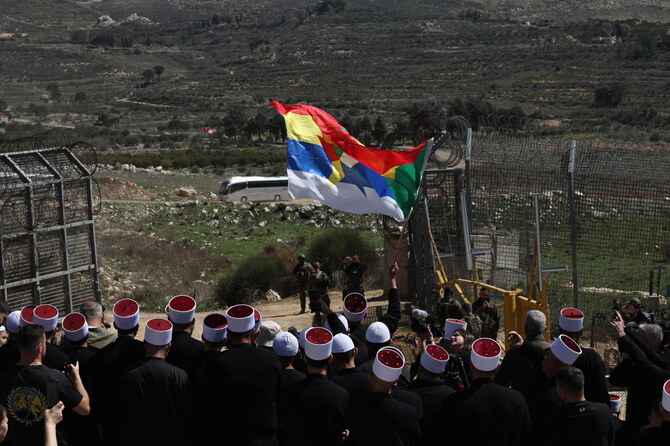
MAJDAL SHAMS: Dozens of Syrian Druze clerics crossed the armistice line on the Golan Heights into Israel on Friday for their community’s first pilgrimage to a revered shrine in decades.
On board three buses escorted by Israeli military vehicles, the clerics crossed at Majdal Shams in the Golan, and headed to northern Israel.
According to a source close to the group, the delegation of around 60 clerics is due to meet the spiritual leader of Israel’s Druze community, Sheikh Mowafaq Tarif, in northern Israel.
They are then set to head to the tomb of Nabi Shuaib in the Galilee — the most important religious site for the Druze.
Followers of the esoteric monotheistic faith are mainly divided between Syria, Lebanon, Israel and the Israeli-occupied Golan Heights.
A source close to the delegation said that the visit followed an invitation from the Druze community in Israel, but that it had been met with “strong opposition” from other Druze in Syria.
The Druze account for about three percent of Syria’s population and are heavily concentrated in the southern province of Sweida.
In Israel and the occupied Golan Heights, there are around 150,000 Druze, with most of those living in Israel holding Israeli citizenship and serving in the army.
However, of the some 23,000 living in the occupied Golan Heights, most do not hold Israeli citizenship and still see themselves as Syrian nationals.
Israel seized much of the strategic Golan Heights from Syria in a war in 1967, later annexing the area in 1981 in a move largely unrecognized by the international community.
The pilgrimage comes as Israel has voiced support for Syria’s Druze and mistrust of the country’s new leaders.
Following the ouster of longtime Syrian president Bashar Assad in December, Israel carried out hundreds of air strikes on Syria and sent troops into the demilitarised buffer zone of the Golan in southwest Syria.
Israeli government spokesman David Mencer said on Thursday that 10,000 humanitarian aid packages had been sent to “the Druze community in battle areas of Syria” over the past few weeks.
“Israel has a bold alliance with our Druze brothers and sisters,” he told journalists.
During a visit to military outposts in the UN-patrolled buffer zone between Israel and Syria on Tuesday, Defense Minister Israel Katz said that Israel would remain in the area and ensure the protection of the Druze.
In early March, following a deadly clash between government-linked forces and Druze fighters in the suburbs of Damascus, Katz said his country would not allow Syria’s new rulers “to harm the Druze.”
Druze leaders immediately rejected Katz’s warning and declared their loyalty to a united Syria.
Israeli Prime Minister Benjamin Netanyahu has said that southern Syria must be completely demilitarised, warning that his government would not accept the presence of the forces of the new Islamist-led government near its territory.


![]()

Syrian Druze cross armistice line for pilgrimage to Israel
Short Url
https://arab.news/72tt6
Syrian Druze cross armistice line for pilgrimage to Israel
- Followers of the esoteric monotheistic faith are mainly divided between Syria, Lebanon, Israel and the Israeli-occupied Golan Heights
- The Druze account for about three percent of Syria’s population and are heavily concentrated in the southern province of Sweida


Latest updates


© 2026 SAUDI RESEARCH & PUBLISHING COMPANY, All Rights Reserved And subject to Terms of Use Agreement.