

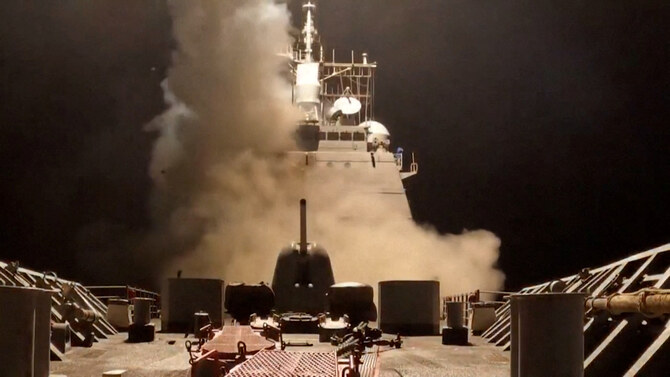
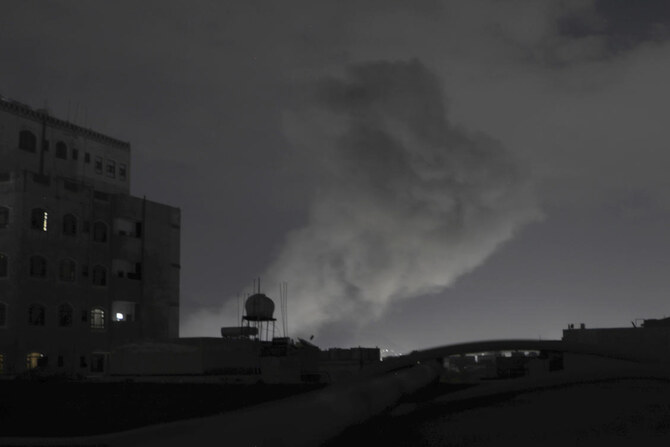

WASHINGTON/ADEN: The United States will keep attacking Yemen’s Houthis until they end attacks on shipping, the US defense secretary said on Sunday, as the Iran-aligned group signaled it could escalate in response to deadly US strikes the day before.
The airstrikes are the biggest US military operation in the Middle East since President Donald Trump took office in January. One US official told Reuters the campaign might continue for weeks.
A spokesperson for the Houthi-run health ministry said the death toll of the US attacks has risen to 53. Five children and two women were among the victims while the number of injuries rose to 98, Anees Alsbahi, the spokesperson, added on X.
Houthi leader Abdul Malik Al-Houthi said on Sunday that his militants would target US ships in the Red Sea as long as the US continues its attacks on Yemen. “If they continue their aggression, we will continue the escalation,” he said in a televised speech.
The Houthi movement’s political bureau described the attacks as a “war crime,” while Moscow urged Washington to cease the strikes.
The Houthis’ military spokesperson on Sunday said, without offering evidence, that the group had targeted US aircraft carrier USS Harry S. Truman and its warships in the Red Sea with ballistic missiles and drones in response to the US attacks.
A US defense official, speaking on condition of anonymity to Reuters, dismissed the claims, saying they were not aware of any Houthi attack on the Truman.
US Defense Secretary Pete Hegseth told Fox News’ “Sunday Morning Futures“: “The minute the Houthis say we’ll stop shooting at your ships, we’ll stop shooting at your drones. This campaign will end, but until then it will be unrelenting.”
“This is about stopping the shooting at assets ... in that critical waterway, to reopen freedom of navigation, which is a core national interest of the United States, and Iran has been enabling the Houthis for far too long,” he said. “They better back off.”
The Houthis, who have taken control of most of Yemen over the past decade, said last week they would resume attacks on Israeli ships passing through the Red Sea if Israel did not lift a block on aid entering Gaza.
They had launched scores of attacks on shipping after Israel’s war with Hamas began in late 2023, saying they were acting in solidarity with Gaza’s Palestinians.
Trump also told Iran, the Houthis’ main backer, to stop supporting the group immediately. He said if Iran threatened the United States, “America will hold you fully accountable and, we won’t be nice about it!“
Iran warns US not to escalate
In response, Hossein Salami, the top commander of Iran’s Revolutionary Guards, said the Houthis made their own decisions.
“We warn our enemies that Iran will respond decisively and destructively if they carry out their threats,” he told state media.
United Nations Secretary-General Antonio Guterres on Sunday called for “utmost restraint and a cessation of all military activities” in Yemen and warned new escalation could “fuel cycles of retaliation that may further destabilize Yemen and the region, and pose grave risks to the already dire humanitarian situation in the country,” his spokesperson said in a statement.
US Secretary of State Marco Rubio told CBS News’ “Face the Nation” program: “There’s no way the ... Houthis would have the ability to do this kind of thing unless they had support from Iran. And so this was a message to Iran: don’t keep supporting them, because then you will also be responsible for what they are doing in attacking Navy ships and attacking global shipping.”
Russian Foreign Minister Sergei Lavrov called Rubio to urge an “immediate cessation of the use of force and the importance for all sides to engage in political dialogue,” Moscow said.
Most of the 31 people confirmed killed in the US strikes were women and children, said Anees Al-Asbahi, spokesperson for the Houthi-run health ministry. More than 100 were injured.
The Pentagon did not immediately respond to a request for comment about the claims of civilian casualties. Reuters could not independently verify the claims.
Residents in Sanaa said the strikes hit a neighborhood known to host several members of the Houthi leadership.
“The explosions were violent and shook the neighborhood like an earthquake. They terrified our women and children,” said one of the residents, who gave his name as Abdullah Yahia.
In Sanaa, a crane and bulldozer were used to remove debris at one site and people used their bare hands to pick through the rubble. At a hospital, medics treated the injured, including children, and the bodies of several casualties were placed in a yard, wrapped in plastic sheets, Reuters footage showed.
Strikes also targeted Houthi military sites in the city of Taiz, two witnesses said on Sunday.
Houthis’ Red Sea attacks disrupt global trade route
Another strike, on a power station in the town of Dahyan, led to a power cut, Al-Masirah TV reported early on Sunday. Dahyan is where Abdul Malik Al-Houthi, the enigmatic leader of the Houthis, often meets visitors.
The Houthi attacks on shipping have disrupted global commerce and set the US military off on a costly campaign to intercept missiles and drones.
The group suspended its campaign when Israel and Hamas agreed to a ceasefire in Gaza in January.
But on March 12, the Houthis said their threat to attack Israeli ships would remain in effect until Israel reapproved the delivery of aid and food into Gaza.


