

Why is Ethiopia’s Tigray again on the brink of conflict?

A damaged tank stands on a road north of Mekele, the capital of Tigray region in northern Ethiopia, where infighting between rival factions has raised the specter of a fresh war between Ethiopia and neighboring Eritrea. (AFP file photo)
Short Url
Updated 16 March 2025
Follow

Why is Ethiopia’s Tigray again on the brink of conflict?

  • Power struggle within the once-dominant Tigray People’s Liberation Front (TPLF) party has sparked fears of renewed conflict
  • There is concern in Addis Ababa that Eritrea, its historic rival that gained independence from Ethiopia in 1993, will exploit the unrest

ADDIS ABABA: More than two years after a peace deal ended the devastating war in Ethiopia’s Tigray region, a power struggle within the once-dominant TPLF party has sparked fears of renewed conflict.
Could these rising tensions lead to violence so soon after one of the century’s deadliest conflicts that killed an estimated 600,000 people?

The Tigray People’s Liberation Front (TPLF) ran the whole of Ethiopia for nearly three decades until Prime Minister Abiy Ahmed, a non-Tigrayan, took power in 2018.
His takeover led to months of tension with the TPLF leadership, eventually leading Abiy to send troops to Tigray in November 2020, accusing their forces of attacking federal army camps.

This triggered two years of horrific war between Tigrayan rebels and government forces backed by militias and Eritrean troops. It finally ended with a November 2022 peace treaty, known as the Pretoria Agreement.
A new interim administration was created in Tigray with TPLF veteran Getachew Reda in charge, though overseen by the federal government.
But divisions have emerged in recent months between Getachew and the TPLF’s leader, Debretsion Gebremichael.

Getachew faces criticism over delays in implementing the peace deal — particularly the failure to expel Eritrean forces who supported the federal government against the Tigrayans, and return the million people displaced by the war.
The Tigray Defense Forces (TDF) had previously stayed neutral in the Getachew-Debretsion dispute.
But in January, a dissident group within the TDF accused Getachew’s administration of undermining “the Tigrayan people’s national interest and engaging in treason.”
One foreign expert, who did not want to be named, estimated around 200 commanders supported the letter.
Getachew described it as declaring “a coup d’etat.”

In early March, he attempted to suspend three TDF generals and accused Debretsion’s faction of trying to “take over the whole of Tigray.”
This week, Debretsion’s forces took control of the municipalities in state capital Mekele and second city Adigrat, putting their own mayors in place.
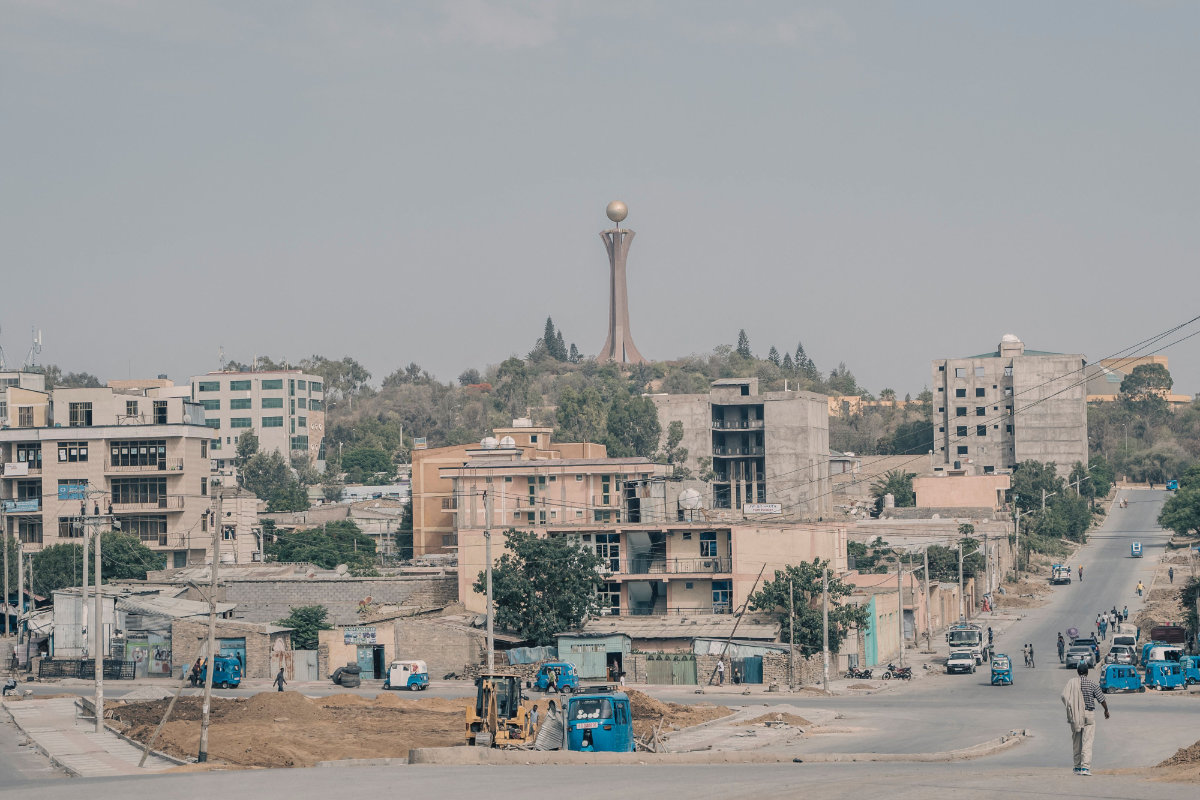


General view of Mekele, the capital city of the Tigray region in northern Ethiopia. (AFP)

Many residents, already deeply weary of war, are panicking over the threat of renewed conflict with reports of bank runs and sold-out flights.
Getachew has asked for assistance from the federal government in Addis Ababa, though he said this should not be military in nature.
The federal government has not responded publicly.

There is concern in Addis Ababa that Eritrea, its historic rival that gained independence from Ethiopia in 1993, will exploit the unrest.
Eritrea’s rhetoric has been increasingly bellicose. Last month, its information minister accused Ethiopia of “waging an intense and unacceptable campaign against Eritrea” and committing “malicious provocations.”
A security source told AFP on condition of anonymity that armed Ethiopian convoys were heading toward the region of Afar, which borders Eritrea, in recent days.
Eritrean President Isaias Afwerki’s dissatisfaction with the 2022 peace agreement, Ethiopian Prime Minister Abiy Ahmed’s ambitions for a Red Sea port and geopolitical interest from the Middle East have fueled the deteriorating tensions, said Kjetil Tronvoll, Oslo University professor specializing in the region.
That has left the “two countries inching closer to a new war,” he said.


Ukraine president to meet European allies after Trump criticism

Updated 58 min 10 sec ago
Follow

Ukraine president to meet European allies after Trump criticism

  • Talks between Ukrainian and US officials in Miami ended on Saturday with no apparent breakthrough
  • President Donald Trump accuses Ukrainian leader of not reading the US proposal to end the war with Russia

LONDON: Ukrainian leader Volodymyr Zelensky was due to meet with European allies in London on Monday, after President Donald Trump accused him of not reading the US proposal to end the war with Russia.

It comes after days of talks between Ukrainian and US officials in Miami ended on Saturday with no apparent breakthrough, with Zelensky committing to further negotiations.

The Ukrainian president will be received in London by British Prime Minister Keir Starmer, along with the German chancellor and French president to discuss the negotiations.

British Foreign Secretary Yvette Cooper is meanwhile expected in Washington on Monday, where she will meet her American counterpart Marco Rubio.

“The UK and US will reaffirm their commitment to reaching a peace deal in Ukraine,” the Foreign Office in London said, announcing Cooper’s visit.

Moscow has meanwhile continued to strike its neighbor, wounding at least nine people overnight Sunday to Monday, according to Ukrainian officials.

‘Disappointed’

Zelensky said he joined his negotiators for a “very substantive and constructive” call with US envoys Steve Witkoff and Jared Kushner during the Miami negotiations.

“Ukraine is committed to continuing to work honestly with the American side to bring about real peace,” Zelensky said on Telegram, adding that the parties agreed “on the next steps and the format of the talks with America.”

But Trump criticized his Ukrainian counterpart on Sunday, telling reporters “I have to say that I’m a little bit disappointed that President Zelensky hasn’t yet read the proposal, that was as of a few hours ago.”

Witkoff and Kushner had met Russian President Vladimir Putin at the Kremlin last week, with Moscow rejecting parts of the US proposal.

French President Emmanuel Macron ahead of Monday’s talks slammed what he called Russia’s “escalatory path.”

“We will continue these efforts with the Americans to provide Ukraine with security guarantees, without which no robust and lasting peace will be possible,” Macron wrote on X.

He added: “We must continue to exert pressure on Russia to compel it to choose peace.”

Hot and cold

Washington’s initial plan to bring an end to the almost four-year war involved Ukraine surrendering land that Russia has not been able to win on the battlefield in return for security promises that fall short of Kyiv’s aspirations to join NATO.

But the nature of the security guarantees that Ukraine could get has so far been shrouded in uncertainty, beyond an initial plan saying that jets to defend Kyiv could be based in Poland.

Trump has blown hot and cold on Ukraine since returning to office in January, initially embracing Putin and chastising Zelensky for not being grateful for US support.

But he has also grown frustrated that his efforts to persuade Putin to end the war, including a summit in Alaska, have failed to produce results and he recently slapped sanctions on Russian oil firms.