

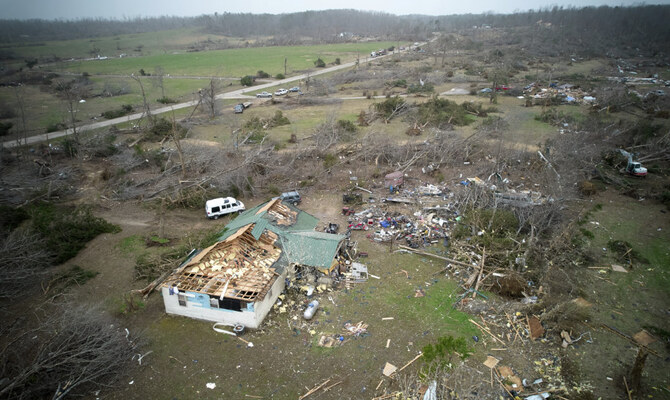
At least 26 dead in massive US storm after Kansas reports 8 fatalities

Destruction from a severe storm is seen Saturday, March 15, 2025, in Wayne County, Mo. (AP)
Short Url
Updated 16 March 2025
Follow

At least 26 dead in massive US storm after Kansas reports 8 fatalities

  • Wildfires elsewhere in the Southern Plains threatened to spread rapidly amid warm, dry weather and strong winds in Texas, Kansas, Missouri and New Mexico

Violent tornadoes ripped through parts of the US, wiping out schools and toppling semitractor-trailers in several states, part of a monster storm that has killed at least 26 people as more severe weather was expected late Saturday.
The number of fatalities increased after the Kansas Highway Patrol reported eight people died in a highway pileup caused by a dust storm in Sherman County Friday. At least 50 vehicles were involved.
Missouri recorded more fatalities than any other state as it withstood scattered twisters overnight that killed at least 12 people, authorities said. The deaths included a man who was killed after a tornado ripped apart his home.
“It was unrecognizable as a home. Just a debris field,” said Coroner Jim Akers of Butler County, describing the scene that confronted rescuers. “The floor was upside down. We were walking on walls.”
Dakota Henderson said he and others rescuing people trapped in their homes Friday night found five dead bodies scattered in the debris outside what remained of his aunt’s house in hard-hit Wayne County, Missouri.
“It was a very rough deal last night,” he said Saturday, surrounded by uprooted trees and splintered homes. “It’s really disturbing for what happened to the people, the casualties last night.”

Henderson said they rescued his aunt from a bedroom that was the only room left standing in her house, taking her out through a window. They also carried out a man who had a broken arm and leg.
Officials in Arkansas said three people died in Independence County and 29 others were injured across eight counties as storms passed through the state.
“We have teams out surveying the damage from last night’s tornadoes and have first responders on the ground to assist,” Arkansas Gov. Sarah Huckabee Sanders said on X.
She and Georgia Gov. Brian Kemp declared states of emergency. Kemp said he was making the declaration in anticipation of severe weather moving in later Saturday.
On Friday, meanwhile, authorities said three people were killed in car crashes during a dust storm in Amarillo in the Texas Panhandle.
Extreme weather encompasses a zone of 100 million people
The deaths came as a massive storm system moving across the country unleashed winds that triggered deadly dust storms and fanned more than 100 wildfires.
Extreme weather conditions were forecast to affect an area home to more than 100 million people. Winds gusting up to 80 mph (130 kph) were predicted from the Canadian border to Texas, threatening blizzard conditions in colder northern areas and wildfire risk in warmer, drier places to the south.
The National Weather Service issued blizzard warnings for parts of far western Minnesota and far eastern South Dakota starting early Saturday. Snow accumulations of 3 to 6 inches (7.6 to 15.2 centimeters) were expected, with up to a foot (30 centimeters) possible.
Winds gusting to 60 mph (97 kph) were expected to cause whiteout conditions.
Evacuations were ordered in some Oklahoma communities as more than 130 fires were reported across the state. Nearly 300 homes were damaged or destroyed. Gov. Kevin Stitt said at a Saturday news conference that some 266 square miles (689 square kilometers) had burned in his state.
The State Patrol said winds were so strong that they toppled several tractor-trailers.
Experts said it’s not unusual to see such weather extremes in March.
Tornadoes hit amid storm outbreak
The Storm Prediction Center said fast-moving storms could spawn twisters and hail as large as baseballs on Saturday, but the greatest threat would come from winds near or exceeding hurricane force, with gusts of 100 mph (160 kph) possible.
Significant tornadoes continued to hit Saturday. The regions at highest risk stretch from eastern Louisiana and Mississippi through Alabama, western Georgia and the Florida panhandle, the center said.
Bailey Dillon, 24, and her fiance, Caleb Barnes, watched a massive tornado from their front porch in Tylertown, Mississippi, about half a mile (0.8 km) away as it struck an area near Paradise Ranch RV Park.
They drove over afterward to see if anyone needed help and recorded a video depicting snapped trees, leveled buildings and overturned vehicles.
“The amount of damage was catastrophic,” Dillon said. “It was a large amount of cabins, RVs, campers that were just flipped over — everything was destroyed.”
Paradise Ranch reported on Facebook that all its staff and guests were safe and accounted for, but Dillon said the damage extended beyond the ranch itself.
“Homes and everything were destroyed all around it,” she said. “Schools and buildings are just completely gone.”
Some of the imagery from the extreme weather has gone viral.
Tad Peters and his dad, Richard Peters, had pulled over to fuel up their pickup truck in Rolla, Missouri, Friday night when they heard tornado sirens and saw other motorists flee the interstate to park.
“Whoa, is this coming? Oh, it’s here. It’s here,” Tad Peters can be heard saying on a video. “Look at all that debris. Ohhh. My God, we are in a torn ...”
His father then rolled up the truck window. The two were headed to Indiana for a weightlifting competition but decided to turn around and head back home to Norman, Oklahoma, about six hours away, where they encountered wildfires.
Wildfires elsewhere in the Southern Plains threatened to spread rapidly amid warm, dry weather and strong winds in Texas, Kansas, Missouri and New Mexico.
A blaze in Roberts County, Texas, northeast of Amarillo, quickly blew up from less than a square mile (about 2 square kilometers) to an estimated 32.8 square miles (85 square kilometers), the Texas A&M University Forest Service said on X. Crews stopped its advance by Friday evening.
About 60 miles (90 kilometers) to the south, another fire grew to about 3.9 square miles (10 square kilometers) before its advance was halted in the afternoon.
High winds also knocked out power to more than 200,000 homes and businesses in Texas, Oklahoma, Arkansas, Missouri, Illinois, Indiana and Michigan, according the website poweroutage.us.


Biden, Obama, GW Bush and Clinton assigned unflattering descriptions on Trump’s Presidential Walk of Fame

Updated 21 min 59 sec ago
Follow

Biden, Obama, GW Bush and Clinton assigned unflattering descriptions on Trump’s Presidential Walk of Fame

  • Two plaques are reserved for Trump's two presidency, each is full of praise and superlatives,  and concludes with “THE BEST IS YET TO COME”
  • Those not to Trump's liking have unflattering descriptions, with Joe Biden introduced as “Sleepy Joe” and “by far, the worst President in American History"

WASHINGTON: President Donald Trump has affixed partisan plaques to the portraits of all US commanders in chief, himself included, on his Presidential Walk of Fame at the White House, describing Joe Biden as “sleepy,” Barack Obama as “divisive” and Ronald Reagan as a fan of a young Trump.
The additions, first seen publicly Wednesday, mark Trump’s latest effort to remake the White House in his own image, while flouting the protocols of how presidents treat their predecessors and doubling down on his determination to reshape how US history is told.
“The plaques are eloquently written descriptions of each President and the legacy they left behind,” White House press secretary Karoline Leavitt said in a statement describing the installation in the colonnade that runs from the West Wing to the residence. “As a student of history, many were written directly by the President himself.”
Indeed, the Trumpian flourishes include the president’s typical bombastic language and haphazard capitalization. They also highlight Trump’s fraught relationships with his more recent predecessors.
An introductory plaque tells passersby that the exhibit was “conceived, built, and dedicated by President Donald J. Trump as a tribute to past Presidents, good, bad, and somewhere in the middle.”
Besides the Walk of Fame and its new plaques, Trump has adorned the Oval Office in gold and razed the East Wing in preparation for a massive ballroom. Separately, his administration has pushed for an examination of how Smithsonian exhibits present the nation’s history, and he is playing a strong hand in how the federal government will recognize the nation’s 250th anniversary in 2026.
Here’s a look at how Trump’s colonnade exhibit tells the presidential story.
Joe Biden
Joe Biden is still the only president in the display not to be recognized with a gilded portrait. Instead, Trump chose an autopen, reflecting his mockery of Biden’s age and assertions that Biden was not up to the job.
Biden, who defeated Trump in the 2020 election and dropped out of the 2024 election before their pending rematch, is introduced as “Sleepy Joe” and “by far, the worst President in American History” who “brought our Nation to the brink of destruction.”
Two plaques blast Biden for inflation and his energy and immigration policy, among other things. The text also blames Biden for Russian President Vladimir Putin’s invasion of Ukraine and asserts falsely that Biden was elected fraudulently.
Biden’s post-White House office had no comment on his plaque.
Barack Obama
The 44th president is described as “a community organizer, one term Senator from Illinois, and one of the most divisive political figures in American History.”
The plaque calls Obama’s signature domestic achievement “the highly ineffective ‘Unaffordable Care Act.”
And it notes that Trump nixed other major Obama achievements: “the terrible Iran Nuclear Deal ... and ”the one-side Paris Climate Accords.”
An aide to Obama also declined comment.
George W. Bush
George W. Bush, who notably did not speak to Trump when they were last together at former President Jimmy Carter’s funeral, appears to win approval for creating the Department of Homeland Security and leading the nation after the terrorist attacks of Sept. 11, 2001.
But the plaque decries that Bush “started wars in Afghanistan and Iraq, both of which should not have happened.”
An aide to Bush didn’t return a message seeking comment.
Bill Clinton
The 42nd president, once a friend of Trump’s, gets faint praise for major crime legislation, an overhaul of the social safety net and balanced budgets.
But his plaque notes Clinton secured those achievements with a Republican Congress, the help of the 1990s “tech boom” and “despite the scandals that plagued his Presidency.”
Clinton’s recognition describes the North American Free Trade Agreement, another of his major achievements, as “bad for the United States” and something Trump would “terminate” during his first presidency. (Trump actually renegotiated some terms with Mexico and Canada but did not scrap the fundamental deal.)
His plaque ends with the line: “In 2016, President Clinton’s wife, Hillary, lost the Presidency to President Donald J. Trump!”
An aide to Clinton did not return a message seeking comment.
Other notable plaques
The broadsides dissipate the further back into history the plaques go.
Republican George H.W. Bush, who died during Trump’s first term, is recognized for his lengthy resume before becoming president, along with legislation including the Clean Air Act and Americans With Disabilities Act — despite Trump’s administration relaxing enforcement of both. The elder Bush’s plaque does not note that he, not Clinton, first pushed the major trade law that became NAFTA.
Lyndon Johnson’s plaque credits the Texas Democrat for securing the Civil Rights Act of 1964 and Voting Rights Act of 1965 (seminal laws that Trump’s administration interprets differently than previous administrations). It correctly notes that discontent over Vietnam led to LBJ not seeking reelection in 1968.
Democrat John F. Kennedy, the uncle of Trump’s health secretary, Robert F. Kennedy Jr., is credited as a World War II “war hero” who later used “stirring rhetoric” as president in opposition to communism.
Republican Richard Nixon’s plaque states plainly that the Watergate scandal led to his resignation.
While Trump spared most deceased presidents of harsh criticism, he jabbed at one of his regular targets, the media — this time across multiple centuries: Andrew Jackson’s plaque says the seventh president was “unjustifiably treated unfairly by the Press, but not as viciously and unfairly as President Abraham Lincoln and President Donald J. Trump would, in the future, be.”
Donald Trump
With two presidencies, Trump gets two displays. Each is full of praise and superlatives — “the Greatest Economy in the History of the World.” He calls his 2016 Electoral College margin of 304-227 a “landslide.”
Trump’s second-term plaque notes his popular vote victory — something he did not achieve in 2016 — and concludes with “THE BEST IS YET TO COME.”
Meanwhile, the introductory plaque presumes Trump’s addition will be a White House fixture once he is no longer president: “The Presidential Walk of Fame will long live as a testament and tribute to the Greatness of America.”