



MITHI: In a desert town in Pakistan, Hindus prepare meals for fasting Muslims, who in turn gather to welcome a Holi procession, a rare moment of religious solidarity in the Islamic nation.
Discrimination against minorities runs deep in Muslim-majority Pakistan, but those tensions are not to be found in Mithi, an affluent city of rolling sand dunes and mud-brick homes in southern Sindh province.
“All the traditions and rituals here are celebrated together,” Raj Kumar, a 30-year-old Hindu businessman told AFP.
“You will see that on Holi, Hindu youth are joined by Muslim youth, celebrating together and applying colors on each other,” he added.
“Even at the end of the Muslim call for prayer, the imam says ‘peace to Hindus and Muslims’.”
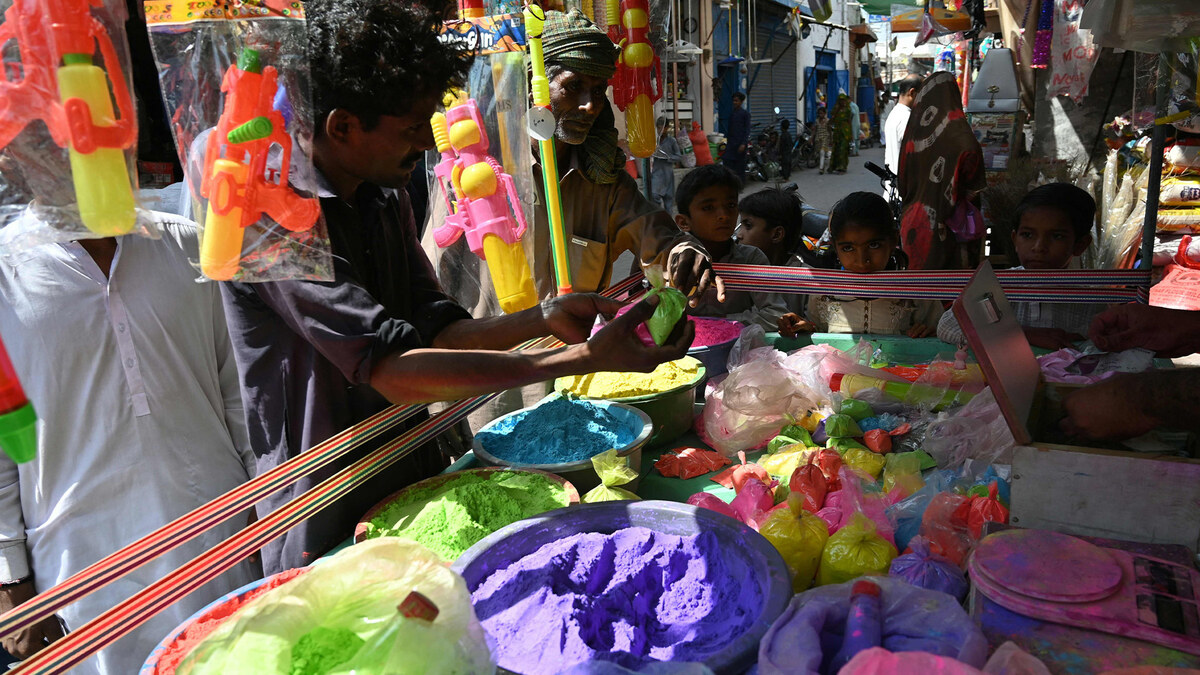
Hindu residents buy colour powders to celebrate the Hindu festival of Holy in Tharparkar district of the desert town of Mithi, south-eastern Pakistan, on March 13, 2025. ( AFP)
This year, the Hindu festival of Holi and the Islamic fasting month of Ramadan fell together. Both events move each year according to the lunar calendar.
Holi, the festival of color, has for centuries marked the arrival of spring and raucous crowds playfully throw colored powder and water over each other.
On Thursday, hundreds of Hindus held a procession through the streets of Mithi, one of the few towns where they form the majority, to be warmly welcomed at the city square by their Muslim neighbors.
“We have learnt to live together since childhood. This has come to us through generations, and we are following it too,” said local Mohan Lal Mali, 53, after arranging a meal for Muslims to break their fast.
Cows, considered sacred in Hinduism, roam freely through the streets of Mithi, while women wear traditional embroidered sarees embellished with mirror work.
There is no beef shop in town, as its meat is prohibited in Hinduism, and Muslims only sacrifice goats during festivals.
Mithi, a city of around 60,000 people, is predominantly Hindu — in a country where 96 percent of its 240 million people are Muslim and two percent are Hindu.
Fozia Haseeb, a Christian woman, traveled from the port city of Karachi, around 320 kilometers (200 miles) away, to witness the blended occasions.
“People following three religions are here: Christians, Hindus and Muslims,” she said.
“We wanted to see for ourselves whether this was correct, and there is no doubt it is.”
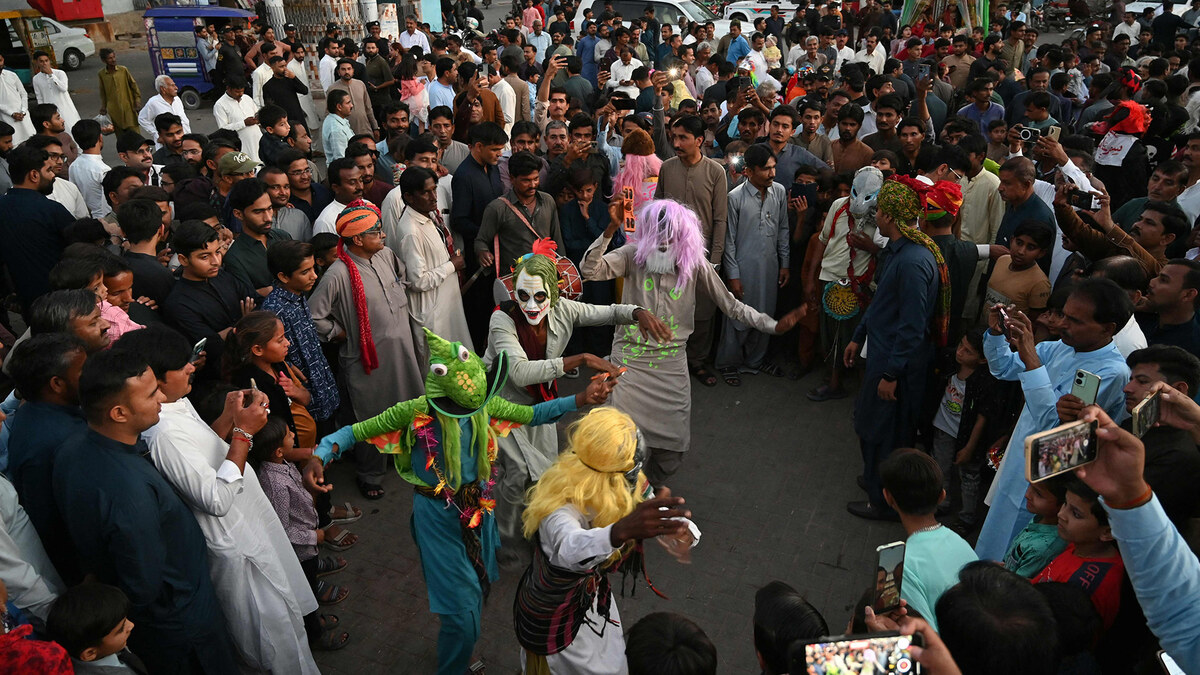
People celebrate Hindu festival of Holy in Tharparkar district of the desert town of Mithi, south-eastern Pakistan, on March 13, 2025. (AFP)
Ramadan is a month of peaceful prayer and reflection in Islam, and Hindus respected their Muslim neighbors would not join Holi celebrations with the usual fervor due to religious observance.
“Today, you might not see colors on me, but in the past, they would drench me in colors,” said Muslim cleric Babu Aslam Qaimkhani while applying powder to the face of local Hindu MP Mahesh Kumar Malani.
“If a Hindu runs for office, Muslims also vote for them, and vice versa,” said Malani, the only elected minority MP in the country’s national assembly.
As Hindus celebrated with processions and visits to temples, there was no armed security — a stark contrast to other parts of Pakistan.
Freedom of religion or belief remains under constant threat in the country, with religiously motivated violence and discrimination increasing yearly, according to the Human Rights Commission of Pakistan.
State authorities, often using religious unrest for political gain, have failed to address this crisis, the commission said.
But in Mithi, 19-year-old Muslim laborer Amaan Ullah told AFP: “There are no divisions among us. We all are humans, and we all are equal.”
Local police and administration officials said the city has a low crime rate, with “no major security challenges,” allowing them to easily make arrangements for the major religious festivals.
“Their businesses, their daily lives, and their interactions have been together for centuries and they are still standing strong,” said local official Abdul Haleem Jagirani.
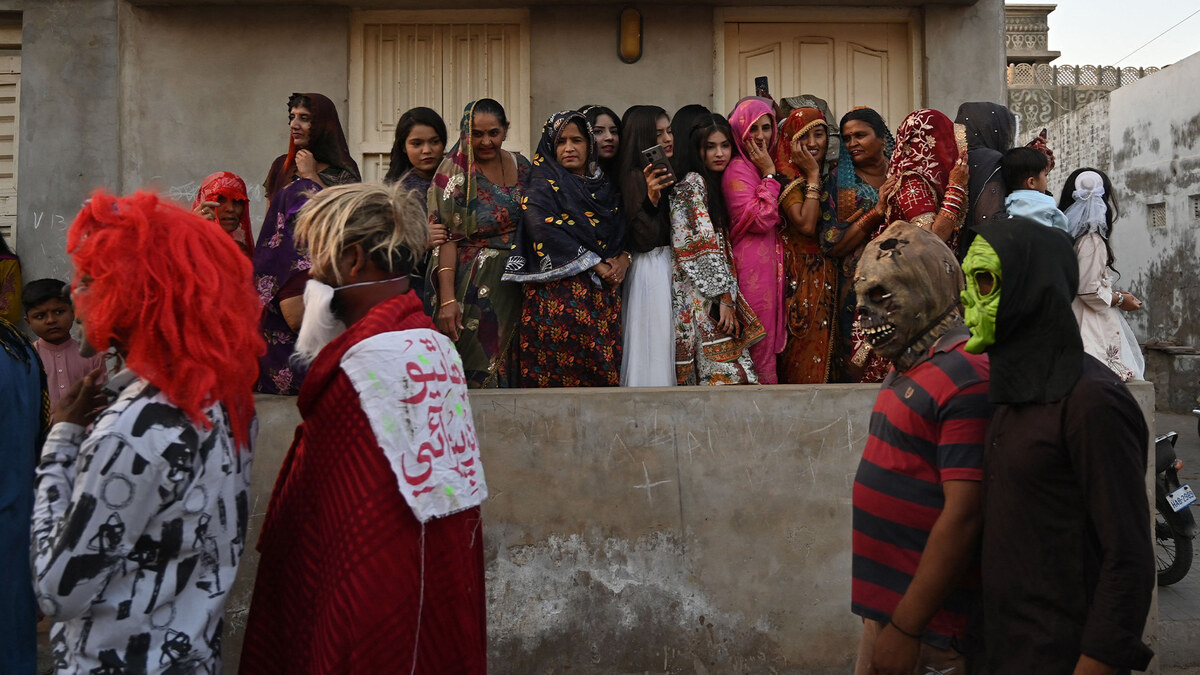
Hindu women watch the procession as they celebrate Hindu festival of Holy in Tharparkar district of the desert town of Mithi, south-eastern Pakistan, on March 13, 2025. (AFP)
Locals say Mithi’s peaceful existence can be traced back to its remote location, emerging from the sand dunes of the Tharparkar desert, which borders the modern Indian state of Rajasthan.
With infertile soil and limited water access, it was spared from centuries of looting and wars, and the bloody Partition violence of 1947 when India and Pakistan were created, and many Hindus fled across the new border.
But several residents told AFP that in recent years the prosperous city has seen a rise in newcomers as a result of its growing infrastructure.
A major coal project nearby has brought laborers from other provinces to the city, and with it, supporters of a radical Islamist party.
On the city’s central square, a large banner hangs for Tehreek-e-Labbaik Pakistan (TLP), which put the explosive issue of blasphemy as its central concern.
“People coming from outside the city are causing some doubt and a slight sense of fear,” Padma Lodha, a 52-year-old Hindu headmistress at a local girls school, told AFP.
“But overall, things are still well-controlled and peaceful.”


