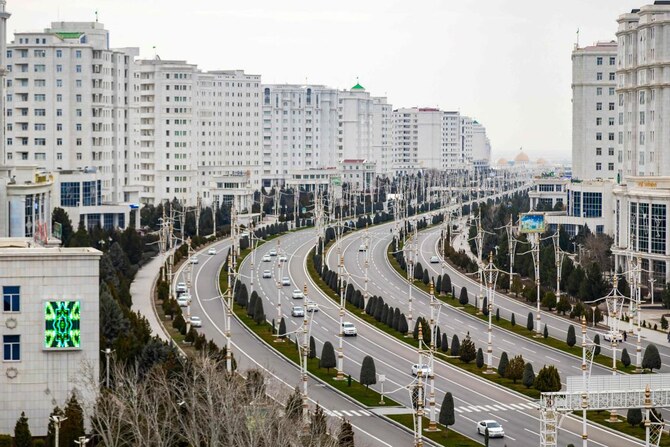
ASHGABAT, Turkmenistan: Mekhri feels “a sense of freedom and self-confidence” when she’s behind the wheel of a car – despite being forced to drive illegally because of an unwritten rule preventing women getting a license.
In Turkmenistan, the reclusive Central Asian state where she lives, young women are effectively banned from driving.
“I know the rules of the road. I drive calmly, don’t overtake anyone and know how to park,” the 19-year-old said.
Like other women interviewed by AFP in Turkmenistan – ranked by rights groups as one of the most closed and repressive countries in the world – she withheld her surname.
There is no legislation specifically outlawing women under 30 from obtaining a driving license.
But it is one of many informal prohibitions that is universally followed, so women that do drive must do so without this precious permit, which is indeed against the law.
“When my daughter wanted to enroll at the driving school, we were told that she could take lessons but that she would probably not pass the test,” said Guzel, Mekhri’s 57-year-old mother.
So instead of paying for lessons, Guzel assumed the role of instructor and now takes Mekhri outside the capital, Ashgabat, to practice.
“Where there are few cars, police officers and cameras, I let my daughter take the wheel and I teach her,” Guzel, who started driving when she was 40, said.
Among the other transport-related diktats imposed by father-and-son duo Gurbanguly and Serdar Berdymukhamedov – who have ruled the country one after the other since 2006 – are a ban on black cars.
Owners have been forced to paint the vehicles white, the favorite color of Gurbanguly, whose official titles are “Hero-Protector” and “leader of the Turkmen nation.”
Many young women share Mekhri’s frustration.
“I wanted to take my test at 18. At the driving school, the instructor immediately warned the many girls there: ‘You’ve come for nothing. You won’t be able to take it,” said Maisa, a 26-year-old saleswoman.
“But up to the exam, driving schools take both boys and girls, because they pay,” she said.
Goulia, 19, said her parents had wanted to buy her a car when she went to university so she could be more independent, do the family shopping and take her grandmother to hospital and the chemist’s.
“But because of the difficulties that girls like me face getting a driver’s license, my mother said she would have to postpone the decision,” she said.
“I’ve just turned 19 and I can’t get a license but the boys can and I don’t understand why,” she added.
Turkmenistan’s motor transport agency did not respond to an AFP request to comment.
Contacted via phone by AFP, one driving school said “women have the right to enroll in the course and take the exam” before abruptly hanging up.
But another instructor from Ashgabat acknowledged the informal ban.
“It is due to a sharp increase in accidents involving female drivers,” the instructor said, speaking on condition of anonymity.
“After an investigation by the authorities, it turned out they were simply buying driving licenses,” the instructor said – a claim AFP could not verify.
Rules have also been tightened for women over 30 who are not covered by the informal ban.
To register a car in their own name, they have to show a marriage certificate, family record book and a report from their employer.
Authorities routinely reject accusations that they are restricting women’s rights.
Responding to a recent United Nations report criticizing the country, the government said: “The motherland treats mothers and women with great respect.”
Ahead of International Women’s Day on March 8, President Serdar Berdymoukhamedov gifted every woman the equivalent of $3 – enough to buy a cake or six kilograms (13 pounds) of potatoes.


![]()

Driving ban puts brakes on young women in Turkmenistan
Short Url
https://arab.news/5mt32
Driving ban puts brakes on young women in Turkmenistan
- There is no legislation specifically outlawing women under 30 from obtaining a driving license in Turkmenistan
- But it is one of many informal prohibitions that is universally followed, so women that do drive must do so without a permit

Latest updates


© 2026 SAUDI RESEARCH & PUBLISHING COMPANY, All Rights Reserved And subject to Terms of Use Agreement.