ASHGABAT, Turkmenistan: The energy-rich former Soviet republic of Turkmenistan has devalued its currency against the US dollar by 18 percent, in the latest sign of contagion among Russia’s neighbors from the plunging ruble.
The secretive Central Asian country has vast oil and gas reserves and has erected grandiose marble-clad palatial government buildings and sports complexes, but failed to raise living standards for most of its five million people.
On Thursday, the website of Turkmenistan’s central bank published the rate of 3.50 manats to the US dollar, up from 2.85 manats, a depreciation of 18.6 percent. It gave no explanation.
The devaluation came as the plunge in value of the Russian ruble, linked to Western sanctions over Ukraine and falling oil prices, sent shockwaves through former Soviet republics.
All currency exchange offices and banks in the capital Ashgabat were closed Thursday, even at the airport, officially due to the public holiday. At one exchange point in the city center that is usually open 24 hours, people regularly drove up to check whether it was operating.
With official state media shut down for the holiday and television channels broadcasting only festive concerts, there was no official comment.
Earlier Thursday, Turkmenistan’s oil and gas ministry announced petrol prices had risen by 60 percent. The rising price did not immediately lead to long queues at petrol pumps.
A liter of one type of petrol on Thursday cost one manat, while previously it cost 62 tenge (22 US cents under the previous exchange rate).
No immediate explanation was given for the sudden price rise.
President Gurbanguly Berdymukhamedov was bullish on the economy in his live televised address to the nation just before midnight Wednesday saying Turkmenistan had “achieved high levels in all areas of the economy” and strengthened its “economic might.”
Rumours of an approaching devaluation had been circulating for several months since the autumn, prompting many to change their savings into dollars. Exchange points had responded by introducing a $1,000 limit on the amount of dollars that could be purchased with manats.
The official exchange rate set by the central bank for the manat had been set at 2.85 to the US dollar since 2009. Earlier in 2009, Turkmenistan had knocked zeroes off the manat in a re-denomination after the official exchange rate reached 14,250 to the dollar.
Turkmenistan’s former Soviet neighbors in Central Asia have already suffered serious economic fallout from the plunge in value of the Russian ruble, which fell 41 percent against the dollar in 2014.
Kyrgyzstan saw its local currency, the som, fall more than 17 percent in value against the dollar in 2014, while Tajikistan’s currency, the somon, lost nearly 14 percent against the dollar. Both countries are highly dependent on remittances from people working in Russia.
Kazakhstan’s central bank back in February devalued its currency, the tenge, by about 19 percent.
The crisis forced the central bank of another of Russia’s ex-Soviet neighbors, Belarus, to introduce emergency measures and its authoritarian President Alexander Lukashenko sacked the prime minister on Saturday.
Kazakhstan, Belarus and Russia have created an economic bloc that comes into force Thursday. Another ex-Soviet state, Armenia, has also joined.
Jitters over Turkmenistan’s currency came despite the country’s enormous energy wealth. It claims to hold the world’s fourth-biggest reserves of natural gas and also has vast oil deposits.
The country’s energy wealth has attracted interest from international energy giants. In November, Italian energy giant Eni signed a preliminary deal to move into offshore oil and gas exploration in Turkmenistan’s Caspian sector.
Turkmenistan has been led by Berdymukhamedov, a former dentist, since 2006, following the death of the eccentric dictator Saparmurat Niyazov, who erected a golden statue of himself that revolved to face the sun.
The country was ranked 169 out of 174 in Transparency International’s corruption perceptions index last month.


![]()
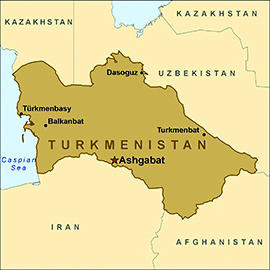
Energy-rich Turkmenistan devalues currency against dollar
Energy-rich Turkmenistan devalues currency against dollar
Latest updates


© 2026 SAUDI RESEARCH & PUBLISHING COMPANY, All Rights Reserved And subject to Terms of Use Agreement.