Jewish protesters flood Trump Tower’s lobby to demand the Columbia University activist’s release

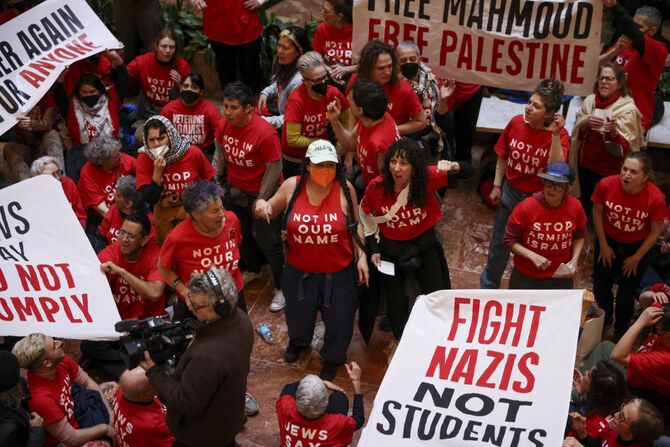
Demonstrators from the Jewish Voice for Peace protest inside Trump Tower in New York in support of Columbia graduate student Mahmoud Khalil, March 13, 2025. (AP)
Short Url
Updated 13 March 2025
Follow

Jewish protesters flood Trump Tower’s lobby to demand the Columbia University activist’s release

  • Mahmoud Khalil helped lead student protests on the Manhattan campus against Israel’s war in Gaza
  • Jewish Voice for Peace protesters chanted 'Bring Mahmoud home now!'

NEW YORK: Demonstrators from a Jewish group filled the lobby of Trump Tower on Thursday to denounce the immigration arrest of a Columbia University activist who helped lead student protests on the Manhattan campus against Israel’s war in Gaza.
The Jewish Voice for Peace protesters, who carried banners and wore red shirts reading “Jews say stop arming Israel,” chanted “Bring Mahmoud home now!“
After warning the protesters to leave the Fifth Avenue building or face arrest, police began putting them in zip ties and loading them into police vans outside about an hour after the demonstration began.
Mahmoud Khalil, a permanent US resident who is married to an American citizen and who hasn’t been charged with breaking any laws, was arrested outside his New York City apartment on Saturday and faces deportation. President Donald Trump has said Khalil’s arrest was the first “of many to come” and vowed on social media to deport students who he said engage in “pro-terrorist, anti-Semitic, anti-American activity.”
Police, who were staged inside and outside the Fifth Avenue building ahead of the demonstration, began arresting protesters after warning them to leave.
Among the protesters was actor Debra Winger, who has discussed her Jewish faith and upbringing over the years.
Winger accused the Trump administration of having “no interest in Jewish safety” and “co-opting antisemitism.”
“I’m just standing up for my rights, and I’m standing up for Mahmoud Khalil, who has been abducted illegally and taken to an undisclosed location,” she told The Associated Press. “Does that sound like America to you?”
Khalil’s supporters say his arrest is an attack on free speech and have staged protests elsewhere in the city and around the country. Hundreds demonstrated Wednesday outside a Manhattan courthouse during a brief hearing on his case.
Trump Tower serves as headquarters for the Trump Organization and is where the president stays when he is in New York. The skyscraper often attracts demonstrations, both against and in support of its namesake, though protests inside are less common. The building’s main entrance opens to a multi-story atrium that is open to the public and connects visitors to stores and eateries such as the Trump Grill.
Khalil, 30, was being detained at an immigration detention center in Louisiana, where he has remained after a brief stop at a New Jersey lockup.
Columbia was a focal point of the pro-Palestinian protest movement that swept across US college campuses last year and led to more than 2,000 arrests.
Khalil, whose wife is pregnant with their first child, finished his requirements for a Columbia master’s degree in December. Born in Syria, he is a grandson of Palestinians who were forced to leave their homeland, his lawyers said in a legal filing.


Only 4% women on ballot as Bangladesh prepares for post-Hasina vote

Updated 19 min 5 sec ago
Follow

Only 4% women on ballot as Bangladesh prepares for post-Hasina vote

  • Women PMs have ruled Bangladesh for over half of its independent history
  • For 2026 vote, only 20 out of 51 political parties nominated female candidates

DHAKA: As Bangladesh prepares for the first election since the ouster of its long-serving ex-prime minister Sheikh Hasina, only 4 percent of the registered candidates are women, as more than half of the political parties did not field female candidates.

The vote on Feb. 12 will bring in new leadership after an 18-month rule of the caretaker administration that took control following the student-led uprising that ended 15 years in power of Hasina’s Awami League party.

Nearly 128 million Bangladeshis will head to the polls, but while more than 62 million of them are women, the percentage of female candidates in the race is incomparably lower, despite last year’s consensus reached by political parties to have at least 5 percent women on their lists.

According to the Election Commission, among 1,981 candidates only 81 are women, in a country that in its 54 years of independence had for 32 years been led by women prime ministers — Hasina and her late rival Khaleda Zia.

According to Dr. Rasheda Rawnak Khan from the Department of Anthropology at Dhaka University, women’s political participation was neither reflected by the rule of Hasina nor Zia.

“Bangladesh has had women rulers, not women’s rule,” Khan told Arab News. “The structure of party politics in Bangladesh is deeply patriarchal.”

Only 20 out of 51 political parties nominated female candidates for the 2026 vote. Percentage-wise, the Bangladesh Socialist Party was leading with nine women, or 34 percent of its candidates.

The election’s main contender, the Bangladesh Nationalist Party, whose former leader Zia in 1991 became the second woman prime minister of a predominantly Muslim nation — after Pakistan’s Benazir Bhutto — was the party that last year put forward the 5 percent quota for women.

For the upcoming vote, however, it ended up nominating only 10 women, or 3.5 percent of its 288 candidates.

The second-largest party, Jamaat-e-Islami, has not nominated a single woman.

The 4 percent participation is lower than in the previous election in 2024, when it was slightly above 5 percent, but there was no decreasing trend. In 2019, the rate was 5.9 percent, and 4 percent in 2014.

“We have not seen any independent women’s political movement or institutional activities earlier, from where women could now participate in the election independently,” Khan said.

“Real political participation is different and difficult as well in this patriarchal society, where we need to establish internal party democracy, protection from political violence, ensure direct election, and cultural shifts around female leadership.”

While the 2024 student-led uprising featured a prominent presence of women activists, Election Commission data shows that this has not translated into their political participation, with very few women contesting the upcoming polls.

“In the student movement, women were recruited because they were useful, presentable for rallies and protests both on campus and in the field of political legitimacy. Women were kept at the forefront for exhibiting some sort of ‘inclusive’ images to the media and the people,” Khan said.

“To become a candidate in the general election, one needs to have a powerful mentor, money, muscle power, control over party people, activists, and locals. Within the male-dominated networks, it’s very difficult for women to get all these things.”