Inspired by diabetic father, Bangladeshi man’s juice recipes go viral in Ramadan

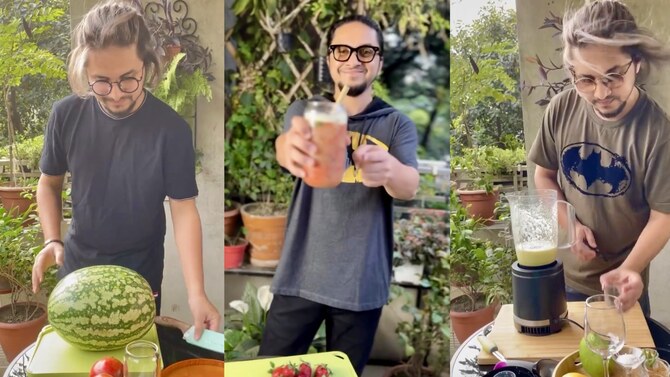
This collage of photos shows Imran Ahmed Saudagar recording his viral videos with healthy juice recipes at his home in Dhaka, Bangladesh. (Instagram/theupsidedownguy)
Short Url
Updated 20 March 2025
Follow

Inspired by diabetic father, Bangladeshi man’s juice recipes go viral in Ramadan

  • Imran Ahmed Saudagar started making healthy fresh juices for his father during COVID-19 pandemic
  • His first viral juice video, a Goa Lemon recipe based on a Nando’s drink, got 2 million views

DHAKA: In a two-minute video, Imran Ahmed Saudagar playfully juggles wood apples before cracking them open, scooping out the flesh, and blending it with jaggery, salt, and water into a creamy juice — one of his signature recipes, which for the past few years have accompanied Bangladeshi netizens during Ramadan.

The wood apple juice video was Saudagar’s first this fasting month and it immediately drew the attention of the tens of thousands of his followers, who welcomed back the “much awaited series” and the “Shorbot Saudagar Season.”

The word “shorbot” means “juice” in Bengali, and Shorbot With Saudagar is what the Dhaka-based advertising professional and accidental healthy juice influencer called his short recipe videos, which he started during the COVID-19 pandemic.

The inspiration to create the recipes came from his late father.

“He was around 75 years old at the time. And he started refusing all kinds of fruits. So, I started creating different combinations of fruits and blended them together to make a new juice every day,” Saudagar told Arab News.

As he mixed new ingredients, his father enjoyed guessing them by taste and looked forward to the juice game the next day.

To make sure his father consumed what was beneficial, Saudagar consulted his doctors and sought help from nutritionists while preparing new blends.

Initially a family affair, the juices started to reach a wider audience a few months later, when Saudagar got married and his wife suggested that they should record the recipes.

“We started researching what kind of crockery I should use to cut the fruits, what fruit should we buy, what are the best fruit combinations. We discussed it every night and we started making different juices every day,” he said.

Their first viral blend was inspired by a Goa Lemon juice they tried at the fast chain Nando’s. Saudagar recalled it was with yoghurt, mint and lime, to which he added some vanilla ice cream.

“It was a blast. People started loving it. They tried it at home, and they were saying: ‘Oh man, this is like the original Goa Lemon,’” he said.

“I didn’t have the recipe. I just tried making it and it happened. The Goa Lemon video was (viewed by) around 2 million people.”

While pursuing a corporate career, Saudagar did the videos only in his free time but tried to make more, especially during the month of fasting, as his fans inspired him to do so.

“People started knocking to me just before the day Ramadan started: ‘Brother, when is Shorbot With Saudagar coming? When are you making new juice? When are you making new recipes?’” he said.

“Every day, people were commenting and replying on my posts: ‘I’m waiting for the new recipe, new video. But the best comment was: ‘Brother, I think, Ramadan is incomplete without your videos.’”

Since he started the project, Saudagar has recorded over 70 videos. While he may be short of new local fruits to explore, as he has already tried most of them, this fasting month he will try to develop some fruit-based electrolyte drinks.

“I’m still researching how to make it,” he said. “That should be one new thing. And also, I want to add more smoothies to help you with stomach health and digestion. You need to be healthy during Ramadan.”


Mistrial declared in the case of Stanford students charged after pro-Palestinian protests in 2024

Updated 6 sec ago
Follow

Mistrial declared in the case of Stanford students charged after pro-Palestinian protests in 2024

SAN FRANCISCO, US: A judge declared a mistrial Friday in the case of five current and former Stanford University students charged after pro-Palestinian protests in 2024, when they barricaded themselves inside the university president and provost executive offices.
The trial in Santa Clara County was a rare instance of demonstrators facing felony charges from protests over the Israel-Hamas war that roiled campuses across the country. The two sides argued over free speech, lawful dissent and crime during the three-week proceedings.
The jury voted 9 to 3 to convict on a felony charge of vandalism and 8 to 4 to convict on a felony charge of conspiracy to trespass. After deliberating for five days, jurors said they could not reach a verdict.
Judge Hanley Chew asked each one if more time deliberating would help break the impasse, and all answered, “No.”
“It appears that this jury is hopelessly deadlocked, and I’m now declaring a mistrial in counts one and two,” Chen said. He then dismissed the jurors.
Demonstrators barricaded themselves inside the offices for several hours on June 5, 2024, the last day of spring classes at the university.
Prosecutors said the defendants spray-painted the building, broke windows and furniture, disabled security cameras and splattered a red liquid described as fake blood on items throughout the offices.
Defense attorneys said the protest was protected speech and there was insufficient evidence of an intent to damage the property. They also said the students wore protective gear and barricaded the offices out of fear of being injured by police and campus security.
If convicted, the defendants would have faced up to three years in prison and been obligated to pay restitution of over $300,000.
Santa Clara County District Attorney Jeff Rosen said he would pursue a new trial.
“This case is about a group of people who destroyed someone else’s property and caused hundreds of thousands of dollars in damage,” Rosen said in a statement. “That is against the law and that is why we will retry the case.”
As the mistrial was announced, the students, some wearing kaffiyehs, sat on a bench in the courtroom and did not show a visible reaction.
“The District Attorney’s Office had Stanford University supporting them and other multibillion-dollar institutions behind them, and even then the district attorney was unable to convict us,” Germán González, who was a sophomore at Stanford when he was arrested, told The Associated Press by phone later. “No matter what happens, we will continue to fight tooth and nail for as long as possible, because at the end of the day, this is for Palestine.”
Authorities initially arrested and charged 12 people in the case, but one pleaded no contest under an agreement that allows some young people to have their cases dismissed and records sealed if they successfully complete probation.
He testified for the prosecution, leading to a grand jury indictment of the others in October of the others. Six of those accepted pretrial plea deals or diversion programs, and the remaining five pleaded not guilty and sought a jury trial.
Protests sprung up on campuses across the country over the Israel-Hamas conflict, with students setting up camps and demanding their universities stop doing business with Israel or companies that support its war efforts against Hamas.
About 3,200 people were arrested in 2024 nationwide. While some colleges ended demonstrations by striking deals with students or simply waited them out, others called in police. Most criminal charges were ultimately dismissed.