

Saudi-run terminal in Chittagong expands as major hub for Bangladesh’s foreign trade

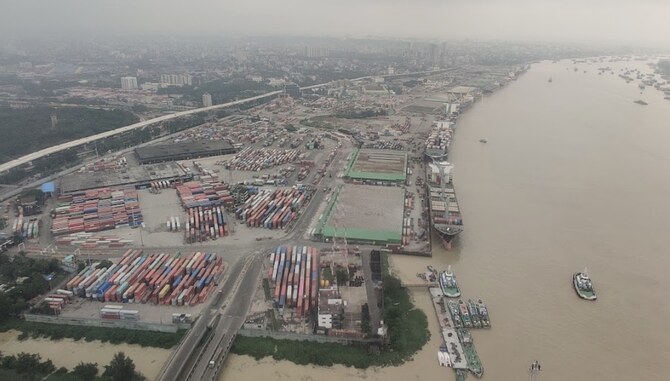
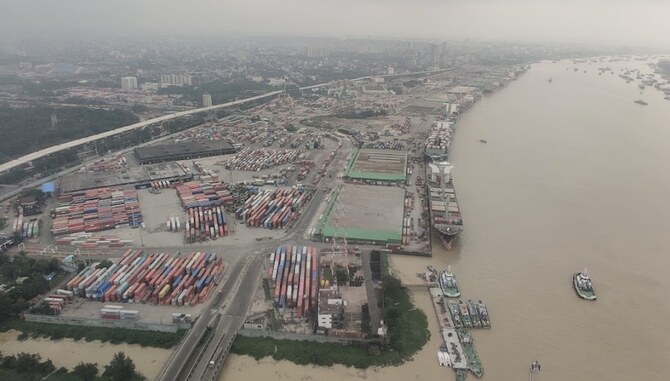
A general view of the Patenga Terminal and the Chittagong Port, Bangladesh, 2024. (Azmal Hossain Fuad)
Short Url
Updated 11 March 2025
Follow

Saudi-run terminal in Chittagong expands as major hub for Bangladesh’s foreign trade

  • Red Sea Gateway Terminal is the first foreign company to operate Bangladeshi ports
  • It is now exploring new opportunities, including in the country’s deep-sea port

DHAKA: Saudi developer Red Sea Gateway Terminal, which last year started operations at Bangladesh’s largest port, plans further expansion as it already facilitates about 10 percent of the country’s imports and exports.

Chittagong Port is the busiest container port on the Bay of Bengal. Last year, it handled about 3.3 million TEU, or 20-foot equivalent units, serving as the main gateway for Bangladesh’s ocean cargo import and export.

RSGT, which in June last year started operations at Chittagong’s Patenga Container Terminal, is the first foreign company operating Bangladeshi ports.

According to its agreement with the Chittagong Port Authority, RSGT will run the terminal for the next 22 years.

“RSGT Chittagong operates 24/7, 365 days a year, ensuring seamless and uninterrupted service for the trade community … Our operations facilitate around 10 percent of Bangladesh’s total imports and exports,” Erwin Haaze, CEO of RSGT Bangladesh, told Arab News on Monday.

“We manage all containerized shipments passing through Patenga Terminal efficiently, facilitating smooth trade for a diverse range of industries, from manufacturing to retail.”

The company is steadily increasing the terminal’s output and is expected to have a maximum annual capacity of 600,000 TEU.

It also plans to more than double its permanent workforce.

“RSGT has plans to invest approximately $170 million in the RSGT Terminal. This investment has already created more than 300 permanent jobs, which are expected to increase to more than 700 when in full operation,” Haaze said.

“Regarding indirect employment, RSGT Chittagong is committed to growing with the community and has engaged with many local vendors to participate in different tasks in RSGT Chittagong. With further expansions, we anticipate generating even more job opportunities in the coming years.”

Following the success of the Patenga Terminal, Saudi investors are exploring more opportunities in port-related sectors in Bangladesh, including the Matarbari Port — the country’s first deep-sea port, which the government wants to build some 120 km south of the Chittagong Port.

Saudi Ambassador to Dhaka Essa Al-Duhailan told Arab News that talks with the relevant authorities were already underway.

“The investment in Chottogram (Chittagong) Bay Terminal is between $300 million and $400 million, and the other one (Matarbari Deep Sea Port) will be maybe $700 million to $800 million,” he said.

“The intention is there, and the willingness is there. The excellent performance of the Saudi company, Red Sea Gateway, is already shown to the Bangladeshis and they are satisfied … The experience is encouraging so far.”


China’s top diplomat to visit Somalia on Africa tour

Updated 54 min 15 sec ago
Follow

China’s top diplomat to visit Somalia on Africa tour

  • Stop in Mogadishu provides diplomatic boost after Israel formally recognized breakaway Somaliland
  • Tour focusses on Beijing's strategic trade ​access across eastern and southern Africa

BEIJING: China’s top diplomat began his annual New Year tour of Africa on Wednesday, focusing on strategic trade ​access across eastern and southern Africa as Beijing seeks to secure key shipping routes and resource supply lines.
Foreign Minister Wang Yi will travel to Ethiopia, Africa’s fastest-growing large economy; Somalia, a Horn of Africa state offering access to key global shipping lanes; Tanzania, a logistics hub linking minerals-rich central Africa to the Indian Ocean; and Lesotho, a small southern African economy squeezed by US trade measures. His trip this year runs until January 12.
Beijing aims to highlight countries it views as model partners of President Xi Jinping’s flagship “Belt and Road” infrastructure program and to expand export markets, particularly in young, increasingly ‌affluent economies such ‌as Ethiopia, where the IMF forecasts growth of 7.2 percent this year.
China, ‌the ⁠world’s ​largest bilateral ‌lender, faces growing competition from the European Union to finance African infrastructure, as countries hit by pandemic-era debt strains now seek investment over loans.
“The real litmus test for 2026 isn’t just the arrival of Chinese investment, but the ‘Africanization’ of that investment. As Wang Yi visits hubs like Ethiopia and Tanzania, the conversation must move beyond just building roads to building factories,” said Judith Mwai, policy analyst at Development Reimagined, an Africa-focussed consultancy.
“For African leaders, this tour is an opportunity to demand that China’s ‘small yet beautiful’ projects specifically target our industrial gaps, ⁠turning African raw materials into finished products on African soil, rather than just facilitating their exit,” she added.
On his start-of-year trip in 2025, ‌Wang visited Namibia, the Republic of Congo, Chad and Nigeria.
His visit ‍to Somalia will be the first by a Chinese foreign minister since the 1980s and is ‍expected to provide Mogadishu with a diplomatic boost after Israel became the first country to formally recognize the breakaway Republic of Somaliland, a northern region that declared itself independent in 1991.
Beijing, which reiterated its support for Somalia after the Israeli announcement in December, is keen to reinforce its influence around the Gulf of Aden, the entrance ​to the Red Sea and a vital corridor for Chinese trade transiting the Suez Canal to Europe.
Further south, Tanzania is central to Beijing’s plan to secure access to Africa’s ⁠vast copper deposits. Chinese firms are refurbishing the Tazara Railway that runs through the country into Zambia. Li Qiang made a landmark trip to Zambia in November, the first visit by a Chinese premier in 28 years.
The railway is widely seen as a counterweight to the US and European Union-backed Lobito Corridor, which connects Zambia to Atlantic ports via Angola and the Democratic Republic of the Congo.
By visiting the southern African kingdom of Lesotho, Wang aims to highlight Beijing’s push to position itself as a champion of free trade. Last year, China offered tariff-free market access to its $19 trillion economy for the world’s poorest nations, fulfilling a pledge by Chinese President Xi Jinping at the 2024 China-Africa Cooperation summit in Beijing.
Lesotho, one of the world’s poorest nations with a gross domestic product of just over $2 billion, ‌was among the countries hardest hit by US President Donald Trump’s sweeping tariffs last year, facing duties of up to 50 percent on its exports to the United States.