

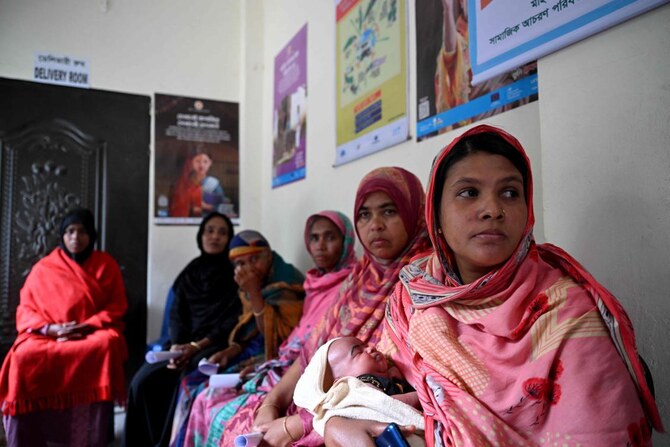
Women spearhead maternal health revolution in Bangladesh

Young Bangladeshi mother Mafia Akhter’s decision to give birth at home and without a doctor left her grieving over her firstborn’s lifeless body and vowing never to repeat the ordeal. (AFP)
Short Url
Updated 07 March 2025
Follow

Women spearhead maternal health revolution in Bangladesh

  • Young Bangladeshi mother Mafia Akhter’s decision to give birth at home and without a doctor left her grieving over her firstborn’s lifeless body and vowing never to repeat the ordeal

BISWAMBHARPUR: Young Bangladeshi mother Mafia Akhter’s decision to give birth at home and without a doctor left her grieving over her firstborn’s lifeless body and vowing never to repeat the ordeal.
“My first baby died,” the 25-year-old told AFP. “I told myself that if I didn’t go to the clinic it could happen again, and that I wouldn’t be able to bear it.”
She gave birth again last month at a medical center in a village hemmed in by rice paddy and rivers, far from the nearest hospital and without the oversight of an obstetrician.
But this time her child survived — something she credits to Nargis Akhter, one of the thousands of Bangladeshi women working as “skilled birth attendants” to help mothers through delivery.
“Giving birth is the most important and critical moment for a woman,” Nargis — no relation to her patient — told AFP.
“I am lucky and proud to be able to be with them at that moment.”
Nargis was speaking to AFP after her routine post-natal consultation with Mafia, who was cradling her young daughter during her return to the spartan village health center where she gave birth.
Skilled birth attendants have been a fixture of Bangladesh’s maternal health policy for two decades and are an important pillar of the South Asian nation’s underfunded health system.
More than 30 percent of Bangladeshi women nationally give birth without the assistance of a doctor, nurse or midwife, according to government data from 2022 Demographic and Health Survey.
Birth attendants like Nargis, 25, are given several months training and put to work plugging this gap by serving in a jack-of-all-trades role akin to a cross between a nurse and a doula.
The use of skilled birth attendants has coincided with dramatic improvements to maternal health outcomes in Bangladesh.
Over the past 20 years, the mortality rate for pregnant women has fallen by 72 percent, to 123 deaths per 100,000 births and babies by 69 percent to 20 deaths per 100,000 births, according to the World Health Organization (WHO).
“Many women do not have access to quality care, so I feel useful by helping them,” said Nargis, who in her five years as a birth attendant has overseen more than 400 deliveries.
“Almost no women die in childbirth here anymore,” she added.
“For me, that’s the most important thing.”

Besides helping with deliveries, birth attendants will screen pregnant women weeks ahead of their due date to refer high-risk pregnancies to hospitals further afield.
For women in Biswambharpur, the remote district that Mafia and Nargis call home, complicated cases will wind up in a district hospital struggling with inadequate resources.
“We never leave a patient without care, but they sometimes have to wait a long time for treatment,” said Abdullahel Maruf, the hospital’s chief doctor.
“Plus, we can’t change the geography. In an emergency, it takes time to get to us.”
Biswambharpur is lashed by monsoon rains for months each year that make travel difficult, and a lack of paved roads mean that many of its villages are inaccesible by the district’s only ambulance, even during the drier months.
Maruf’s hospital sees up to 500 patients each day and still has around eight women die in labor each year — fatalities he says are avoidable, given that his emergency department lacks an obstetrician and backup surgeon.
“We could easily reduce this figure if we had all the required staff,” he said.
Maruf said that mortality rates had nonetheless improved by an awareness campaign encouraging women to give birth at local health clinics rather than at home.
“This is our greatest victory,” he said.
Bangladesh spends only 0.8 percent of its GDP on public health, a figure that Maya Vandenent of the UN children’s agency said risked stalling the country’s improvements to maternal health.
“Huge progress has been made,” she told AFP. “But the movement is slowing down.”
Sayedur Rahman, a physician overseeing Bangladesh’s health ministry, freely concedes that more health funding is far from the top of the agenda of the government he serves.
The country is still reeling from the dramatic ouster of autocratic ex-premier Sheikh Hasina last August during a student-led national uprising.
Rahman is part of an interim administration tasked with steering democratic reforms ahead of fresh elections, and he laments that these priorities will leave others in the health sector unaddressed.
“We need resources to create a national ambulance network, recruit more anesthesiologists, open operating rooms,” Rahman told AFP.
“Our financial constraints will directly impact maternal and neonatal mortality rates.”


Power outages hit Ukraine and Moldova as Kyiv struggles against the winter cold

Updated 10 sec ago
Follow

Power outages hit Ukraine and Moldova as Kyiv struggles against the winter cold

  • Outages had been caused by a technical malfunction affecting power lines linking Ukraine and Moldova
  • Blackouts were reported in Kyiv, as well as Zhytomyr and Kharkiv regions

KYIV: Emergency power cuts swept across several Ukrainian cities as well as neighboring Moldova on Saturday, officials said, amid a commitment from the Kremlin to US President Donald Trump to pause strikes on Kyiv as Ukraine battles one of its bleakest winters in years.
Ukraine’s Energy Minister Denys Shmyhal said that the outages had been caused by a technical malfunction affecting power lines linking Ukraine and Moldova.
The failure “caused a cascading outage in Ukraine’s power grid,” triggering automatic protection systems, he said.
Blackouts were reported in Kyiv, as well as Zhytomyr and Kharkiv regions, in the center and northeast of the country respectively. The outage cut water supplies to the Ukrainian capital, officials said, while the city’s subway system was temporarily suspended because of low voltage on the network.
Moldova also experienced major power outages, including in the capital Chisinau, officials said.
“Due to the loss of power lines on the territory of Ukraine, the automatic protection system was triggered, which disconnected the electricity supply,” Moldova’s Energy Minister Dorin Junghietu said in a post on Facebook. “I encourage the population to stay calm until electricity is restored.”
Weaponizing winter
The large-scale outage followed weeks of Russian strikes against Ukraine’s already struggling energy grid, which have triggered long stretches of severe power shortages.
Moscow has sought to deny Ukrainian civilians heat, light and running water over the course of the war, in a strategy that Ukrainian officials describe as “weaponizing winter.”
While Russia has used similar tactics throughout the course of its almost four-year invasion of Ukraine, temperatures throughout this winter have fallen further than usual, bringing widespread hardship to civilians.
Forecasters say Ukraine will experience a brutally cold period stretching into next week. Temperatures in some areas will drop to minus 30 degrees Celsius (minus 22 Fahrenheit), Ukraine’s State Emergency Service said.
Trump said late Thursday that President Vladimir Putin had agreed to a temporary pause in targeting Kyiv and other Ukrainian towns amid the extreme weather.
“I personally asked President Putin not to fire on Kyiv and the cities and towns for a week during this ... extraordinary cold,” Trump said during a Cabinet meeting at the White House. Putin has “agreed to that,” he said, without elaborating on when the request to the Russian leader was made.
The White House didn’t immediately respond to a query seeking clarity about the scope and timing of any limited pause.
Kremlin spokesperson Dmitry Peskov confirmed Friday that Trump “made a personal request” to Putin to stop targeting Kyiv until Sunday “in order to create favorable conditions for negotiations.”
Talks are expected to take place between US, Russian and Ukrainian officials on Feb. 1 in Abu Dhabi. The teams previously met in late January in the first known time that officials from the Trump administration simultaneously met with negotiators from both Ukraine and Russia. However, it’s unclear many obstacles to peace remain. Disagreement over what happens to occupied Ukrainian territory, and Moscow’s demand for possession of territory it hasn’t captured, are a key issue holding up a peace deal, Zelensky said Thursday.
Russian presidential envoy Kirill Dmitriev said on social media Saturday that he was in Miami, where talks between Russian and US negotiators have previously taken place.
Russia struck Ukrainian energy assets in several regions on Thursday but there were no strikes on those facilities overnight, Ukraine’s President Volodymyr Zelensky said Friday.
In a post on social media, Zelensky also noted that Russia has turned its attention to targeting Ukrainian logistics networks, and that Russian drones and missiles hit residential areas of Ukraine overnight, as they have most nights during the war.
Trump has framed Putin’s acceptance of the pause in strikes as a concession. But Zelensky was skeptical as Russia’s invasion approaches its fourth anniversary on Feb. 24 with no sign that Moscow is willing to reach a peace settlement despite a US-led push to end the fighting.
“I do not believe that Russia wants to end the war. There is a great deal of evidence to the contrary,” Zelensky said Thursday.