BEIRUT: The Lebanese government has taken a significant step away from Hezbollah interference with the appointment of several new security chiefs, though vacancies remain at the head of the nation’s central bank and within its diplomatic and judicial sectors.
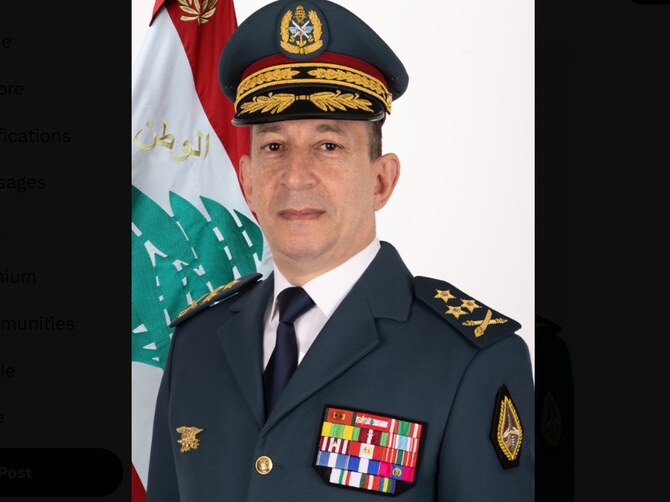
The new appointments are Gen. Rudolph Haykal as army chief, Brig. Gen. Hassan Choucair as head of general security, Brig. Gen. Raed Abdullah as head of Internal Security Forces and Brig. Gen. Edgar Lawandos as head of the agency for state security.
Hezbollah and the Amal Movement had nominated Brig. Morshed Suleiman to head up the general security agency, as the position belongs to the Shiite sect, but the president and prime minister rejected that proposal and instead appointed him deputy director general of state security.
President Joseph Aoun, who headed the Cabinet meeting, told ministers he had “reviewed the professional history of the newly appointed individuals and was reassured by it.”
However, he added that the new chiefs would “be held accountable according to their actions” and that “the Cabinet can dismiss them if needed, just like it appointed them.”
Aoun said that “what matters is restoring internal and external confidence in Lebanon, which requires reforming economic, banking, financial and other sectors.”
The president told the Cabinet that the International Monetary Fund delegation he met on Wednesday stressed “the importance and the urgency of finalizing a program agreement before summer, citing previous unsuccessful attempts.”
The IMF representatives outlined several prerequisites, including the appointment of a new central bank governor, the creation of a centralized data system for the finance ministry and the passage of two vital pieces of legislation — revisions to the banking secrecy law and a comprehensive bank restructuring framework.
Aoun said that the nation’s security apparatus, as well as defense and interior ministries, remained “on high alert monitoring Syrian developments” along Lebanon’s northern and eastern frontiers.
Following their appointments, the new security leaders paid an official visit to the Presidential Palace for meetings with Aoun.
Haykal, who hails from Aqtanit in southern Lebanon’s Sidon region, formerly served as army operations director, first brigade commander and South Litani sector commander.
Military sources said he was ready to tackle challenges such as completing the army’s deployment across southern border territories as Israeli forces withdraw from occupied highlands, enhancing collaboration with UNIFIL to fully implement Resolution 1701, preserving military cohesion despite economic constraints, strengthening operational capabilities, sustaining anti-terrorism initiatives and ensuring national security amid an evolving situation in Syria.
Choucair originates from Mais Al-Jabal and previously served the Lebanese Intelligence Directorate in investigative and operational capacities throughout Beirut and southern Lebanon.
In 2022 he was appointed deputy director general of state security, which involved oversight of counterterrorism operations, anti-espionage efforts and coordination between Lebanon’s various security agencies.
Abdullah hails from the town of Chehime in Iqlim Al-Kharroub and previously headed the technical office at the information branch.
According to the ISF General Directorate, “Brig. Gen. Abdullah possesses extensive experience in key operational and administrative roles. His career has involved handling complex security issues in Lebanon and he has played a role in counterterrorism efforts in the post-ISIS phase.”
Lawandos represented Lebanon on the committee overseeing the implementation of the ceasefire and the enforcement of Resolution 1701.
Earlier on Thursday, the Israeli army released Lebanese soldier Ziad Chebli at the Ras Naqoura crossing. Last week, Israeli forces, which continue to occupy strategic Lebanese hills, shot at Chebli while he was in civilian clothes en route to his fiancee’s home, injuring him before capturing him. He underwent surgery on the Israeli side and after being handed over to the Lebanese army was transferred to a hospital for further treatment.
Aoun described the release of detainees as having been “achieved through indirect negotiations.”
The army issued a statement confirming that it had “received soldier Chebli, who was abducted by the Israeli enemy on March 9, through the International Red Cross and has transferred him to a hospital for treatment.”
Lebanese pressure on the committee overseeing the implementation of the ceasefire also led to the release of four Lebanese detainees from Israeli custody two days ago: Hussein Fares from Maroun Al-Ras, Hussein Qutaish from Hula, Ahmed Al-Sayyed Mohammed Shokr and Mohammed Najm.
According to unofficial sources, an estimated seven civilians and Hezbollah fighters, as well as several Syrian agricultural workers, are still being held by the Israelis.
After the Cabinet session, Deputy Premier Tarek Mitri denied any Lebanese intention to normalize relations with Israel amid discussions about the possibility of resuming negotiations on resolving the dispute over six out of 13 points on the southern land border.
A military source told Arab News: “After completing the military appointments and naming a replacement for Lebanon’s delegate to the ceasefire monitoring committee, Lebanon is set to form three working committees tasked with resolving disputed points with Israel.
“The first will focus on the Israeli occupation of the five hills and the second will follow up on the file of prisoners held by Israel, while the third committee will work on the issue of disputed border points.
“All of this falls within the framework of completing Resolution 1701 and does not imply direct negotiations between Lebanon and Israel.”
Following the Cabinet session, Mitri said: “Israel is trying to impose a fait accompli, but Lebanon still maintains its position.”
On Wednesday, Israeli media quoted an Israeli political official as saying that discussions with Lebanon regarding the land border were “part of a broad and comprehensive plan. We want to maintain momentum and achieve normalization with Lebanon.”


![]()

Lebanon appoints new security chiefs in move away from Hezbollah influence
Short Url
https://arab.news/re5jh
Lebanon appoints new security chiefs in move away from Hezbollah influence
- Gen. Rudolph Haykal takes over as army chief
- Brig. Gen. Raed Abdullah named head of Internal Security Forces


Latest updates





© 2026 SAUDI RESEARCH & PUBLISHING COMPANY, All Rights Reserved And subject to Terms of Use Agreement.