Pakistan urges global action to stop Israel’s ‘genocidal campaign’ in Gaza, calls for accountability

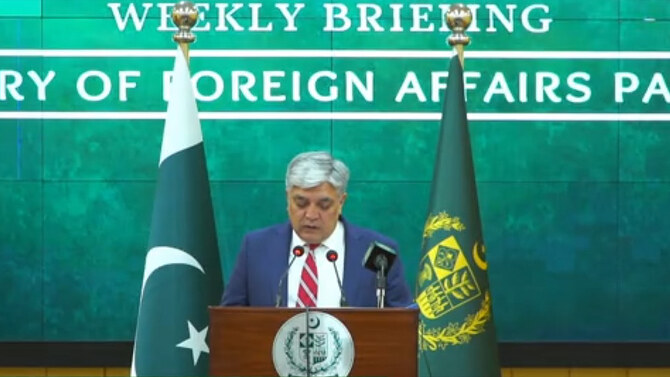
Ministry of Foreign Affairs spokesperson, Shafqat Ali Khan, addresses weekly press briefing in Islamabad, Pakistan, on March 13, 2025. (MOFA/Screengrab)
Short Url
Updated 13 March 2025
Follow

Pakistan urges global action to stop Israel’s ‘genocidal campaign’ in Gaza, calls for accountability

  • The foreign office says Israel is ‘weaponizing humanitarian aid’ by stopping global agencies to operate in Gaza
  • Gaza war began in October 2023 and continued until an uneasy ceasefire was brokered in January 2025

ISLAMABAD: Pakistan urged the international community on Thursday to bring an end to Israel’s “genocidal campaign” against Palestinians in Gaza while calling for it to be held accountable for its “war crimes.”
Israel’s war in Gaza began on October 7, 2023, and continued until an uneasy ceasefire was brokered earlier this year in January. The war completely devastated the Palestinian territory, with Israeli military attacks destroying houses, schools and hospitals, leading to more than 48,000 deaths.
Pakistan is among the countries that have raised concerns about the potential resumption of hostilities between Hamas and Israel.
“The international community must step in to end Israel’s genocidal campaign against Palestinians in Gaza,” foreign office spokesperson Shafqat Ali Khan said during his weekly press briefing.
“We also urge the international community to hold Israel accountable for its war crimes and crimes against humanity.”
Khan condemned Israel’s blockade of humanitarian aid, the disruption of Gaza’s electricity supply and the ongoing assault, which has led to the tragic loss of lives, including women and children.
Calling Israel’s actions to dismantle humanitarian agencies “unacceptable,” he said preventing aid agencies from carrying out their tasks was a “manifestation of Israel’s systematic campaign to weaponize humanitarian aid and dehumanize Palestinians.”
Earlier this month, Pakistan’s Deputy Prime Minister Ishaq Dar attended the extraordinary session of the Organization of Islamic Cooperation in Jeddah, where he reiterated his country’s support for the Palestinian cause and condemned a recent American proposal to permanently displace the residents of Gaza, stressing the need for a two-state solution for lasting peace.
Israeli officials confirmed on Sunday they had cut off Gaza’s electricity, impacting a desalination plant that provides drinking water, with Hamas denouncing it as part of Israel’s “starvation policy.”
Pakistan, which does not maintain diplomatic relations with Israel, has consistently called on the United Nations to enforce resolutions supporting a two-state solution in the Middle East.
Pakistan advocates for the establishment of an independent Palestinian state based on the pre-1967 borders, with Al-Quds Al-Sharif as its capital.



Under floodlights after Tarawih prayers, late-night Ramadan volleyball lights up Islamabad

Updated 5 sec ago
Follow

Under floodlights after Tarawih prayers, late-night Ramadan volleyball lights up Islamabad

  • Players and spectators gather after Tarawih prayers and matches run until 3am
  • Teams travel from across Islamabad and nearby towns to take part in the tournament

ISLAMABAD: Soon after the Tarawih prayers end each night in Ramadan, a playground in Islamabad’s D-17 sector comes alive under bright floodlights.

The quiet residential corner fills with the thwack of volleyballs flying across the net as players leap for smashes and spectators line the edges of the ground, cheering and clapping late into the night. Matches often stretch until 3am, just hours before Sehri, the pre-dawn meal before the day’s fast begins.

Volleyball, one of the cheapest team sports, has long been popular in Pakistani towns and villages. Pakistan’s national team currently ranks 44th out of 101 teams in the FIVB Senior World Rankings and seventh in Asia.

During Ramadan, however, the game becomes more than just competition. With daily routines slowed by fasting, nighttime offers a rare window for activity, socializing and community gatherings.

“It has been four years since I started playing here,” said Ismail Khan, who hails from North Waziristan in the northwestern Khyber Pakhtunkhwa province and has represented Pakistan at the Under-19 level.

Players compete in a volleyball match under floodlights during a late-night game in Islamabad, Pakistan, February 27, 2026.

“Late-night matches in Ramadan have become a tradition. We are busy during the day and fasting, so the night is when everyone is free. That’s when we come together.”

This year, the D-17 Volley Club has organized a Ramadan tournament that has drawn teams from across the capital as well as nearby towns and villages. For many participants, the games are about more than winning.

Khan says the atmosphere during Ramadan is unique.

“It feels different in Ramadan,” he told Arab News. “There is more energy.”

Spectators watch a late-night volleyball match from a small bridge as players compete under floodlights in Islamabad, Pakistan, February 27, 2026.

The appeal of the matches extends beyond local players. Whyn Whyn, a volleyball player from the Philippines visiting Pakistan for the second time, occasionally joins games at the D-17 ground.

“This is my exercise. And through sports, I meet many people,” she said, adding that she often spends evenings rotating between different grounds in Islamabad.

Around the court, spectators gather on motorbikes or stand shoulder-to-shoulder near the sidelines, watching each rally unfold. The crowd’s cheers rise with every powerful serve or well-timed block.

“In Ramadan, the atmosphere is different,” Naveed Mahmood, who regularly comes to watch the matches, told Arab News.

“There are more people compared to other months. We stay here until Sehri.”

 A player jumps to strike the ball during a volleyball match in Islamabad, Pakistan, February 27, 2026.

Children are frequent visitors as well, weaving through the crowd or sitting beside their parents while watching the games.

“I come here two to three times a week to watch volleyball,” said Muhammad Haroon, 13. “My father also plays here and watching him has inspired me to play as well.”

For Munawar Khan, the tournament’s organizer and a doctor by profession, the idea began five years ago with a simple aim: to keep people active during a month when daily routines slow.

“In Ramadan, people don’t have much activity during the day,” he said. “They are fasting and working. At night, they feel free. So, we decided to install floodlights and organize games.”

Over time, the initiative has grown into something larger.

Now, as the night deepens and the crowd lingers by the court, the rhythm of rallies continues beneath the lights, a small Ramadan ritual where sport, community and late-night energy meet until the approach of dawn.

“People from all walks of life come here to play,” Munawar said. “It brings the community together.”