

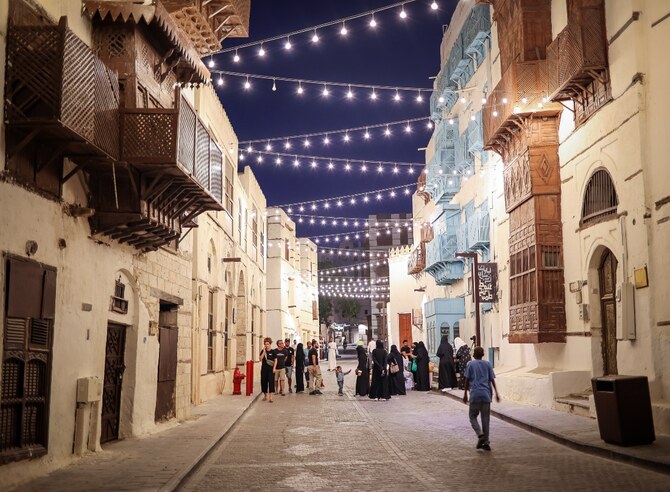

RIYADH: With the advent of Ramadan, the rhythm of Saudi cities shifts more toward nightlife, carrying on until just before dawn.
In light of the fasting from food and drink throughout the day in Ramadan, establishments extend their opening hours later into the evening.
Markets and roads can be seen teeming with shoppers at night, and homes are busy welcoming visitors.
Reham Al-Azwari, clinical nutrition track leader at the Makkah Health Cluster, spoke to Arab News about the importance of healthy eating habits during Ramadan to enhance productivity as working hours shift.

The historic district of Jeddah during Ramadan. (Getty Images)
Healthy nutrition “helps improve productivity during the day, even with the change in lifestyle to nighttime,” Al-Azwari said.
“Despite the economic and social benefits, the nighttime shift in Ramadan is not without challenges, especially in terms of health,” she said.
“Changing sleep patterns and staying up late for long hours can negatively affect general health. Staying up at night and sleeping during the day can lead to disruptions in the body’s biological clock, affecting focus and productivity during the day.
“We have to follow moderation … in staying up late and having sufficient sleep, especially for people who work during the day,” Al-Azwari said.

Pilgrims from all over the world gather around Masjid al-Haram on the twenty-ninth night of Ramadan in Makkah. (Getty Images)
Abdulaziz Al-Kaltham, professor of sociology at Imam Mohammad Ibn Saud Islamic University, spoke to Arab News about the societal effects of Ramadan hours.
“Ramadan rituals reshape social structures clearly and evidently, as most daily activities turn into intensive social activities,” he said.
“Many activities in Ramadan, such as charitable iftar tables, enhance the values of solidarity and giving, where individuals from different social classes participate in providing food,” Al-Kaltham said.
“This type of interaction contributes to bridging social gaps between social classes and contributes to creating an atmosphere of social justice,” he said.
Dhahi Alwan Al-Barrak, CEO of Zatisto Services, has faced difficulties importing products from major establishments operating during daytime hours, and retail stores that often open during the evening.

Lights, celebrations, people talking and drinking Arabic coffee, shops selling drinks and snacks, and banners with Al-Baha Ramadan on them in the city of Al-Hajra in Al-Baha region celebrating the month of Ramadan. (Getty Images)
“During Ramadan, we operate under two systems. On one hand, we must deal with suppliers who work during the day, and on the other hand, we open our stores at night to receive customers. This requires extra effort and careful coordination,” he said.
However, Al-Barrak said that the month offers an opportunity for employees to form a closer bond.
“Ramadan brings us together as a team. We work together at night, and we share iftar and suhoor meals, which strengthens the bonds between us. This sense of cohesion helps us overcome challenges,” he said.
Mansour Al-Osaimi, founder of Right Decision for Customer Experience Consulting, said that Ramadan imposes a different rhythm on daily life, where the evening period after iftar becomes a valuable time for interacting with customers.
“Companies can adapt the customer experience by adjusting working and service hours to suit peak periods after iftar, and providing flexible services such as order delivery during evening hours,” he said.
“Challenges such as reduced concentration during fasting hours and different work patterns can be overcome by providing flexibility in working hours, such as adopting flexible hours or remote work for some periods.”
He highlighted the importance of “reducing burdens and focusing on priorities, and enhancing internal communication among employees.”


