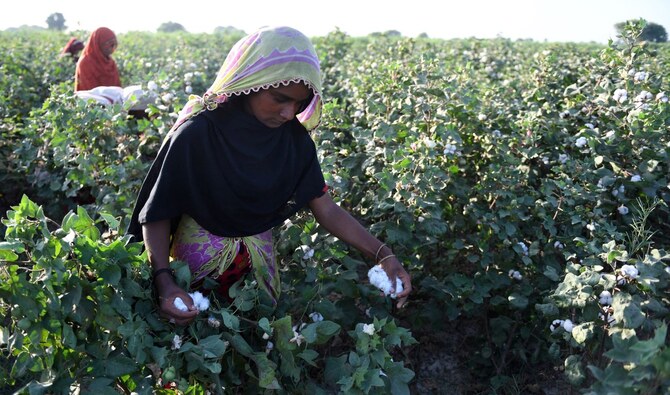

KARACHI: Cash-strapped Pakistan’s cotton imports are set to surge this year as irregular weather patterns brought about by climate change effects have significantly lowered production, financial analysts and cotton experts said on Wednesday.
According to the Pakistan Central Cotton Committee, factories in Pakistan have received 5.51 million bales of cotton as of January this year, a significant decline of 34 percent compared to last year.
Pakistan’s eastern Punjab province, which produces the most cotton out of all provinces in the country, grew 2.7 million bales, showing a decline of more than 36 percent compared to last year.
“The biggest reason for this fall [in cotton production] is climate change,” Khalid Abdullah, Pakistan’s former cotton commissioner, told Arab News.
Pakistan is recognized as one of the world’s most vulnerable countries to climate change, where over 1,700 people were killed in 2022 after torrential rains triggered flash floods. Islamabad is negotiating for additional financing of $1 billion to $1.5 billion from the International Monetary Fund (IMF) to strengthen climate resilience.
Abdullah said the early cotton sowing method had proved very successful in terms of production in 2023. However, he said when farmers planted cotton after Feb. 15 this year, some of the plants died as the temperature suddenly dropped and it rained in some areas.
“The farmers had to replant cotton which resulted in extra costs on account of seeds and sowing charges,” Abdullah explained
He said re-sowing cotton also resulted in delays which decreased the time window during which cotton remains free from viruses, further impacting its yield.
Abdullah said another reason for a dismal crop yield this season was the price disruptions caused in the local market, adding that they restricted farmers from investing in cotton, with the government not offering any support price.
Market uncertainties dampened farmers’ confidence further, who spent less on fertilizer and plant protection measures, he said.
Financial analysts pointed out that a drop in cotton production would mean the country would spend more on cotton imports this year to support its huge textile industry.
Textile is a massive earner for Pakistan. During fiscal year 2024, Pakistan exported a whopping $16.7 billion worth of textile goods, according to the Pakistan Bureau of Statistics.
To attain these export figures, the country had to import $448 million of raw cotton. This figure was 73 percent lower than $1.68 billion that Pakistan spent on raw cotton imports in FY23.
“Naturally imports are going to be higher due to lower local output of cotton,” Muhammad Waqas Ghani, head of research at Karachi-based investment banking firm JS Global Capital Ltd., told Arab News.
Naseem Usman, a cotton analyst and chairman at the Karachi Cotton Brokers Forum, said in a report that Pakistan’s cotton import bill could surge to as high as $5 billion this year.
“This serious drop in cotton production is forcing textile spinners to increase their dependence on imported cotton,” Usman said.
Rising imports can cause headaches for cash-strapped Pakistan, which is trying to navigate a tricky path to economic recovery from a prolonged macroeconomic crisis by undertaking financial reforms, cutting back on imports and increasing exports.
Agriculture has an impressive contribution of about 24 percent to Pakistan’s Gross Domestic Product (GDP) and accounts for nearly half of the country’s employed labor force.
Currently, the South Asian country has $11 billion in foreign exchange reserves, enough to finance about two months of imports only.
The IMF, which is currently reviewing Pakistan’s economic progress as part of the $7 billion Extended Fund Facility (EFF) program, wants Islamabad to have an import cover of at least three months.
Sensing the gravity of the situation, Prime Minister Shehbaz Sharif formed the Committee on Cotton Crop Production Enhancement, which held its first meeting in Islamabad on Mar. 11.
The food ministry said the committee’s primary focus was to take steps needed to increase cotton production in Pakistan, noting that it had decreased significantly.