

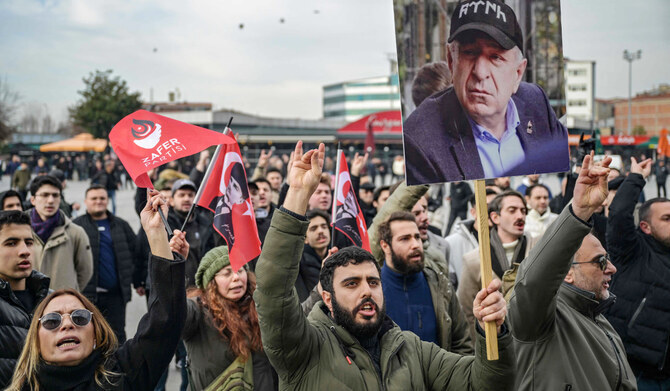

ISTANBUL: The leader of a Turkish nationalist party has said he was arrested and detained on political grounds as part of an opposition crackdown that contradicts the government’s purported effort to boost democracy while ending a Kurdish militant insurgency.
Umit Ozdag, leader of the Victory Party and known for his fierce opposition to the presence of millions of Syrian migrants in Türkiye, is currently in jail pending trial on charges of insulting President Tayyip Erdogan and inciting hatred.
“Democracy cannot be established with illegal arrests and silencing,” he said in a hand-written statement responding to Reuters’ questions from his cell in Silivri prison in northwest Türkiye.
Erdogan’s office did not immediately respond to Ozdag’s claims about his arrest.
Opposition politicians have faced a series of legal probes, detentions and arrests in what critics say is a government effort to muzzle dissent and hurt their popularity among voters.
Last month Turkish police detained nine district municipal council members from the main opposition Republican People’s Party (CHP) on terrorism-related charges and several pro-Kurdish DEM party mayors have been removed from their posts over convictions on terrorism-related offenses.
The government has repeatedly stated that the judiciary operates independently in response to criticism that arrests are politically motivated.
Opinion polls suggest Ozdag’s nationalist rhetoric, such as calling for an end to financial support for Syrian migrants and proposing that they be sent home, resonated with some voters. A survey by research firm Konda, carried out after his January arrest, showed support for his party rose to 6 percent in February — its highest ever — up from 4.6 percent in January.
In his first response to media queries since being detained seven weeks ago, Ozdag dismissed Ankara’s current effort to end a 40-year conflict with the Kurdistan Workers Party, or PKK, as “too good to be true.”
The PKK’s jailed leader Abdullah Ocalan brought that goal one step closer last month when he called on the group’s commanders in Iraq to convene, disarm, and disband.
The PKK, designated as a terrorist organization by Turkiye and its Western allies, responded by agreeing to heed the call.
Ozdag linked his arrest to this ongoing process.
“I was arrested by the political decision of the government because I had studied terrorism issues as an academic for years before politics and was the party leader who best analyzed the politics carried out with the PKK,” he said.
Erdogan’s office did not respond to Ozdag’s claims about the PKK.
Previously, Ozdag has said in a statement on X that his party rejects the current process with the PKK, saying it had the potential to harm Türkiye’s national identity and unity.
Ending the insurgency would be a major achievement for Erdogan after past efforts failed to resolve a conflict in which more than 40,000 people have died since 1984.
Ocalan’s call may also boost Erdogan’s own political prospects. In order to extend his rule beyond 2028, when his last term as president ends, he would need the support of an opposition party, in order to amend the constitution or bring about early elections.
INTIMIDATION
Ozdag was detained in Ankara in January after he was accused of inflaming tensions during anti-refugee riots in Kayseri in the summer of 2022. The riots, which lasted a week, involved widespread vandalism.
Authorities say Ozdag’s statements on social media played a role in inciting the unrest. Ozdag denied this. The Konda Barometer’s February report found that three out of five people believe his detention is illegal.
Ozdag said the ruling alliance was using its engagement with Ocalan to burnish its democratization credentials with voters while continuing to silence political opponents and intimidate independent institutions.
It has not taken the needed steps for a lasting peace, he said.
“It is not clear what changes to the Constitution or laws will be required. Will there be an amnesty for PKK members? How will the YPG be treated?” he said, referring to the Kurdish militia in Syria that Ankara views as an extension of the PKK.
“There are too many dark points in this process,” he added.
Ozdag pointed to the investigation into leaders of TUSIAD, Türkiye’s leading business group, as further evidence of authorities’ disinterest in democratic reforms. “The entire business world has been intimidated through TUSIAD,” he said.


