

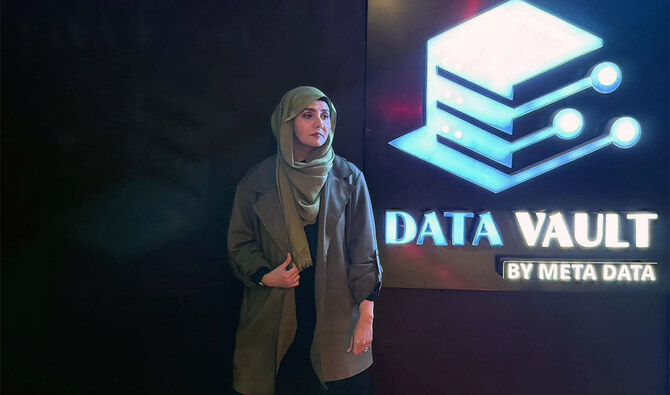

KARACHI: A Pakistani tech entrepreneur who represented her country at the recent International Digital Cooperation Forum (IDCF) in Jordan said this week the event served as a crucial platform for highlighting Pakistan’s progress in artificial intelligence (AI), attracting potential investors and facilitating foreign direct investment (FDI), especially from the Middle East.
Mehwish Salman Ali, born and raised in Karachi, earned a degree in genetics from the University of Karachi in 2007. However, due to limited job opportunities in the field, she shifted gears and entered Pakistan’s information technology sector in 2008.
After gaining four years of experience, she got married and moved to Dubai in 2012 and launched her own company, 3wOgle Group of Companies, providing web-based IT services and solutions. Since then, Ali has primarily operated in the Middle Eastern market, though she has remained engaged in Pakistan, where she established the country’s first woman-led solar-powered quantum-encrypted data center, Data Vault, specializing in AI systems designed to operate autonomously.
Ali said she was thrilled to represent Pakistan at the IDCF in Jordan alongside the country’s Minister for Information Technology Shaza Fatima Khawaja, which allowed her to discuss future possibilities with leading figures in the global AI industry.
“One of the propositions I raised there was borderless technology,” she told Arab News during a conversation on Monday. “When it comes to the AI space, everything is broad spectrum. When we work toward borderless technology, that’s what can bridge the gap between us and the investors.”
“CRAZY AMOUNTS”
AI is predicted to significantly boost the global economy primarily through increased productivity and new consumption opportunities, while also impacting employment and requiring strategic adaptation.
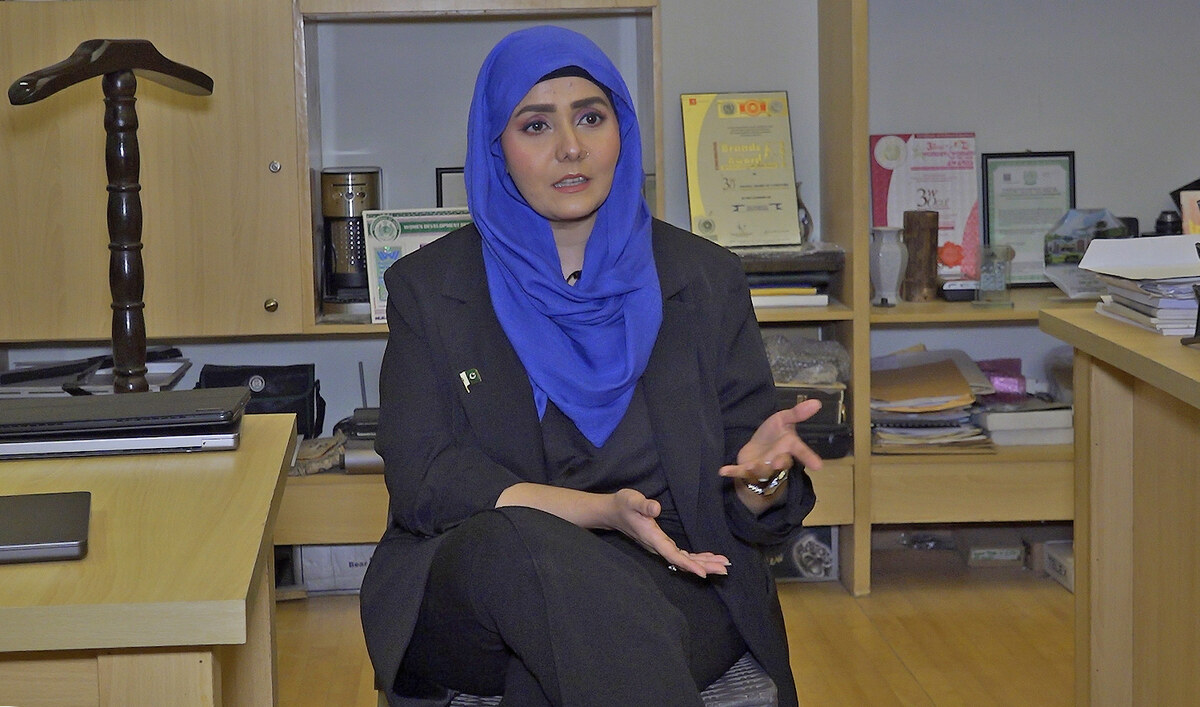
Mehwish Salman Ali, tech entrepreneur, talks to Arab News in Karachi, Pakistan, on March 10, 2025. (AN photo)
Ali said AI was estimated to contribute about $15.7 trillion to the world economy by 2030 — more than the current output of China and India combined — and Pakistan’s ambition to raise up to $20 billion from it was almost negligible in that context.
Asked how that number could be increased, Ali said it was important to adopt more AI-friendly policies, something she also highlighted at the conference in Jordan.
“It was a very big market to project what Pakistan is doing in the AI space and to invite investors into our country and to basically pave ways for foreign direct investment as well,” she said, referring to the IDCF event.
Ali said IT was one of the best options available to help Pakistan achieve its target of becoming a $1 trillion economy by 2035.
She said that she decided to spend time in Riyadh in 2022 since it was an emerging advanced technology market but had now decided to move back to Pakistan to help expand the AI space and prepare “good solutions” for the Gulf market.
“The Middle East is spending crazy amounts in the AI space, be it the United Arab Emirates, Kingdom of Saudi Arabia, Qatar or others,” she added. “They are spending billions of dollars, specifically in the AI space, and all they need are good solutions.”
But Pakistani firms in the field needed to understand the broader market dynamics.
“When startups from Pakistan go [to the Middle East] and pitch their ideas, they are asking [for] very small amounts,” she said. “They are asking for $100,000 or $200,000 [even when] they want to invest in a bigger vision.”
Ali has recently been inducted as an official member of the Forbes Technology Council, which had only four Pakistani members, with Ali the only woman among them. She has also recently announced the launch of an AI innovation lab in Pakistan.
“It may become a center of excellence for AI and that is very big news,” the IT executive said. “We are in talks with a few people and a few investors who are going to help in achieving that dream.”


